Motherboards Buying Guide (2026): What Matters and 8 Picks
As an Amazon Associate we earn from qualifying purchases. Links on this page are affiliate links.
This motherboard buying guide helps you match a board to your specific CPU socket and memory type. You will learn how to evaluate form factors like ATX and Micro-ATX against your case size. The selection process focuses on published specifications, ensuring each pick meets clear hardware requirements. You can decide between Intel LGA 1700 and AMD AM5 platforms based on your processor choice.
The recommended products were chosen strictly from their published specifications. We compare features like DDR5 support, PCIe versions, and connectivity options such as Wi-Fi 6E and 2.5GbE Ethernet. You will see how these specs impact your build's bandwidth and storage capacity. The guide walks through these technical details to help you choose a board that fits your needs without unnecessary extras. You can review the 8 picks to find the right balance of features for your desktop.
Our top pick: MSI PRO ATX DDR5 Motherboard.
Key Specs to Check
CPU Socket Compatibility
The socket determines which processors fit your board. Intel LGA 1700 supports 12th, 13th, and 14th Gen Core chips. AMD AM5 handles Ryzen 7000 and newer series. Mismatching the socket means the CPU will not install. You must choose the socket before selecting the board. This choice locks you into a specific platform for the life of the build. If you already have a CPU, match its socket. If you are buying both, pick a modern socket like LGA 1700 or AM5 for future upgrade paths. The socket is the most critical physical constraint.
- Match CPU to socket type
- Check generation support list
Form Factor and Size
Form factor defines the board's physical dimensions and mounting holes. ATX is the standard size, fitting most mid-tower and full-tower cases. Micro-ATX is smaller, saving space and cost but offering fewer expansion slots. The data shows boards like the MSI PRO ATX and ASUS Prime Micro-ATX. Ensure your case supports the chosen form factor. An ATX board will not fit in a Micro-ATX case. Consider your case's internal layout and drive bays. Larger boards offer more PCIe slots and RAM slots. Smaller boards are easier to install in tight spaces. Measure your case before buying.
- Verify case compatibility
- Count required expansion slots
Memory Type Support
Motherboards support either DDR4 or DDR5 memory. DDR5 offers higher bandwidth and efficiency but requires compatible RAM sticks and a CPU that supports it. All listed boards use DDR5. You cannot mix DDR4 and DDR5 modules. Check the number of DIMM slots, usually four for ATX boards. More slots allow larger total capacity. DDR5 runs at higher voltages and speeds. Ensure your chosen RAM matches the board's QVL if possible. The memory type is fixed by the board design. You cannot upgrade from DDR4 to DDR5 by changing RAM alone.
- Confirm DDR5 compatibility
- Check number of DIMM slots
PCIe Version for Expansion
PCIe version dictates the speed of your GPU and NVMe storage. PCIe 5.0 is the newest standard, offering double the bandwidth of PCIe 4.0. Current GPUs and SSDs often use PCIe 4.0. PCIe 5.0 provides headroom for future devices. Some boards like the MSI PRO Z790 offer PCIe 5.0 for both GPU and SSD slots. Others may only offer it for storage. Check which slots are Gen 5. This affects high-end SSD performance. For most users, PCIe 4.0 is sufficient today. However, Gen 5 ensures longevity for top-tier components.
- Check GPU slot version
- Verify M.2 slot speeds
Wireless Connectivity Standards
Built-in Wi-Fi removes the need for a separate card. Wi-Fi 6 and Wi-Fi 6E offer improved speed and latency over older standards. Wi-Fi 6E adds the 6 GHz band for less congestion. Boards like the MSI MAG Z790 Tomahawk include Wi-Fi 6E. Check the Wi-Fi generation listed in specs. Higher generations support more concurrent devices and better throughput. Ensure your router supports the same standard to benefit. If you use Ethernet primarily, this matters less. For wireless peripherals or streaming, modern Wi-Fi is valuable.
- Identify Wi-Fi generation
- Check router compatibility
Ethernet Port Speed
Wired connections provide stable, low-latency networking. Most modern boards include 2.5GbE ports. This is faster than traditional 1GbE and helps with large file transfers or local backups. The ASUS TUF Gaming Z790 and MSI PRO B760 both feature 2.5GbE. Ensure your network switch or router supports 2.5G to see the benefit. If your home network is only 1G, the port still works but at lower speeds. It is a future-proofing feature. Check the port specification to avoid legacy 1GbE boards.
- Confirm 2.5GbE or 1GbE
- Check network hardware support
Types of Motherboards and Processors
Intel LGA 1700 DDR5 Boards
These motherboards support Intel 12th, 13th, and 14th Gen Core processors via the LGA 1700 socket. They utilize DDR5 memory for higher bandwidth compared to older standards. Models like the MSI PRO Z790-P WiFi offer PCIe 5.0 readiness and Wi-Fi 6E for fast data transfer. The ASUS Prime B760-VC WiFi provides a baseline option with PCIe 4.0 and Wi-Fi 5. You get robust connectivity for modern desktop builds. The trade-off is that you must purchase separate DDR5 RAM and compatible Intel CPUs, which can increase the total system cost.
AMD AM5 DDR5 Boards
AM5 motherboards are designed for AMD Ryzen 7000 series and newer processors. They exclusively support DDR5 memory, ensuring high-speed data access for demanding tasks. The ASUS TUF Gaming B650-PLUS WiFi features 14 power stages to stabilize voltage for high-core-count chips. The X670E-PLUS WiFi adds Wi-Fi 6E and 2.5GbE Ethernet for superior networking. These boards fit standard ATX cases. You benefit from a modern platform with future upgrade paths. The main consideration is that AM5 requires DDR5 modules, so you cannot reuse older DDR4 memory from previous generations.
Compact Micro-ATX Boards
Micro-ATX motherboards offer a smaller footprint than standard ATX boards, making them ideal for compact cases. The ASUS Prime B760M-A AX supports Intel LGA 1700 CPUs and DDR5 memory. It includes dual M.2 slots for storage and Wi-Fi 6 connectivity. This form factor saves space inside the chassis while maintaining core functionality. You get PCIe 4.0 expansion lanes for graphics cards and peripherals. The trade-off involves fewer expansion slots compared to full-size ATX boards. If you need multiple high-speed drives or extra PCIe cards, a larger board might be necessary.
Common Motherboard Buying Mistakes
Ignoring VRM power limits for high-end CPUs
High-performance processors draw significant current. If the motherboard’s voltage regulator module cannot supply stable power, the CPU will throttle. Check the power delivery specifications. Choose a board with robust VRM phases and adequate heatsinks to maintain peak performance under load without thermal issues.
Overlooking PCIe lane availability for multiple drives
Many boards share bandwidth between M.2 slots and PCIe expansion slots. Adding multiple high-speed drives can disable other ports. Review the chipset’s lane distribution. Ensure your primary storage and expansion cards have dedicated lanes. This prevents unexpected speed drops or disabled connections when you upgrade later.
Assuming all DDR5 slots support maximum speeds
Motherboard memory speed depends on the CPU and board design. Not all DIMM slots support the highest advertised frequencies. Consult the official memory support list. Stick to qualified speeds listed for your specific processor. This ensures stability and prevents boot failures or automatic downclocking to lower, slower timings.
Choosing a form factor that fits poorly
Case compatibility is critical. An ATX board will not fit in a Micro-ATX case. Measure your case’s internal dimensions carefully. Match the motherboard’s form factor, such as ATX, Micro-ATX, or Mini-ITX, to the chassis size. This avoids physical installation conflicts and ensures proper airflow and cable management.
Quick picks
Our 8 picks

MSI PRO ATX DDR5 Motherboard
Best for: Intel LGA 1700 DDR5 desktop builds
- CPU Socket
- LGA 1700
- Form Factor
- ATX
- Memory Type
- DDR5
- PCIe Version
- PCIe 5.0
- Wi-Fi Standard
- Wi-Fi 6E
- Ethernet Speed
- 2.5Gbps
This ATX motherboard features an LGA 1700 socket designed for 12th, 13th, and 14th Gen Intel processors. You get high-speed connectivity via PCIe 5.0, four DDR5 memory slots handling up to 128GB, and 2.5Gbps Ethernet alongside Wi-Fi 6E and Bluetooth 5.3. Display options include HDMI and DisplayPort outputs. It suits you if you plan a modern Intel desktop build requiring fast wireless networking and current generation DDR5 memory bandwidth.
Pros
- PCIe 5.0 expansion support
- Four DDR5 slots supporting up to 128GB
- Integrated Wi-Fi 6E and Bluetooth 5.3
- 2.5Gbps Ethernet and USB 3.2 Gen2 connectivity
Cons
- LGA 1700 socket excludes AMD processors
- Full ATX form factor does not fit compact cases
- Lacks support for older DDR4 memory sticks
Good fit if
- You use a 12th, 13th, or 14th Gen Intel processor.
- You need built-in Wi-Fi 6E and 2.5Gbps wired networking.
- You plan to run up to 128GB of DDR5 memory.
Skip if
- You build with an AMD Ryzen processor.
- You want to reuse existing DDR4 memory.
- You need a compact microATX or Mini-ITX board.
Verdict: MSI ProSeries Z790 ATX Motherboard provides essential LGA 1700 platform features including DDR5 support, PCIe 5.0, and Wi-Fi 6E. It delivers solid high-bandwidth connectivity for modern Intel desktop setups.

MSI PRO DDR5 ATX Motherboard
Best for: Intel LGA 1700 builds using DDR5 memory
- CPU Socket
- LGA 1700
- Chipset
- Intel B760
- Form Factor
- ATX
- Memory Type
- DDR5
- PCIe Version
- PCIe 4.0
- Wi-Fi Standard
- Wi-Fi 5
This MSI PRO B760 WiFi ATX Motherboard provides an Intel B760 chipset with an LGA 1700 socket designed for 12th and 13th Generation Intel processors. It pairs fast DDR5 system memory support with PCIe 4.0 expansion bandwidth across a full-size ATX layout. You get built-in Wi-Fi 5 and a 2.5 Gbps Ethernet port for local networking. This board suits you if you need a standard desktop build with modern memory speeds.
Pros
- Supports fast DDR5 memory
- High-speed 2.5 Gbps Ethernet connection
- PCIe 4.0 expansion interface
- Full-size ATX form factor
Cons
- Equipped with older Wi-Fi 5 instead of Wi-Fi 6
- Lacks PCIe 5.0 expansion support
Good fit if
- You plan to use a 12th or 13th Gen Intel processor.
- You want DDR5 memory in a full ATX system build.
- You rely on a wired 2.5 Gbps network setup.
Skip if
- You need modern Wi-Fi 6 or Wi-Fi 6E connectivity.
- You require PCIe 5.0 bandwidth for your expansion cards.
Verdict: MSI PRO B760 WiFi ATX Motherboard delivers core DDR5 memory support and 2.5 Gbps Ethernet for LGA 1700 desktop systems. It provides baseline PCIe 4.0 speeds and Wi-Fi 5 for day-to-day computing builds.

MSI MPG LGA 1700 DDR5 ATX Motherboard
Best for: Intel 12th and 13th Gen DDR5 builds
- CPU Socket
- LGA 1700
- Form Factor
- ATX
- Memory Type
- DDR5
- PCIe Version
- PCIe 5.0
- Wi-Fi Standard
- Wi-Fi 6E
- Ethernet Speed
- 2.5Gbps LAN
The MSI MPG Edge WiFi is an ATX motherboard built around the LGA 1700 socket. You get compatibility with Intel 12th and 13th Generation processors alongside DDR5 memory slots. It provides PCIe 5.0 support for graphics hardware, multiple M.2 storage slots, and Wi-Fi 6E networking. Wired connections run at 2.5 Gbps through the LAN port. This renewed board suits you if you want modern standard connectivity for an Intel desktop build.
Pros
- Supports DDR5 memory and PCIe 5.0 expansion
- Features integrated Wi-Fi 6E and 2.5 Gbps LAN
- Provides multiple M.2 slots and USB 3.2 connectivity
- Compatible with Intel 12th and 13th Gen LGA 1700 processors
Cons
- Renewed product rather than factory-new hardware
- Lacks listed support for 14th Gen Intel processors
- Full ATX form factor does not fit compact PC cases
Good fit if
- You plan to run an Intel 12th or 13th Gen processor on an LGA 1700 socket.
- You want fast networking through Wi-Fi 6E and 2.5 Gbps Ethernet.
- You need DDR5 memory support and PCIe 5.0 bandwidth.
Skip if
- You prefer factory-new hardware over a renewed unit.
- You are building inside a microATX or Mini-ITX chassis.
- You plan to build with an AMD processor.
Verdict: MSI MPG Edge WiFi ATX Motherboard delivers PCIe 5.0 readiness, DDR5 support, and dual high-speed networking options for LGA 1700 systems. It gives you core modern desktop specifications in an inspected renewed ATX package.

ASUS Prime Micro-ATX DDR5 Motherboard
Best for: compact Intel 12th and 13th Gen builds
- CPU Socket
- LGA 1700
- Form Factor
- microATX
- Memory Type
- DDR5
- PCIe Version
- PCIe 4.0
- M.2 Slots
- 2
- Wi-Fi Standard
- Wi-Fi 6
This microATX board gives you an Intel LGA 1700 platform designed for 12th and 13th Gen Core CPUs. You get DDR5 memory support up to 64GB, dual M.2 slots running on PCIe 4.0, and onboard Wi-Fi 6 paired with 2.5 Gb Ethernet. It suits you if you want a compact build with modern networking and high-speed USB-C connections without taking up full ATX case space.
Pros
- Integrated Wi-Fi 6 and 2.5 Gb Ethernet
- Dual M.2 storage slots with PCIe 4.0 support
- Rear USB 3.2 Gen 2 and front USB 3.2 Gen 1 Type-C support
- Space-saving microATX layout with DDR5 memory slots
Cons
- Maximum memory capacity is limited to 64GB
- Provides only two M.2 storage slots
- Specification covers only 12th and 13th Gen Intel processors
Good fit if
- You build inside a compact microATX chassis.
- You pair your system with a 12th or 13th Gen Intel CPU and DDR5 RAM.
- You want integrated Wi-Fi 6 alongside high-speed 2.5 Gb LAN.
Skip if
- You need more than two M.2 solid-state drives.
- You require more than 64GB of system memory.
- You use an AMD processor.
Verdict: ASUS Prime Micro-ATX DDR5 Motherboard provides PCIe 4.0 expansion, Wi-Fi 6, and dual M.2 storage in a space-saving form factor. It gives you core connectivity for Intel 12th and 13th Gen desktop builds.
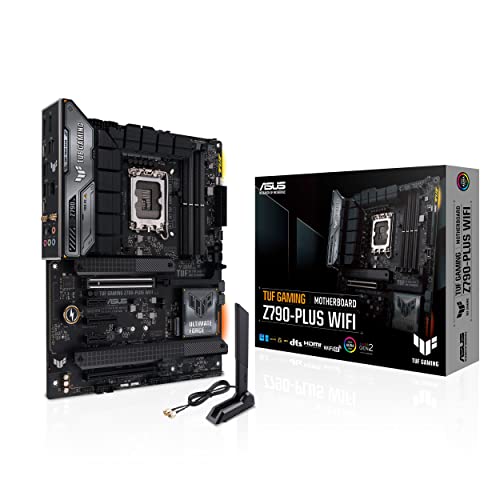
ASUS TUF Gaming PCIe 5.0 ATX Motherboard
Best for: Intel gaming builds needing four M.2 slots
- CPU Socket
- LGA 1700
- Chipset
- Z790
- Form Factor
- ATX
- Memory Type
- DDR5
- PCIe Version
- PCIe 5.0
- M.2 Slots
- 4
This ATX motherboard runs on the Intel Z790 chipset and uses the LGA 1700 socket for 12th, 13th, and 14th Gen Intel processors. You get DDR5 memory support, a PCIe 5.0 expansion slot, and four onboard M.2 storage slots. With a 16+1 power phase design, 2.5GbE networking, and integrated Wi-Fi 6, it suits you if you want a full-sized gaming build with modern expansion.
Pros
- PCIe 5.0 expansion support
- Four onboard M.2 slots
- 16+1 power phase configuration
- 2.5GbE Ethernet and built-in Wi-Fi 6
Cons
- Uses Wi-Fi 6 rather than Wi-Fi 6E or Wi-Fi 7
- ATX dimensions prevent installation in compact microATX or ITX enclosures
Good fit if
- You plan to run an Intel 12th, 13th, or 14th Gen CPU on socket LGA 1700.
- You need four dedicated M.2 slots for internal solid-state drives.
- You want DDR5 memory support alongside a PCIe 5.0 slot.
Skip if
- You use an AMD processor requiring an AM5 socket.
- You build in a small-form-factor case requiring microATX or Mini-ITX.
Verdict: ASUS TUF Gaming Z790 ATX Motherboard provides robust 16+1 power delivery, DDR5 memory capability, and four M.2 drives for full-sized Intel desktop builds.

MSI Tomahawk ATX DDR5 Motherboard
Best for: Intel gaming builds needing Wi-Fi 6E
- CPU Socket
- LGA 1700
- Form Factor
- ATX
- Memory Type
- DDR5
- PCIe Version
- PCIe 5.0
- Wi-Fi Standard
- Wi-Fi 6E
- Use Case
- Gaming
The MSI MAG Z790 Tomahawk WiFi is an ATX motherboard for 12th, 13th, and 14th Gen Intel processors. It uses the LGA 1700 socket and supports DDR5 memory. You get PCIe 5.0 lanes and built-in Wi-Fi 6E. This board is designed for gaming builds that need modern connectivity and fast data transfer speeds for compatible components.
Pros
- Supports 12th, 13th, and 14th Gen Intel CPUs via LGA 1700 socket
- Includes Wi-Fi 6E for high-speed wireless networking
- Features PCIe 5.0 support for next-generation graphics cards and storage
- Uses DDR5 memory for increased bandwidth
Cons
- Limited to ATX form factor, which may not fit smaller cases
- Requires DDR5 RAM, which is more expensive than DDR4
- No mention of USB-C front panel header support in specifications
Good fit if
- You are building a standard ATX gaming PC
- You want Wi-Fi 6E without adding a separate card
- You plan to use PCIe 5.0 SSDs or GPUs
Skip if
- You need a microATX or ITX board for a compact case
- You want to stick with DDR4 memory to save costs
- You are using AMD Ryzen processors
Verdict: MSI MAG Z790 Tomahawk WiFi ATX is a solid choice for gamers building on Intel's latest platforms who need Wi-Fi 6E and PCIe 5.0 readiness.

ASUS TUF Gaming AM5 ATX Motherboard
Best for: AMD Ryzen 7000 builds using DDR5 memory
- CPU Socket
- Socket AM5 (LGA 1718)
- Form Factor
- ATX
- Memory Type
- DDR5
- PCIe Version
- PCIe 5.0
- Wi-Fi Standard
- WiFi 6
- Ethernet Speed
- 2.5 Gb
This ATX board features the AMD AM5 socket designed for Ryzen 7000 series processors. You get DDR5 memory support, a PCIe 5.0 interface, and a 14-stage power delivery system for your hardware setup. For networking, it includes integrated Wi-Fi 6 alongside a 2.5 Gb Ethernet port. This motherboard suits you if you plan an AMD build requiring current memory standards and high-speed wired or wireless connectivity in a full-sized desktop case.
Pros
- Socket AM5 design supports AMD Ryzen 7000 processors
- PCIe 5.0 connectivity for modern expansion cards
- 14 power stages for stable processor operation
- Dual networking with Wi-Fi 6 and 2.5 Gb Ethernet
Cons
- Standard ATX form factor does not fit compact PC cases
- Uses Wi-Fi 6 instead of Wi-Fi 6E or Wi-Fi 7
Good fit if
- You plan to run an AMD Ryzen 7000 series processor on Socket AM5.
- You want DDR5 memory and a PCIe 5.0 expansion pathway.
- You need both 2.5 Gb wired LAN and integrated Wi-Fi 6.
Skip if
- You are building a system with an Intel desktop processor.
- You need a smaller microATX footprint for a compact chassis.
Verdict: ASUS TUF Gaming AM5 ATX Motherboard delivers PCIe 5.0 support, DDR5 memory capability, and 14 power stages for AMD Ryzen 7000 builds. It provides a balanced set of core specs for standard mid-tower and full-tower desktop installations.

ASUS TUF Gaming AM5 ATX Motherboard
Best for: Ryzen 7000 gaming builds with ample case space
- CPU Socket
- AM5
- Form Factor
- ATX
- Memory Type
- DDR5
- PCIe Version
- PCIe 5.0
- M.2 Slots
- 4
- Wi-Fi Standard
- WiFi 6E
This ATX motherboard supports AMD Ryzen 7000 series processors via the AM5 socket. It features 16 power stages for stable performance and four M.2 slots for storage. You get PCIe 5.0 support and Wi-Fi 6E connectivity. The board includes 2.5 Gb Ethernet for wired connections. It is designed for gaming builds that need modern expansion options and reliable power delivery for high-end CPUs.
Pros
- Supports Ryzen 7000 series on AM5 socket
- 16 power stages for stable voltage
- Four M.2 slots for storage expansion
- Wi-Fi 6E wireless connectivity
Cons
- Heavier at 4.45 pounds than lighter boards
- ATX form factor requires a large case
- 2.5 Gb Ethernet is slower than 10 Gb options
Good fit if
- You are building a Ryzen 7000 gaming PC
- You need multiple M.2 SSD slots
- You want Wi-Fi 6E support
Skip if
- You are using an Intel processor
- You need a smaller microATX form factor
- You require 10 Gb Ethernet speeds
Verdict: ASUS TUF X670E-PLUS WiFi AM5 provides a robust platform for Ryzen 7000 users who prioritize storage capacity and modern wireless standards. It fits well in mid-tower cases that accommodate ATX boards and need reliable power delivery.
Specifications side by side
| Spec | MSI PRO ATX DDR5 Motherboard | MSI PRO DDR5 ATX Motherboard | MSI MPG LGA 1700 DDR5 ATX Motherboard | ASUS Prime Micro-ATX DDR5 Motherboard | ASUS TUF Gaming PCIe 5.0 ATX Motherboard | MSI Tomahawk ATX DDR5 Motherboard | ASUS TUF Gaming AM5 ATX Motherboard | ASUS TUF Gaming AM5 ATX Motherboard |
|---|---|---|---|---|---|---|---|---|
| CPU Socket | LGA 1700 | LGA 1700 | LGA 1700 | LGA 1700 | LGA 1700 | LGA 1700 | Socket AM5 (LGA 1718) | AM5 |
| Chipset | not specified | Intel B760 | not specified | not specified | Z790 | not specified | not specified | not specified |
| Form Factor | ATX | ATX | ATX | microATX | ATX | ATX | ATX | ATX |
| Memory Type | DDR5 | DDR5 | DDR5 | DDR5 | DDR5 | DDR5 | DDR5 | DDR5 |
| PCIe Version | PCIe 5.0 | PCIe 4.0 | PCIe 5.0 | PCIe 4.0 | PCIe 5.0 | PCIe 5.0 | PCIe 5.0 | PCIe 5.0 |
| M.2 Slots | not specified | not specified | not specified | 2 | 4 | not specified | not specified | 4 |
| Wi-Fi Standard | Wi-Fi 6E | Wi-Fi 5 | Wi-Fi 6E | Wi-Fi 6 | not specified | Wi-Fi 6E | WiFi 6 | WiFi 6E |
| Ethernet Speed | 2.5Gbps | 2.5 Gbps | 2.5Gbps LAN | 2.5 Gb | not specified | not specified | 2.5 Gb | 2.5 Gb |
| Power Phases | not specified | not specified | not specified | not specified | 16+1 | not specified | 14 | 16 |
| Wi-Fi | Wi-Fi 6E | Wi-Fi 5 | Wi-Fi 6E | Wi-Fi 6 | Wi-Fi 6 | Wi-Fi 6E | Wi-Fi 6 | Wi-Fi 6E |
| Use Case | not specified | not specified | Gaming | not specified | Gaming | Gaming | Gaming | Gaming |
| Dimensions | 5.91 × 1.57 × 5.91 inches | 12 × 9.6 × 2.5 inches | 2.76 × 1.97 × 0.39 inches | 10.8 × 10.4 × 2.58 inches | 10.7 × 2.75 × 14 inches | 12 × 9.6 × 2.5 inches | 10.8 × 2.9 × 13.3 inches | 10.8 × 2.9 × 13.3 inches |
| Weight | 1.25 pounds | not specified | 3.92 pounds | 3.11 pounds | 2.91 pounds | not specified | 1 pounds | 4.45 pounds |
| Model | PRO Z790-P WiFi ProSeries | MSI PRO B760-VC WiFi | Z790 | PRIME B760M-A AX | TUF GAMING Z790-PLUS WIFI | MAG Z790 Tomahawk WiFi | B650-PLUS | TUF GAMING X670E-PLUS WIFI |
| Size | not specified | ATX | not specified | PRIME B760M-A AX | not specified | ATX | not specified | not specified |
| Color | not specified | not specified | Black | BLACK | BLACK | not specified | not specified | not specified |
If you need continuous electrical power for a workstation build, our generator buying guide outlines wattage and output specifications.
Frequently asked questions
What is the difference between PCIe 4.0 and PCIe 5.0?
PCIe 5.0 offers double the bandwidth of PCIe 4.0. This allows faster data transfer for compatible GPUs and storage drives. The MSI PRO Z790-P WiFi supports PCIe 5.0. The MSI PRO B760-VC WiFi is limited to PCIe 4.0 speeds. Choose PCIe 5.0 if you need maximum expansion headroom.
Do I need Wi-Fi 6E or is Wi-Fi 6 enough?
Wi-Fi 6E adds the 6 GHz band for less interference. Standard Wi-Fi 6 uses the 2.4 GHz and 5 GHz bands. The MSI MPG Edge WiFi includes Wi-Fi 6E. The MSI PRO B760-VC WiFi only has Wi-Fi 5. Select Wi-Fi 6E for cleaner wireless connections in dense areas.
Can I use DDR5 memory on all these motherboards?
All listed motherboards support DDR5 memory. You cannot use older DDR4 sticks on these boards. The ASUS Prime B760M-A AX and MSI MAG Z790 Tomahawk both use DDR5. Ensure your RAM matches this standard for compatibility with the LGA 1700 and AM5 platforms featured here.
What is the benefit of having four M.2 slots?
Four M.2 slots allow you to install multiple fast NVMe drives. This expands storage capacity without using SATA ports. The ASUS TUF Gaming Z790-PLUS WIFI provides four M.2 slots. This is useful for large game libraries or video editing projects requiring high-speed sequential reads.
Is ATX or Micro-ATX better for my case?
ATX boards fit standard mid-tower and full-tower cases. Micro-ATX boards are smaller and fit in compact cases. The ASUS Prime B760M-A AX is Micro-ATX. Most other picks are standard ATX. Measure your case interior before buying to ensure the form factor fits physically.
What does 2.5GbE Ethernet provide over standard Gigabit?
2.5GbE offers 2.5 times the speed of standard Gigabit Ethernet. It reduces file transfer times on local networks. The MSI PRO Z790-P WiFi and MSI MPG Edge WiFi both include 2.5GbE ports. This is helpful if you have a compatible router and large local files.
How do I choose between Intel LGA 1700 and AMD AM5?
LGA 1700 supports Intel 12th, 13th, and 14th Gen Core processors. AM5 supports AMD Ryzen 7000 series and newer. The MSI PRO series targets Intel. The ASUS TUF Gaming AM5 series targets AMD. Select the socket that matches your intended CPU brand.