7 Best Motherboards with 4 Cores, Compared
As an Amazon Associate we earn from qualifying purchases. Links on this page are affiliate links.
Finding the best motherboards with 4 Cores depends on your specific hardware needs and build size. We compared 7 products based on the specifications published on their listings. The Supermicro Mini-ITX Quad-Core CPU Combo leads the list because its Mini-ITX form factor and DDR3 memory support provide an energy-efficient base for low-power storage and server builds.
This guide helps you decide on the right model by comparing key published specifications, including form factor and memory type, for your next build.
Quick picks
The best fit for you
- You want a compact low-power quad-core server build Supermicro Mini-ITX Quad-Core CPU Combo It features an integrated four-core low-power processor, Mini-ITX dimensions, and ECC DDR3 memory support.
- You need fast networking and DDR4 memory for storage Staclik Mini-ITX Quad-Core DDR4 Motherboard It provides dual 2.5GbE interfaces, eight SATA ports, and eight threads with DDR4 memory.
- You want a compact desktop supporting modern DDR5 memory GIGABYTE Mini-ITX Core i3 Motherboard Bundle It features an LGA 1700 socket, PCIe 4.0, and DDR5 memory support on Mini-ITX.
- You need a full-size ATX board for basic multimedia ASRock Quad-Core ATX DDR3 Motherboard It offers an ATX form factor, integrated four-core processor, and built-in Radeon HD 8330 graphics.
Our 7 picks

Supermicro Mini-ITX Quad-Core CPU Combo
Best for: low-power Mini-ITX storage and server builds
- Core Count
- 4 Cores (what this guide is about)
- Form Factor
- Mini-ITX
- Memory Type
- DDR3
- PCIe Version
- PCI-Express 2.0
- Dimensions
- 13 × 10 × 2 inches
This Supermicro combo pairs an integrated quad-core Intel Atom C2550 processor with a compact Mini-ITX board. You get low power draw with a 14W TDP rating, four DDR3 ECC SODIMM slots supporting up to 64GB of memory, and six total SATA ports. It suits you if you need a dedicated, low-draw four-core platform for compact network builds, file storage setups, or lightweight continuous computing without purchasing a separate CPU.
Pros
- Integrated quad-core Intel Atom C2550 processor with low 14W TDP
- Supports up to 64GB DDR3 ECC SODIMM memory across four slots
- Six onboard SATA connections including two SATA3 and four SATA2 ports
- Includes four USB 3.0 ports
Cons
- Expansion limited to an older PCI-Express 2.0 x8 slot
- Requires DDR3 SODIMM memory rather than standard full-size modules
- Four of the six SATA ports operate at SATA2 speeds
Good fit if
- You want an included quad-core CPU with a low 14W TDP.
- You need ECC memory support up to 64GB in a Mini-ITX build.
- You plan to connect up to six internal SATA drives.
Skip if
- You need modern DDR4 or DDR5 memory speeds.
- You require faster PCI-Express 3.0 or higher expansion slots.
Verdict: Supermicro Mini-ITX Quad-Core CPU Combo delivers an integrated low-power processor, substantial ECC memory capacity, and versatile SATA storage on a small footprint. It provides a balanced, energy-efficient foundation for compact four-core system builds.

Supermicro Mini-ITX Quad-Core Combo
Best for: compact low-power ECC storage builds
- Core Count
- 4 Cores (what this guide is about)
- Form Factor
- Mini-ITX
- Memory Type
- DDR3
- PCIe Version
- PCI-Express 2.0
- Dimensions
- 11 × 10 × 2 inches
- Weight
- 10.6 ounces
This Mini-ITX motherboard includes an integrated four-core Intel Atom C2558 processor with a 15-watt TDP. It features four DDR3 SODIMM slots supporting up to 64GB of ECC memory, alongside six storage connections split across two SATA3 and four SATA2 ports. You also get four USB 3.0 ports and one PCIe 2.0 x8 expansion slot. It suits you if you need a compact, low-power server platform with ECC support.
Pros
- Integrated 15W quad-core Intel Atom C2558 processor
- Supports up to 64GB DDR3 ECC SODIMM memory across four slots
- Six internal storage ports with two SATA3 and four SATA2 connections
- Four USB 3.0 ports
Cons
- Uses older DDR3 SODIMM memory rather than standard desktop DDR4 or DDR5
- Expansion limited to a single PCIe 2.0 x8 slot
- Four of the six SATA ports run at SATA2 speeds
Good fit if
- You need a compact Mini-ITX board with an integrated quad-core CPU.
- You require ECC SODIMM memory support up to 64GB for reliable operation.
- You want low power draw with a 15W processor TDP.
Skip if
- You need high-speed PCIe 3.0, 4.0, or full x16 expansion cards.
- You want modern DDR4 or DDR5 desktop RAM support.
- You require all storage ports to support 6Gbps SATA3 speeds.
Verdict: Supermicro Mini-ITX Quad-Core Combo delivers low-power four-core processing and ECC memory expansion in a small footprint. It provides a dedicated Mini-ITX foundation for storage-heavy low-power builds.

Staclik Mini-ITX Quad-Core DDR4 Motherboard
Best for: high-capacity DDR4 compact NAS builds
- Core Count
- 4 Cores (what this guide is about)
- Form Factor
- Mini-ITX
- Memory Type
- DDR4
- PCIe Version
- PCIe 3.0
- M.2 Slots
- 2
- Ethernet Speed
- 2.5GbE
This Staclik Mini-ITX motherboard features an integrated 4-core, 8-thread processor and two DDR4 SO-DIMM slots supporting up to 64GB of memory. It provides eight SATA 3.0 ports and dual 2.5GbE LAN ports for dense data storage and fast networking. You also get two M.2 NVMe slots for solid-state drives. It suits you if you need a low-power home server or compact network-attached storage system.
Pros
- Eight SATA 3.0 ports for storage expansion
- Dual 2.5GbE RJ45 network ports
- Supports up to 64GB DDR4 SO-DIMM memory
- Includes active cooler with dual copper heat pipes
Cons
- M.2 slots run at PCIe 3.0 x2 bandwidth
- Expansion slot limited to PCIe x4 physical and electrical
- Documented sleep mode limitation
Good fit if
- You need eight native and extended SATA ports for a compact NAS build.
- You want dual 2.5GbE networking with low-power 15W TDP processing.
- You plan to run DDR4 SO-DIMM memory up to 3200MHz.
Skip if
- You need a standard PCIe x16 slot for add-in desktop graphics cards.
- You require full PCIe 3.0 x4 or PCIe 4.0 speed on M.2 NVMe drives.
- You rely on operating system sleep mode functionality.
Verdict: Staclik Mini-ITX 4-Core DDR4 Motherboard delivers extensive drive connectivity with eight SATA ports, dual 2.5GbE interfaces, and DDR4 memory support in a small footprint. It serves as a capable platform for dedicated local storage setups and lightweight network servers.

ASRock Quad-Core ATX DDR3 Motherboard
Best for: basic multimedia builds using DDR3 memory
- Core Count
- 4 Cores (what this guide is about)
- CPU Socket
- FT3
- Form Factor
- M-ATX
- Memory Type
- DDR3
This board features an integrated quad-core Kabini processor on an FT3 socket, paired with integrated Radeon HD 8330 graphics. It supports DDR3 memory and includes an extended heatsink with thermal pads for cooling. You also get an upgraded network solution designed for steady connections. If you need a straightforward four-core platform with built-in graphics and DDR3 RAM support for everyday multimedia or basic computing, this setup suits your build.
Pros
- Integrated 4-core Kabini processor
- Onboard Radeon HD 8330 graphics
- Extended heatsink and thermal pads
- Upgraded network solution
Cons
- Limited to DDR3 memory
- FT3 socket restricts processor upgrades
Good fit if
- You need an all-in-one 4-core processor with integrated graphics.
- You plan to reuse existing DDR3 memory hardware.
- You want integrated cooling with an extended heatsink and thermal pads.
Skip if
- You require modern DDR4 or DDR5 system memory.
- You want an interchangeable desktop CPU socket for future upgrades.
Verdict: ASRock QC5000M Quad-Core Motherboard delivers an integrated four-core setup with onboard Radeon HD 8330 graphics for DDR3 systems. It handles general computing and multimedia tasks without needing a dedicated graphics card.
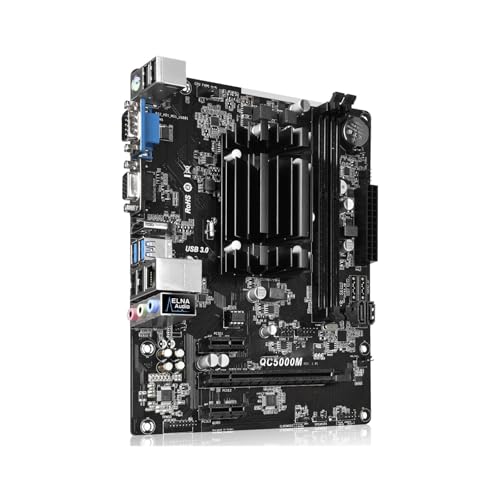
ASRock QC5000M Quad-Core Motherboard
Best for: All-in-one quad-core basic desktop builds
- Core Count
- 4 Cores (what this guide is about)
- CPU Socket
- FT3
- Form Factor
- Micro-ATX
- Memory Type
- DDR3
This board features an integrated 4-core processor on the FT3 socket, paired with built-in Radeon HD 8330 graphics. It uses DDR3 memory and includes an extended heatsink with thermal pads for heat dissipation. You also get an upgraded network connection. It fits standard cases supporting Micro-ATX layouts, making it a practical option if you need a self-contained system for everyday tasks.
Pros
- Integrated 4-core CPU with Radeon HD 8330 graphics
- Extended heatsink and thermal pads for cooling
- Upgraded network connection for stable connectivity
Cons
- Uses older DDR3 memory standard
- Integrated FT3 processor limits future CPU upgrades
Good fit if
- You want an all-in-one 4-core processor and graphics solution.
- You already have DDR3 memory modules available.
- You need a Micro-ATX motherboard with onboard passive cooling.
Skip if
- You need modern DDR4 or DDR5 system memory.
- You plan to swap or upgrade your processor later.
Verdict: ASRock QC5000M Quad-Core Motherboard provides an integrated 4-core processing platform with Radeon HD 8330 graphics and built-in passive cooling. It serves as a dependable all-in-one base for basic computing builds using DDR3 memory.

TYTMSCA FT3 4-Core DDR3 Motherboard
Best for: basic quad-core builds using DDR3 memory
- Core Count
- 4 Cores (what this guide is about)
- CPU Socket
- FT3
- Form Factor
- M-ATX
- Memory Type
- DDR3
This TYTMSCA motherboard provides a built-in 4-core setup on the FT3 socket, paired with integrated AMD Radeon HD 8330 graphics. Designed for DDR3 memory, the board features digital power regulation and a systematic thermal design to keep components stable under load. It fits M-ATX cases with clearly labeled ports for straightforward assembly. You will find it suitable if you need a self-contained, low-complexity quad-core platform for everyday essential computing.
Pros
- Integrated 4-core Kabini APU with AMD Radeon HD 8330 graphics
- FT3 socket platform compatible with DDR3 memory
- Digital power regulation paired with filtering and storage hardware
- Clearly labeled connection ports for simplified setup
Cons
- Uses legacy DDR3 memory rather than newer DDR4 or DDR5 standards
- Product details show conflicting form factor listings between ATX and M-ATX
- Integrated FT3 processor limits future standalone CPU upgrades
Good fit if
- You need an all-in-one quad-core platform with integrated AMD Radeon graphics.
- You intend to use existing DDR3 memory hardware in your configuration.
Skip if
- You require modern DDR4 or DDR5 system memory.
- You plan to upgrade to a higher-tier standalone desktop processor later.
Verdict: TYTMSCA FT3 4-Core DDR3 Motherboard combines an integrated 4-core APU and Radeon HD 8330 graphics into a low-maintenance setup. It serves as a straightforward option for builders running simple tasks on legacy DDR3 memory.

GIGABYTE Mini-ITX Core i3 Motherboard Bundle
Best for: compact LGA 1700 DDR5 desktop builds
- Core Count
- 4 Cores (what this guide is about)
- CPU Socket
- LGA 1700
- Chipset
- H610
- Form Factor
- Mini-ITX
- Memory Type
- DDR5
- PCIe Version
- PCIe 4.0
View on Amazon: GIGABYTE Mini-ITX Core i3 Motherboard Bundle
This bundle combines a Mini-ITX motherboard with an Intel Core i3 processor featuring 4 cores and a 3.30 GHz base frequency. You get support for fast dual-channel DDR5 memory, a PCIe 4.0 expansion slot, and integrated Intel UHD Graphics 730 that runs up to four displays. It suits you if you want a compact modern desktop build that handles everyday workloads on the LGA 1700 platform.
Pros
- Includes 4-core Intel Core i3 processor with 12 MB L3 cache
- Supports dual-channel DDR5 memory on 2 DIMM slots
- PCIe 4.0 slot and single NVMe PCIe 3.0 x4 M.2 connector
- Built-in Intel UHD Graphics 730 supports up to 4 monitors
Cons
- Offers only one M.2 slot for solid-state storage
- Restricted to two DDR5 DIMM slots
- M.2 slot is limited to PCIe 3.0 transfer speeds
Good fit if
- You want a compact Mini-ITX system powered by a 4-core Intel Core i3 processor.
- You plan to use DDR5 memory on an LGA 1700 socket motherboard.
- You need integrated graphics capable of driving up to four monitors.
Skip if
- You need more than one internal M.2 NVMe SSD.
- You require four RAM slots for system memory expansion.
Verdict: GIGABYTE Mini-ITX Core i3 Motherboard Bundle delivers modern LGA 1700 capabilities and DDR5 support in a space-saving format. It gives you a capable 4-core foundation with multi-display output straight out of the box.
Specifications side by side
| Spec | Supermicro Mini-ITX Quad-Core CPU Combo | Supermicro Mini-ITX Quad-Core Combo | Staclik Mini-ITX Quad-Core DDR4 Motherboard | ASRock Quad-Core ATX DDR3 Motherboard | ASRock QC5000M Quad-Core Motherboard | TYTMSCA FT3 4-Core DDR3 Motherboard | GIGABYTE Mini-ITX Core i3 Motherboard Bundle |
|---|---|---|---|---|---|---|---|
| CPU Socket | not specified | not specified | not specified | FT3 | FT3 | FT3 | LGA 1700 |
| Chipset | not specified | not specified | not specified | not specified | not specified | not specified | H610 |
| Form Factor | Mini-ITX | Mini-ITX | Mini-ITX | M-ATX | Micro-ATX | M-ATX | Mini-ITX |
| Memory Type | DDR3 | DDR3 | DDR4 | DDR3 | DDR3 | DDR3 | DDR5 |
| PCIe Version | PCI-Express 2.0 | PCI-Express 2.0 | PCIe 3.0 | not specified | not specified | not specified | PCIe 4.0 |
| M.2 Slots | not specified | not specified | 2 | not specified | not specified | not specified | 1 |
| Ethernet Speed | not specified | not specified | 2.5GbE | not specified | not specified | not specified | not specified |
| Power Phases | not specified | not specified | not specified | not specified | not specified | not specified | 4+1+1 |
| Use Case | not specified | not specified | Server | not specified | not specified | not specified | not specified |
| Core Count | 4 Cores | 4 Cores | 4 Cores | 4 Cores | 4 Cores | 4 Cores | 4 Cores |
| Thread Count | not specified | not specified | 8 Threads | not specified | not specified | not specified | not specified |
| Dimensions | 13 × 10 × 2 inches | 11 × 10 × 2 inches | not specified | not specified | not specified | not specified | not specified |
| Weight | not specified | 10.6 ounces | not specified | not specified | not specified | not specified | not specified |
| Model | A1SAI-2550F-O | A1SRI-2558F-O | CWWK-NMWL-2L | PKAUAUEHP | UVHKCCPBH | MSSTYVWYA | H610I |
| Size | not specified | not specified | not specified | One Size | One Size | One Size | not specified |
| Color | not specified | not specified | not specified | One Color | One Color | One Color | not specified |
Is a 4-Core Setup Worth It for Your Build?
Four cores handle basic everyday computing, dedicated local storage setups, and lightweight network servers. These platforms frequently feature integrated processors, which simplifies assembly on compact boards. Select options include built-in Radeon HD 8330 graphics for display output without adding a dedicated graphics card. You can also find configurations supporting eight threads, multi-display setups, and PCIe 4.0 data lanes. A four-core processor delivers sufficient compute capacity for low-power Mini-ITX servers and general tasks without excess power draw.
Worth it if
- You plan to run lightweight network storage, a dedicated home server, or basic multimedia tasks.
- You want an integrated low-power processor that operates without a dedicated graphics card.
Skip it if
- You require more than four cores or eight threads for heavy multitasking workloads.
- You run intensive processing tasks that exceed the demands of basic desktop or low-power storage setups.
If you also configure automated yard hardware, you can evaluate hunter x core 4 zone sprinkler alternatives by controller specifications.
How We Chose These Motherboards
We select listings that explicitly state a 4-core processor in the title or feature list. Every detail comes entirely from published manufacturer specifications, without physical testing. Only one model or size variant per product family is included to give you a distinct selection of options.
Products in stock appear first. We compare published specifications like Mini-ITX and ATX form factors, DDR3, DDR4, and DDR5 memory support, and CPU sockets. Listings also specify interfaces such as 2.5GbE networking and PCIe generation, helping you evaluate the right 4-core platform for your system.
How to Choose a 4-Core Motherboard
-
Select the Right Form Factor
You must verify the form factor matches your computer enclosure. Four-core motherboards typically come in Mini-ITX or standard ATX dimensions. Mini-ITX boards suit compact server cubes and space-saving desktop cases where internal clearance is tight. If you have a standard mid-tower or full-tower enclosure, an ATX model such as the ASRock Quad-Core ATX DDR3 Motherboard fits traditional mounting points. Choosing ATX gives you standard spacing across your chassis tray, whereas Mini-ITX keeps total footprint small for constrained desktop spaces.
-
Check Socket Upgrade Flexibility
Check whether the board uses an integrated processor or a dedicated CPU socket. Many quad-core models feature an embedded processor soldered directly onto the circuit board. These all-in-one setups simplify installation because the chip is pre-installed. However, you cannot swap the processor later. If you want the option to change components, look for a standard socket. The GIGABYTE Mini-ITX Core i3 Motherboard Bundle features an LGA 1700 socket, allowing you to mount or replace the processor instead of staying locked to a permanently attached unit.
-
Verify Simultaneous Thread Counts
Examine the thread count specification alongside the physical four-core count. Standard four-core units often execute four threads, handling one instruction stream per core. Higher-tier options double this capacity by offering eight threads across the four cores. The Staclik Mini-ITX Quad-Core DDR4 Motherboard provides eight threads, which gives your operating system extra logical pathways to schedule background services and network storage tasks. If you run multiple concurrent server processes or lightweight virtual environments, prioritize boards that state eight threads to keep parallel processing smooth.
-
Prioritize ECC Memory Support
Evaluate whether your workload demands error-correcting code memory. Non-ECC memory works well for general desktop tasks, but continuous file storage and network appliances benefit from ECC support. ECC memory detects and corrects internal data corruption before errors cause system instability or file damage. If you intend to operate a continuous network storage appliance, confirm the board specification explicitly notes ECC compatibility. A model like the Supermicro Mini-ITX Quad-Core Combo supports ECC RAM, ensuring dependable data integrity during uninterrupted file transfers and long operating stretches.
-
Assess Passive Thermal Design
Review the board cooling system before deciding on your setup. Some four-core integrated boards include built-in passive heatsinks instead of active cooling fans. The ASRock QC5000M Quad-Core Motherboard includes passive cooling, which relies entirely on ambient airflow inside your case. Passive cooling operates in total silence and eliminates mechanical fan failure, making it ideal for quiet living spaces or dust-prone environments. Make sure your chassis provides steady case airflow across the heatsink fins so your passively cooled four-core hardware maintains steady operating temperatures under load.
Frequently asked questions
Can you use ECC memory with a 4-core motherboard?
Yes, certain 4-core motherboards support ECC memory for specialized tasks. Models such as the Supermicro A1SAI-2550F-O and A1SRI-2558F-O are built to accommodate error-correcting DDR3 memory modules. This capability helps maintain system stability and prevents data corruption in dedicated storage systems or compact server environments where continuous operational integrity is critical.
Do 4-core motherboards come with integrated graphics?
Several 4-core boards integrate graphics directly on the platform to eliminate the need for an add-in card. For example, options like the ASRock QC5000M and the TYTMSCA FT3 feature onboard Radeon HD 8330 graphics for basic video output. Other platforms, like the GIGABYTE H610I bundle, provide multi-display outputs to support multi-monitor setups without requiring a separate expansion graphics card.
What expansion options do modern 4-core motherboards offer for high-speed components?
Modern boards provide high-bandwidth lanes to accommodate newer add-in cards and peripherals. The GIGABYTE H610I Mini-ITX bundle includes PCIe 4.0 support, which doubles the potential bandwidth compared to earlier PCIe 3.0 interfaces. This allows you to install faster expansion cards alongside updated hardware like DDR5 memory, ensuring higher data throughput across your system bus for compact desktop configurations.
How many threads can a 4-core motherboard handle simultaneously?
A 4-core motherboard typically handles four or eight concurrent threads, depending on whether the processor supports multithreading. For example, the Staclik CWWK-NMWL-2L features four physical cores configured to execute eight threads simultaneously. This multi-threaded design improves task distribution across lightweight virtual machines, background services, and continuous network processes compared to single-threaded quad-core setups.
Can you build a high-capacity storage server using a 4-core Mini-ITX motherboard?
Yes, you can construct dense storage configurations using compact 4-core boards. The Staclik Mini-ITX board includes eight SATA ports, allowing you to attach multiple hard drives or solid-state drives without requiring extra host bus adapter cards. Paired with dual 2.5GbE network interfaces, it provides the storage connectivity and bandwidth needed for dedicated network-attached storage within a small chassis.
Which processor sockets are available on 4-core motherboards?
While many 4-core motherboards utilize embedded processors permanently soldered to the circuit board, others offer standard CPU sockets. For instance, the GIGABYTE Mini-ITX bundle features an LGA 1700 socket designed for interchangeable desktop processors. Sockets allow you to replace or upgrade the central processing unit later, whereas soldered all-in-one motherboards rely on their integrated quad-core chip for the hardware lifespan.