15 Best E-Atx Motherboards, Compared
As an Amazon Associate we earn from qualifying purchases. Links on this page are affiliate links.
Finding the best E-ATX motherboards requires balancing case clearance with your need for expansion. The ASUS Prime Threadripper TR4 E-ATX Motherboard leads our list because it provides 128GB DDR4 memory capacity, reinforced GPU slots, and U.2 storage support for TR4 builds.
We evaluated 15 products based strictly on the specifications published on their listings. This guide helps you determine which processor socket, memory type, and connectivity options fit your planned workstation or desktop setup.
Quick picks
The best fit for you
- You build an AMD Ryzen Threadripper TR4 workstation ASUS Prime Threadripper TR4 E-ATX Motherboard It supports Ryzen Threadripper processors, up to 128GB of DDR4 memory, and dedicated U.2 storage connectivity.
- You need high-speed networking on an AM5 platform GIGABYTE AORUS Xtreme AM5 E-ATX Motherboard It pairs the AMD AM5 socket with 10GbE wired Ethernet, Wi-Fi 7, and PCIe 5.0 support.
- You need multi-GPU capability for Intel Xeon workloads ASRock Intel W790 E-ATX Motherboard It offers four PCIe 5.0 x16 slots, eight ECC RDIMM slots, and onboard 10GbE networking.
- You prefer an all-white AMD AM5 desktop build GIGABYTE AORUS E-ATX White Motherboard It provides a white finish, an AM5 CPU socket, PCIe 5.0 lanes, and Wi-Fi 6E connectivity.
Our 15 picks

ASUS Prime Threadripper TR4 E-ATX Motherboard
Best for: AMD Ryzen Threadripper TR4 workstation builds
- Form Factor
- E-ATX (what this guide is about)
- CPU Socket
- TR4
- Chipset
- X399
- Memory Type
- DDR4
- Series
- Ryzen Threadripper
- Dimensions
- 12 × 1 × 10.1 inches
View on Amazon: ASUS Prime Threadripper TR4 E-ATX Motherboard
The ASUS PRIME Threadripper E-ATX Motherboard provides a workstation foundation built around the AMD TR4 socket. Its Extended ATX design supports AMD Ryzen Threadripper processors and up to 128GB of DDR4 memory. You receive dual NVMe M.2 slots, a front-side U.2 connector, and three reinforced SafeSlots for multiple graphics cards. It suits you if you need a high-bandwidth desktop build with extensive storage and cooling options.
Pros
- Supports up to 128GB of DDR4 memory
- Three metal-framed SafeSlots for heavy graphics cards
- Dual NVMe M.2 drive support plus front-side U.2 port
- Front panel USB 3.1 Gen2 connectivity
- Dedicated AIO and water-cooling headers
Cons
- Limited to TR4 socket Threadripper processors
- Supports DDR4 memory rather than DDR5
- Provides only two onboard M.2 drive slots
Good fit if
- You build a system using an AMD Ryzen Threadripper TR4 processor.
- You need up to 128GB of DDR4 RAM for workstation tasks.
- You use multiple heavy GPUs that benefit from reinforced PCIe slots.
Skip if
- You plan to build with DDR5 memory modules.
- You use a mainstream AMD AM5 or Intel desktop processor.
- You require more than two onboard NVMe M.2 slots.
Verdict: ASUS PRIME Threadripper E-ATX Motherboard delivers dependable connectivity for TR4 builds, offering 128GB DDR4 capacity, reinforced GPU slots, and U.2 storage support. It functions as a solid, durable platform for high-end desktop workstations.

GIGABYTE AORUS Xtreme AM5 E-ATX Motherboard
Best for: high-end AMD Ryzen system builds
- Form Factor
- E-ATX (what this guide is about)
- CPU Socket
- AM5, LGA 1718
- Chipset
- X870E
- Memory Type
- DDR5
- PCIe Version
- PCIe 5.0
- M.2 Slots
- 4
This GIGABYTE board is an E-ATX motherboard built around the AMD AM5 socket for Ryzen 9000, 8000, and 7000 series processors. Its Extended ATX layout provides room for an 18+2+2 phase power delivery system, four DDR5 memory slots, and four M.2 solid-state drive mounts with PCIe 5.0 speed. Dual USB4 ports and high-speed Wi-Fi 7 round out the connectivity, making it a capable foundation if you need high-bandwidth expansion.
Pros
- 18+2+2 phase power design with 110A power stages
- PCIe 5.0 support with four M.2 slots
- Wi-Fi 7 and multi-gigabit Ethernet connectivity
- Dual USB4 and front and rear USB-C ports
Cons
- Large E-ATX dimensions require a compatible full-size case
- AM5 socket does not support Intel processors
- Features four M.2 slots where some flagship boards offer more
Good fit if
- You plan to run an AMD Ryzen 7000, 8000, or 9000 series processor.
- You require fast external transfer speeds via dual USB4 interfaces.
- You want advanced wireless networking with Wi-Fi 7 hardware.
Skip if
- You plan to build using an Intel desktop processor.
- You have a standard case that only accepts standard ATX boards.
Verdict: GIGABYTE AORUS Xtreme AM5 E-ATX Motherboard provides heavy-duty power delivery and modern Wi-Fi 7 networking for current AMD processors. It serves as an expansive platform if your case supports the Extended ATX footprint.

ASUS ROG Maximus Z690 E-ATX Motherboard
Best for: high-speed networking and multi-drive LGA 1700 builds
- Form Factor
- E-ATX (what this guide is about)
- CPU Socket
- LGA 1700
- Chipset
- Z690
- Memory Type
- DDR5
- PCIe Version
- PCIe 5.0
- M.2 Slots
- 5
This E-ATX motherboard pairs Intel LGA 1700 socket support with a Z690 chipset. You get five M.2 slots for storage, dual Ethernet with 10Gb and 2.5Gb ports, plus Wi-Fi 6E connectivity. Its 24+1 power stage setup supports heavy workloads and DDR5 memory. If you build a high-demand gaming rig inside a large case that fits a 30.5 by 27.7 centimeter board, this model gives you substantial networking and storage headroom.
Pros
- 24+1 teamed power stages rated for 105 A
- Dual Ethernet with 10Gb and 2.5Gb ports
- Five M.2 storage slots with heatsinks
- PCIe 5.0 and DDR5 memory support
- Integrated Wi-Fi 6E wireless
Cons
- Maximum RAM capacity is listed at 64 GB
- Large 30.5 cm by 27.7 cm dimensions require a compatible case
- Data explicitly lists support only up to 12th Gen Intel Core processors
Good fit if
- You want 10Gb and 2.5Gb dual wired networking alongside Wi-Fi 6E.
- You plan to install up to five M.2 solid-state drives.
- You need a 24+1 power stage design for an LGA 1700 processor.
Skip if
- You need more than 64 GB of total system memory.
- You have a PC chassis that cannot accommodate an Extended ATX layout.
Verdict: ASUS ROG Maximus Z690 E-ATX Motherboard delivers high-end power delivery and 10Gb networking for LGA 1700 setups. It provides five M.2 slots and DDR5 compatibility if your case accommodates its large footprint.

MSI MEG E-ATX DDR5 Motherboard
Best for: 12th Gen Intel builds needing extensive storage
- Form Factor
- E-ATX (what this guide is about)
- CPU Socket
- LGA 1700
- Chipset
- Z690
- Memory Type
- DDR5
- PCIe Version
- PCIe 5
- M.2 Slots
- 5
This MSI MEG Z690 E-ATX Motherboard is built for 12th Gen Intel processors on the LGA 1700 socket. It pairs DDR5 memory support with PCIe 5 capability and five onboard M.2 slots for expansive high-speed storage. You also get dual Thunderbolt 4 ports and dual 2.5G Ethernet connections. It suits you if you need extensive connectivity, high internal storage capacity, and an E-ATX layout for your Intel build.
Pros
- Five onboard M.2 slots with heatsink coverage
- Dual Thunderbolt 4 ports with 40 Gb/s transfer and 8K display support
- PCIe 5 support and DDR5 memory compatibility
- Dual 2.5G Ethernet ports and Wi-Fi 6E
Cons
- Specifications only list support for 12th Gen Intel processors
- Large E-ATX footprint requires a case with sufficient clearance
- Total weight is 5 pounds
Good fit if
- You build with a 12th Gen Intel LGA 1700 processor.
- You plan to install up to five M.2 solid-state drives.
- You require dual Thunderbolt 4 ports and dual 2.5G LAN ports.
Skip if
- You build with an AMD processor.
- You use a standard chassis that cannot accommodate an E-ATX form factor.
Verdict: MSI MEG Z690 E-ATX Motherboard delivers extensive storage and high-speed data connectivity for 12th Gen Intel setups. Its five M.2 slots, dual Thunderbolt 4 ports, and DDR5 support make it a strong platform for hardware-dense systems.

ASRock Intel W790 E-ATX Motherboard
Best for: Intel Xeon workstation and multi-GPU builds
- Form Factor
- E-ATX (what this guide is about)
- CPU Socket
- LGA-4677
- Chipset
- Intel W790
- Memory Type
- DDR5
- PCIe Version
- PCIe 5.0
- M.2 Slots
- 4
This E-ATX workstation board features the Intel W790 chipset and an LGA-4677 socket designed for Intel Xeon W-3400 and W-2400 processors. It provides four PCIe 5.0 x16 slots alongside eight DDR5 ECC RDIMM slots supporting up to 2048GB of memory. You also get four Gen5 M.2 slots, dual 10GbE ports, and dual Thunderbolt 4 connections. It suits you if you build high-throughput workstations for multi-GPU setups, rendering, or heavy computational workloads.
Pros
- Four PCIe 5.0 x16 slots for multi-GPU configurations
- Eight DDR5 ECC RDIMM slots supporting up to 2048GB
- Dual Marvell 10GbE LAN plus Intel 2.5GbE LAN
- Four PCIe Gen5x4 M.2 slots and one U.2 connector
- Two 40 Gbps Thunderbolt 4 Type-C ports
Cons
- Requires Intel Xeon W-3400 or W-2400 processors
- Requires DDR5 ECC RDIMM memory instead of standard desktop RAM
- Large 12-inch by 13-inch dimensions require specialized case clearance
Good fit if
- You need quad-channel ECC RDIMM support with capacities up to 2048GB.
- You run multi-GPU configurations across four PCIe 5.0 x16 slots.
- You want built-in dual 10GbE networking and dual Thunderbolt 4 ports.
Skip if
- You plan to use standard consumer Core or Ryzen desktop processors.
- You already own non-ECC desktop DDR5 memory.
- You have a case that cannot clear a 12-inch by 13-inch form factor.
Verdict: ASRock Intel W790 Workstation Motherboard delivers enterprise-level expansion with four PCIe 5.0 x16 slots, eight ECC RDIMM slots, and 10GbE networking. It provides a heavy-duty platform for professional Xeon-based computing setups.

GIGABYTE Aero E-ATX Threadripper Motherboard
Best for: AMD Threadripper PRO workstation builds
- Form Factor
- E-ATX (what this guide is about)
- CPU Socket
- sTR5
- Chipset
- TRX50
- Memory Type
- DDR5
- PCIe Version
- PCIe 5.0
- Wi-Fi Standard
- Wi-Fi 7
View on Amazon: GIGABYTE Aero E-ATX Threadripper Motherboard
The GIGABYTE AERO Threadripper E-ATX Motherboard supports AMD Ryzen Threadripper PRO 7000 processors on the sTR5 socket. You get high-bandwidth connectivity with PCIe 5.0 lanes, dual USB4 Type-C ports, and high-speed networking via Wi-Fi 7 plus 10GbE and 2.5GbE LAN ports. Its four R-DIMM slots run DDR5 memory with EXPO and XMP profiles. This board suits workstation builders needing heavy multi-threaded processing power and fast data transfers.
Pros
- Dual LAN with 10GbE and 2.5GbE plus Wi-Fi 7
- PCIe 5.0 expansion slots and PCIe 5.0 M.2 support
- Dual high-speed USB4 Type-C ports
- 16+8+4 digital VRM power phases with thermal armor
Cons
- Limited to four DDR5 R-DIMM memory slots
- Requires AMD sTR5 socket processors
- Large 12 by 10.4 inch footprint requires an E-ATX case
Good fit if
- You plan to run an AMD Ryzen Threadripper PRO 7000 series CPU.
- You need 10GbE wired networking alongside Wi-Fi 7 support.
- You want tool-free installation via EZ-Latch for PCIe and M.2 devices.
Skip if
- You use standard desktop processors on AM5 or LGA sockets.
- You need eight memory channels or more than four DIMM slots.
- You own a standard mid-tower chassis limited to standard ATX boards.
Verdict: GIGABYTE AERO Threadripper E-ATX Motherboard delivers workstation-tier connectivity with PCIe 5.0, Wi-Fi 7, and 10GbE networking for AMD sTR5 processors. It provides reliable 16+8+4 phase digital power delivery for demanding compute workflows.
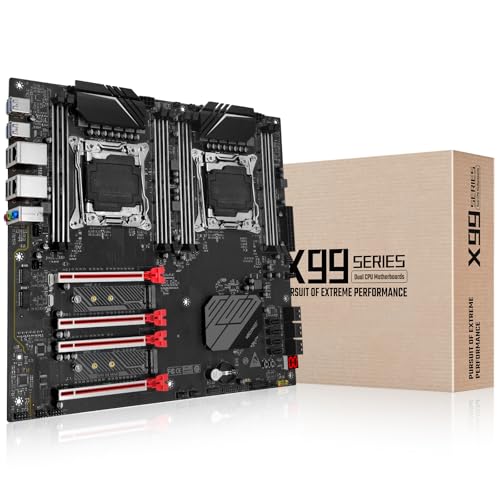
MACHINIST Dual Socket E-ATX Server Motherboard
Best for: dual-socket legacy server and workstation builds
- Form Factor
- E-ATX (what this guide is about)
- CPU Socket
- LGA 2011-3
- Chipset
- C612
- Memory Type
- DDR4
- PCIe Version
- PCIe 3.0
- M.2 Slots
- 2
View on Amazon: MACHINIST Dual Socket E-ATX Server Motherboard
This E-ATX server board features dual LGA 2011-3 sockets and an Intel C612 chipset. It provides eight DDR4 memory slots supporting up to 256GB across four channels. You get four PCIe 3.0 x16 slots, dual M.2 storage slots, and ten SATA 3.0 connectors for extensive drive setups. It suits you if you plan to build a multi-threaded workstation or home server using legacy Intel Xeon E5 V3 or V4 processors.
Pros
- Dual LGA 2011-3 sockets for Intel Xeon E5 V3/V4 and Core i7 processors
- Eight DDR4 slots supporting up to 256GB total memory across four channels
- Four PCIe 3.0 x16 expansion slots
- Ten SATA 3.0 ports and dual M.2 storage slots
Cons
- Requires a dedicated dual-socket server power supply with 24+8+8-pin connectors
- Package excludes a CR2032 CMOS battery and printed user manual
- Non-ECC memory is incompatible when paired with Xeon E5 V4 series processors
Good fit if
- You need dual LGA 2011-3 sockets for multi-processor computing.
- You plan to run up to ten SATA 3.0 storage drives.
- You want eight DDR4 slots with support for up to 256GB of RAM.
Skip if
- You want newer PCIe 4.0 or PCIe 5.0 expansion lanes.
- You intend to use a standard power supply without 24+8+8-pin cabling.
- You plan to pair non-ECC DDR4 memory with Intel Xeon E5 V4 CPUs.
Verdict: MACHINIST Dual LGA 2011-3 E-ATX Motherboard delivers dual-socket processing, eight memory slots, and ten storage ports on an E-ATX layout. It serves as a practical foundation if you rely on compatible Intel Xeon or Core i7 hardware.

GIGABYTE AORUS E-ATX White Motherboard
Best for: white-themed AMD AM5 desktop builds
- Form Factor
- E-ATX (what this guide is about)
- CPU Socket
- AM5
- Chipset
- AMD B650E
- Memory Type
- DDR5
- PCIe Version
- PCIe 5.0
- M.2 Slots
- 3
This white E-ATX motherboard pairs AMD Socket AM5 with modern DDR5 memory and PCIe 5.0 support. It features a twin 12+2+2 digital power phase design, three M.2 slots, Wi-Fi 6E, and 2.5 GbE networking. Built for AMD Ryzen 7000, 8000, and 9000 series processors, it gives you reliable power delivery and fast connectivity. It suits you if you want a clean white aesthetic for your desktop workstation or gaming setup without sacrificing hardware bandwidth.
Pros
- Twin 12+2+2 digital VRM power design
- PCIe 5.0 lane support and three M.2 storage slots
- Integrated Wi-Fi 6E and Bluetooth 5.3 connectivity
- Four DDR5 DIMM slots supporting AMD EXPO and Intel XMP
Cons
- Provides three M.2 storage slots instead of four
- Uses Wi-Fi 6E rather than Wi-Fi 7
Good fit if
- You build an AMD AM5 system using Ryzen 7000, 8000, or 9000 series processors.
- You want an all-white component layout with dual USB-C ports and PCIe 5.0.
- You require 2.5 GbE wired networking alongside DDR5 memory support.
Skip if
- You need more than three onboard M.2 solid-state drives.
- You run an Intel processor requiring an LGA socket.
Verdict: GIGABYTE AORUS Ice White E-ATX Motherboard delivers PCIe 5.0 speeds and robust 12+2+2 power delivery for AMD AM5 processors. Its clean white finish and solid connectivity make it a dependable base for modern desktop systems.

Gigabyte Dual Socket SP5 E-ATX Motherboard
Best for: dual AMD EPYC server builds
- Form Factor
- E-ATX (what this guide is about)
- CPU Socket
- Socket SP5
- PCIe Version
- PCIe Gen4
- M.2 Slots
- 1
- Weight
- 7 pounds
This Gigabyte Extended ATX board supports dual AMD EPYC 9004 series processors on Socket SP5 using 5nm technology. You get server-grade hardware in a standard E-ATX footprint, complete with a dedicated management port for remote administration. Storage expansion includes one M.2 slot operating on a PCIe Gen4 x4 interface. It suits you if you need dense dual-socket compute power and remote management in an E-ATX build.
Pros
- Supports dual AMD EPYC 9004 series processors
- Dedicated management port
- PCIe Gen4 x4 M.2 slot
Cons
- Only one onboard M.2 slot
- PCIe Gen4 specification rather than PCIe Gen5
Good fit if
- You need dual AMD EPYC 9004 series processors in an E-ATX build.
- You require a dedicated management port for network administration.
Skip if
- You require more than one onboard M.2 drive slot.
- You plan to build with consumer desktop CPUs instead of Socket SP5.
Verdict: Gigabyte Dual Socket SP5 E-ATX Motherboard delivers enterprise dual-processor capability and remote management in an E-ATX form factor. It prioritizes dual AMD EPYC 9004 compute power over multiple onboard M.2 storage slots.

SHANGZHAOYUAN Dual CPU DDR4 E-ATX Motherboard
Best for: dual Xeon server and workstation builds
- Form Factor
- E-ATX (what this guide is about)
- CPU Socket
- LGA 2011-V3
- Chipset
- C612
- Memory Type
- DDR4
- PCIe Version
- PCIe 3.0
- M.2 Slots
- 2
View on Amazon: SHANGZHAOYUAN Dual CPU DDR4 E-ATX Motherboard
This SHANGZHAOYUAN board gives you dual LGA 2011-V3 sockets on an E-ATX layout. It runs the Intel C612 chipset and supports dual Xeon E5-2XXX v3 or v4 processors. You get eight DDR4 memory slots supporting up to 256GB of RAM, dual M.2 PCIe 3.0 x4 slots, and two PCIe 3.0 x16 slots. It suits you if you need a high-capacity multi-threaded workstation or server setup.
Pros
- Dual LGA 2011-V3 sockets for Xeon E5-2XXX v3 and v4 series processors
- Eight DDR4 memory slots supporting up to 256GB capacity
- Dual M.2 PCIe 3.0 x4 slots plus two PCIe 3.0 x16 slots
- Dual network ports and an integrated diagnostic card
Cons
- Package excludes a CR2032 battery and printed user manual
- PCIe speeds capped at PCIe 3.0 and PCIe 2.0 standards
- Requires two matching CPUs and a power supply over 600W
Good fit if
- You plan to run dual Intel Xeon E5 v3 or v4 processors.
- You require up to 256GB of DDR4 memory across eight slots.
- You want built-in diagnostic display hardware and dual Ethernet ports.
Skip if
- You plan to use Intel Core i7 processors in a dual-CPU layout.
- You need newer PCIe 4.0 or PCIe 5.0 bandwidth.
- You expect an included CMOS battery or printed setup manual.
Verdict: SHANGZHAOYUAN Dual CPU E-ATX Motherboard delivers dual LGA 2011-V3 sockets and 256GB DDR4 memory capacity for multi-threaded workloads. It provides a straightforward hardware foundation for workstation setups using Intel C612 architecture.

ASUS ROG Maximus Z890 Extreme E-ATX Motherboard
Best for: Intel LGA 1851 builds requiring 10G networking
- Form Factor
- E-ATX (what this guide is about)
- CPU Socket
- LGA 1851
- Chipset
- Z890
- Memory Type
- DDR5
- M.2 Slots
- 4
- Wi-Fi Standard
- Wi-Fi 7
View on Amazon: ASUS ROG Maximus Z890 Extreme E-ATX Motherboard
This E-ATX motherboard pairs an Intel Z890 chipset with an LGA 1851 socket for Intel Core Ultra Series 2 processors. You get a 24+2+1+2 power stage delivery system, DDR5 memory support, four M.2 slots, and an integrated 5-inch LCD screen. It includes Wi-Fi 7 and dual 2.5G and 10G Ethernet ports. This board suits builders who want high-speed networking and heavy power delivery for modern Intel processors.
Pros
- Robust 24+2+1+2 power stage design
- High-speed 10G and 2.5G dual Ethernet ports
- Integrated Wi-Fi 7 wireless connectivity
- Built-in 5-inch LCD screen
Cons
- Provides four M.2 slots, fewer than the six found on other Z890 options
- Heavy board weight of 8 pounds
Good fit if
- You use an Intel Core Ultra Series 2 processor on socket LGA 1851.
- You need dual 2.5G and 10G Ethernet along with Wi-Fi 7.
- You want a 24+2+1+2 power stage configuration for your build.
Skip if
- You plan to use an AMD or older Intel LGA 1700 processor.
- You require more than four onboard M.2 storage slots.
- You have a compact case that cannot fit an E-ATX motherboard.
Verdict: ASUS ROG Maximus Z890 Extreme combines an Intel LGA 1851 socket with 24+2+1+2 power stages, Wi-Fi 7, and 10G Ethernet. It is an expansive E-ATX option for builders who do not need more than four M.2 slots.

Dual 7003/7002 Series E-ATX Motherboard
Best for: dual-processor builds needing 10GbE networking
- Form Factor
- E-ATX (what this guide is about)
- Ethernet Speed
- 10GBase-T
This E-ATX motherboard supports dual 7003 and 7002 series processors for high-density computing tasks. You get dual 10GBase-T LAN ports that deliver 10GbE networking speeds for handling demanding data transfers across your local network. It also features a dedicated IPMI LAN port for remote hardware management. This board suits you if you need dual processor sockets and fast 10GbE networking integrated into an E-ATX server or workstation build.
Pros
- Supports dual 7003 and 7002 series processors
- Dual 10GBase-T LAN ports for 10GbE networking
- Dedicated IPMI LAN port for management
Cons
- Limited to 7003 and 7002 series processors
- E-ATX form factor requires a compatible large chassis
Good fit if
- You need a motherboard that supports dual 7003 or 7002 series processors.
- You require dual 10GBase-T LAN ports for 10GbE networking.
- You manage systems over a dedicated IPMI LAN port.
Skip if
- You plan to use processors other than the 7003 or 7002 series.
- You have a standard case that cannot fit an E-ATX form factor board.
Verdict: Dual 7003/7002 E-ATX Motherboard provides dual processor support alongside dual 10GBase-T LAN ports for 10GbE networking. It includes a dedicated IPMI LAN port for remote hardware management in an E-ATX footprint.

MSI MEG GODLIKE E-ATX Motherboard
Best for: high-speed storage arrays and fast networking builds
- Form Factor
- E-ATX (what this guide is about)
- CPU Socket
- LGA 1851
- Chipset
- Z890
- Memory Type
- DDR5
- PCIe Version
- PCIe 5.0
- Wi-Fi Standard
- Wi-Fi 7
This E-ATX board supports Intel Core Ultra Series 2 processors on the LGA 1851 socket. It features dual LAN controllers offering 10Gbps and 5Gbps speeds, onboard Wi-Fi 7, and support for up to eight total M.2 drives through onboard slots and an included expansion card. If you plan an expansive storage setup or high-bandwidth networking around Intel's desktop platform, this layout provides extensive connectivity for your build.
Pros
- Up to eight M.2 drives using onboard slots and expansion card
- Dual wired LAN ports providing 10Gbps and 5Gbps speeds
- Built-in 3.99-inch LCD for hardware monitoring
- Wi-Fi 7 and Bluetooth 5.4 wireless support
Cons
- Board weight is high at 6.83 pounds
- Only works with Intel LGA 1851 socket processors
Good fit if
- You need high-bandwidth networking with both 10Gbps and 5Gbps LAN ports.
- You run multiple NVMe drives using onboard slots and the M.2 expansion card.
- You want real-time hardware status shown directly on an onboard 3.99-inch LCD.
Skip if
- You use an AMD processor or an older Intel LGA 1700 CPU.
- You have a computer case that cannot accommodate wider E-ATX dimensions.
Verdict: MSI GODLIKE E-ATX Motherboard delivers expansive connectivity with Wi-Fi 7, dual high-speed LAN, and up to eight M.2 storage options. It serves demanding Intel LGA 1851 builds requiring heavy data throughput and broad device expansion.

MSI MEG AM5 E-ATX Motherboard
Best for: high-bandwidth AM5 storage and 10Gbps networking
- Form Factor
- E-ATX (what this guide is about)
- CPU Socket
- AM5
- Chipset
- AMD X870E
- Memory Type
- DDR5
- PCIe Version
- PCIe 5.0
- Wi-Fi Standard
- Wi-Fi 7
This E-ATX board features an AMD AM5 socket running on the X870E chipset, designed for AMD Ryzen 9000, 8000, and 7000 series processors. You get seven total M.2 storage slots using onboard connectors and the bundled Gen5 expansion card, along with 10Gbps plus 5Gbps dual wired LAN and Wi-Fi 7. It suits power users who need extensive high-speed storage, 40Gbps USB4 connectivity, and heavy-duty 24-phase power delivery for demanding desktop builds.
Pros
- Supports up to seven M.2 NVMe SSDs across onboard slots and the included XPANDER-Z SLIDER Gen5 card
- Dual Ethernet with 10Gbps and 5Gbps ports alongside Wi-Fi 7 and Bluetooth 5.4
- 24-phase (110A SPS) power delivery system for AM5 Ryzen processors
- Onboard 3.99-inch LCD Dynamic Dashboard III for real-time hardware monitoring
- Dual rear USB4 Type-C ports with 40Gbps bandwidth and display output
Cons
- Large E-ATX footprint requires a case that accommodates 9.61-inch board width
- Total weight of 14 pounds adds significant load inside your chassis
- Two of the seven M.2 slots require an add-in PCIe card rather than onboard slots
Good fit if
- You need up to seven M.2 NVMe drives for high-capacity solid-state storage.
- You want multi-gigabit wired networking with dedicated 10Gbps and 5Gbps ports.
- You build with AMD Ryzen 9000, 8000, or 7000 series AM5 processors.
Skip if
- You use a compact or standard case that cannot fit an E-ATX motherboard.
- You want all M.2 storage drives installed directly on the main PCB without add-in cards.
- You require an Intel CPU socket.
Verdict: MSI MEG X870E GODLIKE E-ATX Motherboard delivers robust AM5 power delivery, dual 10Gbps and 5Gbps networking, and support for up to seven M.2 drives. It is an expansive platform built specifically for high-throughput AMD Ryzen setups.

ASUS ROG Crosshair AM5 E-ATX Motherboard
Best for: high-speed networking and multi-drive AM5 builds
- Form Factor
- E-ATX (what this guide is about)
- CPU Socket
- AM5
- Chipset
- AMD X870E
- Memory Type
- DDR5
- PCIe Version
- PCIe 5.0
- M.2 Slots
- 5
This ASUS ROG Crosshair AM5 E-ATX Motherboard is an Extended ATX board designed for AMD Ryzen 9000, 8000, and 7000 series processors. Its 10.9-inch wide E-ATX frame holds five M.2 storage slots, including three PCIe 5.0 interfaces and two PCIe 4.0 slots via Q-DIMM.2. You get dual wired networking with 10Gb and 5Gb Ethernet alongside Wi-Fi 7. It suits you if you run high-bandwidth storage arrays and multi-gigabit local networks.
Pros
- Three onboard PCIe 5.0 M.2 slots plus two PCIe 4.0 slots via Q-DIMM.2
- Dual Ethernet ports with 10Gb Marvell and 5Gb Realtek controllers
- Wi-Fi 7 connectivity and dual rear USB4 Type-C ports
- 20+2+2 power stage design rated for 110A
Cons
- Wide 10.9-inch footprint requires an E-ATX compatible PC case
- Two M.2 slots require installing the separate Q-DIMM.2 module
- Board weight of 6.69 pounds requires sturdy case mounting
Good fit if
- You build with AMD Ryzen 9000, 8000, or 7000 series processors.
- You require 10Gbps and 5Gbps wired LAN ports on the rear I/O.
- You plan to install up to five M.2 NVMe solid-state drives.
Skip if
- You use an Intel CPU or an older AM4 socket processor.
- You have a standard case that cannot fit 10.9-inch wide boards.
Verdict: ASUS ROG Crosshair AM5 E-ATX Motherboard delivers expansive connectivity with Wi-Fi 7, dual 10Gb and 5Gb Ethernet, and five total M.2 slots. It provides the heavy power delivery and physical clearance needed for high-end AM5 desktop builds.
Specifications side by side
| Spec | ASUS Prime Threadripper TR4 E-ATX Motherboard | GIGABYTE AORUS Xtreme AM5 E-ATX Motherboard | ASUS ROG Maximus Z690 E-ATX Motherboard | MSI MEG E-ATX DDR5 Motherboard | ASRock Intel W790 E-ATX Motherboard | GIGABYTE Aero E-ATX Threadripper Motherboard | MACHINIST Dual Socket E-ATX Server Motherboard | GIGABYTE AORUS E-ATX White Motherboard | Gigabyte Dual Socket SP5 E-ATX Motherboard | SHANGZHAOYUAN Dual CPU DDR4 E-ATX Motherboard | ASUS ROG Maximus Z890 Extreme E-ATX Motherboard | Dual 7003/7002 Series E-ATX Motherboard | MSI MEG GODLIKE E-ATX Motherboard | MSI MEG AM5 E-ATX Motherboard | ASUS ROG Crosshair AM5 E-ATX Motherboard |
|---|---|---|---|---|---|---|---|---|---|---|---|---|---|---|---|
| CPU Socket | TR4 | AM5, LGA 1718 | LGA 1700 | LGA 1700 | LGA-4677 | sTR5 | LGA 2011-3 | AM5 | Socket SP5 | LGA 2011-V3 | LGA 1851 | not specified | LGA 1851 | AM5 | AM5 |
| Chipset | X399 | X870E | Z690 | Z690 | Intel W790 | TRX50 | C612 | AMD B650E | not specified | C612 | Z890 | not specified | Z890 | AMD X870E | AMD X870E |
| Form Factor | Extended ATX | E-ATX | Extended ATX | E-ATX | Extended ATX | E-ATX | E-ATX | ATX | Extended ATX | E-ATX | E-ATX | EATX | E-ATX | E-ATX | E-ATX |
| Memory Type | DDR4 | DDR5 | DDR5 | DDR5 | DDR5 | DDR5 | DDR4 | DDR5 | not specified | DDR4 | DDR5 | not specified | DDR5 | DDR5 | DDR5 |
| PCIe Version | not specified | PCIe 5.0 | PCIe 5.0 | PCIe 5 | PCIe 5.0 | PCIe 5.0 | PCIe 3.0 | PCIe 5.0 | PCIe Gen4 | PCIe 3.0 | not specified | not specified | PCIe 5.0 | PCIe 5.0 | PCIe 5.0 |
| M.2 Slots | not specified | 4 | 5 | 5 | 4 | not specified | 2 | 3 | 1 | 2 | 4 | not specified | not specified | not specified | 5 |
| Wi-Fi Standard | not specified | Wi-Fi 7 | Wi-Fi 6E | Wi-Fi 6E | Wi-Fi 6E | Wi-Fi 7 | not specified | Wi-Fi 6E | not specified | not specified | Wi-Fi 7 | not specified | Wi-Fi 7 | Wi-Fi 7 | Wi-Fi 7 |
| Ethernet Speed | not specified | 10 GbE, 5 GbE | 10Gb, 2.5Gb | Dual 2.5G | 10GbE, 2.5GbE | 10GbE + 2.5GbE | not specified | 2.5 GbE | not specified | not specified | 2.5G/10G | 10GBase-T | 10Gbps, 5Gbps | 10Gbps, 5Gbps | 5 Gbps, 10 Gbps |
| Power Phases | not specified | 18+2+2 | 24+1 | not specified | 20+2 | 16+8+4 | 12+4+1 | 12+2+2 | not specified | 6-phase | 24+2+1+2 | not specified | not specified | not specified | 20+2+2 |
| Wi-Fi | not specified | Wi-Fi 7 | Wi-Fi 6E | Wi-Fi 6E | not specified | Wi-Fi 7 | not specified | Wi-Fi 6E | not specified | not specified | Wi-Fi 7 | not specified | Wi-Fi 7 | Wi-Fi 7 | Wi-Fi 7 |
| Use Case | not specified | not specified | Gaming | Gaming | Gaming | not specified | Server | not specified | not specified | not specified | not specified | not specified | not specified | not specified | Gaming |
| Series | Ryzen Threadripper | not specified | not specified | not specified | not specified | not specified | not specified | not specified | not specified | not specified | not specified | not specified | not specified | not specified | not specified |
| Dimensions | 12 × 1 × 10.1 inches | 12.6 × 4.37 × 15.2 inches | 12 × 10.9 × 1.93 inches | 12 × 9.6 × 2.5 inches | 12.2 × 8.27 × 1.97 inches | 3.1 × 13.6 × 11.6 inches | 13 × 12 × 1.5 inches | 13.2 × 3.15 × 10.6 inches | not specified | 13 × 13 × 13 inches | 15 × 5.1 × 12.8 inches | not specified | 12 × 9.61 × 2.64 inches | 12 × 9.61 × 2.64 inches | 12 × 10.9 × 1.93 inches |
| Weight | 4.5 pounds | 8.14 pounds | 2.2 pounds | 5 pounds | 2.16 pounds | 4 pounds | not specified | not specified | 7 pounds | not specified | 8 pounds | not specified | 6.83 pounds | 14 pounds | 6.69 pounds |
| Size | Extended ATX | EATX | not specified | eATX | not specified | 12" x 10.4" | 305*330 mm | EATX | not specified | not specified | Z890 Extreme|M.2 x4|WiFi 7|5" LCD Screen | not specified | not specified | not specified | X870E Extreme|M.2x5|5”LCD |
| Model | PRIME X399-A | X870E AORUS XTREME AI TOP | PRIME H610M-A D4-CSM | MEG Z690 ACE | W790WS | TRX50 AERO D | X99 D8 | B650E AORUS ELITE X AX ICE | MZ73-LM0 | SHANGZHAOYUAN X99 MD8 | ROG MAXIMUS Z890 EXTREME | not specified | MEG Z890 GODLIKE | Meg X870E GODLIKE | ROG CROSSHAIR X870E EXTREME |
| Color | not specified | XTREME-AITOP | not specified | not specified | not specified | black | X99 D8-Red+E-ATX | White | not specified | not specified | BLACK | not specified | not specified | not specified | BLACK |
Is an E-ATX Motherboard Worth It?
The larger footprint provides physical space for dense hardware configurations that standard motherboards cannot accommodate. In daily use, this form factor allows for high-density storage arrays supporting up to seven or eight M.2 drives, dual processor sockets, and eight memory slots handling up to 256GB of RAM. It also provides the board area needed for four PCIe 5.0 x16 slots and dual high-speed Ethernet ports. However, these boards require cases with extended clearance and weigh up to 14 pounds.
Worth it if
- You need extensive onboard storage expansion with up to seven or eight M.2 drive slots.
- You plan a dual-socket workstation or require four PCIe 5.0 x16 slots for multiple expansion cards.
Skip it if
- You use a standard chassis that cannot clear motherboards measuring up to 13 inches wide or long.
- You only require a single graphics card and standard storage with fewer than four M.2 drives.
How We Picked E-ATX Motherboards
This guide identifies motherboards designed with an E-ATX form factor based strictly on what manufacturers state in their product titles and specifications. Only one variant from each product line is included to give you a clear comparison across 15 distinct options. All technical details come directly from published feature lists without physical handling.
You will see the list arranged with products in stock first. Availability details refresh on the page at least daily so you see current options. Comparing these motherboards by their published specifications helps you evaluate socket types, memory standards, and expansion slots for your specific build.
How to Choose an E-ATX Motherboard
-
Verify Chassis Clearance and Dimensions
Extended ATX motherboards do not share a single standardized width. While standard ATX measures 12 by 9.6 inches, E-ATX widths vary widely across models. For example, the MACHINIST Dual Socket E-ATX Motherboard measures 12 inches by 13 inches. Other consumer models measure around 10.4 to 10.9 inches wide. You must measure the clearance inside your PC case before purchasing. Ensure your chassis includes offset mounting standoffs and sufficient space next to cable grommets. A wider board can block rubber grommets and interfere with front radiator installations.
-
Evaluate PCIe Generation and Slots
Look closely at the revision and physical layout of the expansion slots. PCIe 5.0 doubles the bandwidth of PCIe 4.0, which benefits next-generation graphics cards and add-in storage controllers. High-end workstations require multiple full-length slots with dedicated lane assignments. For instance, the ASRock Intel W790 E-ATX Motherboard provides four PCIe 5.0 x16 slots for multi-GPU configurations. If you plan to install multiple compute cards, sound cards, or high-speed capture cards, verify that the board provides adequate slot spacing so that thick coolers do not block adjacent expansion slots.
-
Calculate M.2 Drive Capacity
The large surface area of an E-ATX PCB allows manufacturers to integrate numerous onboard storage connectors. Standard desktop boards often feature two or three M.2 slots, but larger platforms expand this significantly. The MSI MEG GODLIKE E-ATX Motherboard accommodates up to eight M.2 drives for extensive local storage arrays. If you manage large video libraries or heavy local datasets, prioritize boards with four or more M.2 slots. Check whether these slots include integrated metal heatsinks, as high-speed NVMe drives generate heat and require direct thermal dissipation to maintain peak read and write transfer rates.
-
Select Wired Ethernet Speeds
Network connectivity specifications differ substantially between gaming and workstation models. Many desktop options provide 2.5GbE LAN, which handles standard home gigabit and multi-gigabit broadband connections effectively. However, heavy file transfers across network-attached storage or local servers benefit from 10GbE connectivity. Models such as the GIGABYTE Aero E-ATX Threadripper Motherboard integrate 10GbE Ethernet for high-bandwidth data transfers. Some workstation boards also provide secondary LAN ports or dedicated IPMI ports for remote hardware management. If your workflow relies on fast local network arrays, look for boards offering native 10GbE ports rather than standard 2.5GbE interfaces.
-
Compare Wireless Networking Generation
Wireless connectivity standards determine your maximum wireless transfer speeds and network latency. Motherboards in this category generally feature either Wi-Fi 6E or Wi-Fi 7. Wi-Fi 6E operates across the 6GHz frequency band, providing reliable low-interference wireless performance. Newer boards like the ASRock Taichi E-ATX DDR5 Motherboard include Wi-Fi 7, which supports wider channels and higher data throughput when paired with compatible wireless routers. If your computer connects to your network using wireless instead of Ethernet cables, selecting a motherboard with Wi-Fi 7 provides access to the newest wireless protocols and improved multi-device performance.
-
Assess Dual Processor Support
Some E-ATX motherboards are built specifically for enterprise servers and dual-CPU computing rather than conventional desktop tasks. The SHANGZHAOYUAN Dual CPU DDR4 E-ATX Motherboard, for example, integrates two LGA 2011-V3 sockets to double available physical processor cores. Dual-socket systems require specialized setups, including two matched CPU coolers, dedicated power supply cables for both sockets, and symmetric memory module configurations. If your computing needs involve heavily virtualized environments, database management, or parallel computing tasks, a dual-socket layout delivers dense multi-threaded capability. For standard gaming or creative desktop tasks, a single-socket board remains the simpler choice.
Frequently asked questions
Which processors work with E-ATX motherboards?
You can find E-ATX motherboards for consumer desktop chips, workstation processors, and enterprise server CPUs. For example, boards like the GIGABYTE AORUS Xtreme AM5 host AMD Ryzen desktop CPUs on socket AM5, while the ASUS ROG Maximus Z690 supports Intel LGA 1700 processors. Workstation models like the ASRock Intel W790 accommodate Intel Xeon chips, and the GIGABYTE TRX50 AERO D runs AMD sTR5 Threadripper PRO hardware.
Do E-ATX motherboards require special PC cases?
Yes, you need a PC chassis specifically built to accommodate Extended ATX boards. Standard mid-tower cases often lack the clearance or standoff placements required for boards wider than standard ATX. For instance, the MACHINIST X99 D8 measures 12 inches by 13 inches, while the MSI MEG Z890 GODLIKE uses a 9.61 by 12-inch footprint. Always review your case specifications to ensure the tray and cable grommets clear your board.
What networking speeds do high-end E-ATX motherboards offer?
High-end E-ATX motherboards offer multi-gigabit wired and high-bandwidth wireless connections. Several models, including the GIGABYTE AORUS Xtreme AM5 and GIGABYTE TRX50 AERO D, integrate 10GbE Ethernet ports alongside Wi-Fi 7 controllers. Other boards, such as the MSI MEG Z690 ACE, feature 2.5GbE Ethernet and Wi-Fi 6E. Some server options like the Dual 7003/7002 series motherboard even supply dual 10GBase-T ports alongside dedicated IPMI remote management ports.
Can an E-ATX motherboard support multiple physical CPUs?
Yes, several E-ATX motherboards feature dual CPU sockets designed for multi-threaded workstation or server builds. The MACHINIST X99 D8 and SHANGZHAOYUAN X99 MD8 feature dual LGA 2011-v3 sockets, with the latter supporting up to 256GB of DDR4 memory. For AMD systems, boards like the Gigabyte MZ73-LM0 supply dual SP5 sockets for AMD EPYC 9004 processors, allowing you to run two processors on a single system board.
How many PCIe lanes and expansion slots do E-ATX boards provide?
E-ATX motherboards often provide expanded expansion capabilities compared to smaller boards. For instance, workstation models like the ASRock W790WS feature four PCIe 5.0 x16 slots alongside eight ECC RDIMM slots to support multi-GPU setups. Desktop versions like the ASUS ROG Crosshair X870E EXTREME focus instead on PCIe 5.0 card support alongside five M.2 slots for storage. You get the physical surface area needed for complex add-in cards.
Do all E-ATX motherboards support DDR5 RAM?
No, E-ATX motherboards do not all support DDR5 RAM. Memory compatibility depends entirely on the motherboard chipset and processor generation. While modern boards like the ASRock X870E TAICHI and MSI MEG Z890 GODLIKE use DDR5, other options rely on DDR4. For instance, the ASUS PRIME X399-A supports up to 128GB of DDR4 RAM, and the SHANGZHAOYUAN X99 MD8 utilizes DDR4 memory across eight slots.