Best Motherboards with 1GbE: 15 Spec-Based Picks
As an Amazon Associate we earn from qualifying purchases. Links on this page are affiliate links.
A reliable motherboard with 1GbE delivers dependable gigabit networking for gaming, office workstations, and routine desktop tasks. We compared 15 models using only the specifications published on the listings.
The Biostar Intel H310 Micro-ATX Motherboard takes the top spot by pairing dedicated 1GbE connectivity and legacy display outputs with a compact Micro-ATX form factor for 8th and 9th Gen Intel setups. This guide helps you identify the ideal socket, memory support, and expansion layout for your build.
Quick picks
The best fit for you
- You build an 8th or 9th Gen Intel system Biostar Intel H310 Micro-ATX Motherboard The Micro-ATX design features an Intel H310 chipset with 1GbE networking and legacy display outputs.
- You want an AM5 platform using modern DDR5 memory GIGABYTE Eagle ATX AM5 Motherboard This ATX board features Socket AM5 compatibility, DDR5 support, and PCIe 5.0 storage expansion.
- You need an AMD X570 motherboard for gaming ASUS ROG Strix AM4 ATX Motherboard It offers an AMD X570 chipset, PCIe 4.0 connectivity, and dual heatsink-cooled M.2 slots.
- You want the smallest Intel build with DDR5 memory GIGABYTE Mini-ITX DDR5 Intel Motherboard Its Mini-ITX form factor combines Socket LGA 1700 processor compatibility with DDR5 support.
Our 15 picks

Biostar Intel H310 Micro-ATX Motherboard
Best for: 8th and 9th Gen Intel 1GbE builds
- Ethernet Speed
- 1GbE (what this guide is about)
- Chipset
- Intel H310
- Form Factor
- MicroATX
- Dimensions
- 0.98 × 8.9 × 6.73 inches
- Weight
- 1.34 pounds
This Biostar Micro-ATX motherboard runs on the Intel H310 chipset and delivers standard 1GbE wired networking for everyday connectivity. It supports 8th and 9th Generation Intel Core processors, making it suitable if you want to maintain or build a compact system using compatible Intel hardware. Built-in display outputs include HDMI and D-Sub ports for flexible monitor setups. It provides basic functionality in a micro-ATX profile.
Pros
- 1GbE Ethernet port for wired connectivity
- Micro-ATX form factor fits compact enclosures
- Dual display outputs with HDMI and D-Sub
- Supports 8th and 9th Gen Intel Core processors
Cons
- CPU support limited to 8th and 9th Generation Intel chips
- Networking speed caps at 1GbE without multi-gigabit support
Good fit if
- You need 1GbE networking on an Intel H310 platform.
- You are building with an 8th or 9th Gen Intel Core processor.
- You require HDMI or D-Sub display outputs on a Micro-ATX board.
Skip if
- You use modern AMD or newer Intel processors.
- You require Ethernet speeds faster than 1GbE.
Verdict: Biostar Micro-ATX Intel H310 Motherboard provides essential 1GbE connectivity and legacy display outputs for 8th and 9th Gen Intel builds. It serves as a straightforward Micro-ATX option for compact systems.

ASUS ROG Strix AM4 ATX Motherboard
Best for: premium AMD AM4 1GbE gaming builds
- Ethernet Speed
- 1GbE (what this guide is about)
- CPU Socket
- AM4
- Chipset
- AMD X570
- Form Factor
- ATX
- Memory Type
- DDR4
- PCIe Version
- PCIe 4.0
This full-size ATX board features the AMD AM4 socket and an AMD X570 chipset. It provides Intel 1GbE networking with ASUS LANGuard and GameFirst V software. You get PCIe 4.0 support across dual M.2 slots, an active PCH heatsink, and DDR4 memory compatibility. It suits you if you run a 2nd, 3rd, or 5000-series AMD Ryzen processor and need wired gigabit speed alongside multi-drive M.2 cooling and full ATX expansion.
Pros
- Intel 1GbE port with ASUS LANGuard protection
- Dual PCIe 4.0 M.2 slots with dedicated heatsinks
- Active PCH heatsink and MOS heatsink with 8mm heat pipe
- Dedicated water pump header and addressable Gen 2 RGB headers
Cons
- Requires BIOS update before installing Ryzen 5000 series CPUs
- Limited to 1GbE wired transfer rates
- Supports DDR4 memory instead of DDR5
Good fit if
- You plan to use a 2nd, 3rd Gen, or 5000 series AMD Ryzen processor.
- You want PCIe 4.0 bandwidth for two heatsink-cooled M.2 storage drives.
- You require standard 1GbE wired networking with dedicated management software.
Skip if
- You need native multi-gigabit Ethernet speeds exceeding 1GbE.
- You intend to build with newer DDR5 RAM.
- You use an Intel desktop processor.
Verdict: ASUS ROG Strix AM4 ATX Motherboard delivers PCIe 4.0 connectivity, dual heatsink-cooled M.2 slots, and reliable Intel 1GbE networking for AM4 Ryzen platforms. It provides comprehensive thermal hardware and USB 3.2 Gen2 ports for high-demand gaming builds.

GIGABYTE Eagle ATX AM5 Motherboard
Best for: AM5 builds with gigabit Ethernet connectivity
- Ethernet Speed
- 1GbE (what this guide is about)
- CPU Socket
- AM5, LGA 1718
- Chipset
- B650
- Form Factor
- ATX
- Memory Type
- DDR5
- PCIe Version
- PCIe 5.0, PCIe 4.0
This Gigabyte ATX motherboard pairs AMD Socket AM5 with a 1GbE LAN connection. You get support for Ryzen 7000, 8000, and 9000 series processors alongside four DDR5 memory slots. For expansion and storage, it provides three M.2 slots, including one PCIe 5.0 interface and two PCIe 4.0 interfaces, plus built-in Wi-Fi 6E. It suits you if you want a modern AM5 build with standard gigabit wired networking.
Pros
- AMD Socket AM5 supports Ryzen 7000, 8000, and 9000 series processors
- Triple M.2 setup includes one PCIe 5.0 and two PCIe 4.0 slots
- Integrated Wi-Fi 6E alongside 1GbE LAN
- Four DDR5 DIMM slots compatible with AMD EXPO and Intel XMP
Cons
- Wired network speed is limited to 1GbE rather than multi-gigabit
- Full ATX form factor will not fit compact micro-ATX or mini-ITX cases
Good fit if
- You plan to run an AMD Ryzen 7000, 8000, or 9000 series processor on Socket AM5.
- You want DDR5 RAM support with three high-speed M.2 storage drives.
- You require built-in Wi-Fi 6E paired with standard 1GbE wired networking.
Skip if
- You need faster wired networking speeds such as 2.5GbE.
- You are building with an older AMD AM4 CPU or DDR4 memory kits.
Verdict: Gigabyte Eagle ATX AM5 Motherboard provides current-generation AMD Socket AM5 compatibility, DDR5 support, and PCIe 5.0 storage alongside standard 1GbE networking. It delivers modern platform expansion for builders who do not need multi-gigabit wired infrastructure.

MSI MPG Micro-ATX Wi-Fi Motherboard
Best for: compact 10th Gen Intel gaming systems
- Ethernet Speed
- 1GbE (what this guide is about)
- CPU Socket
- LGA 1200
- Chipset
- Z490
- Form Factor
- Micro-ATX
- Memory Type
- DDR4
- Wi-Fi Standard
- Wi-Fi 6
This Micro-ATX board provides an LGA 1200 socket tailored for 10th Generation Intel Core, Pentium Gold, and Celeron processors. For networking, it includes 1GbE wired connectivity alongside built-in Wi-Fi 6 capable of speeds up to 2400Mbps. You also get dual-channel DDR4 memory support and an aluminum IO cover for heat dissipation. It suits you if you want a compact Intel-based gaming build with modern wireless and wired connections.
Pros
- LGA 1200 socket for 10th Generation Intel Core, Pentium Gold, and Celeron CPUs
- Integrated Wi-Fi 6 supporting MU-MIMO and speeds up to 2400Mbps
- Dual-channel DDR4 memory architecture
- Aluminum IO cover for heat dissipation
Cons
- Limited to LGA 1200 socket processors rather than newer sockets
- Uses DDR4 memory instead of DDR5
- Micro-ATX layout offers less expansion space than full ATX boards
Good fit if
- You plan to run a 10th Gen Intel processor on the LGA 1200 socket.
- You need integrated Wi-Fi 6 paired with a 1GbE LAN connection.
- You are building inside a compact Micro-ATX case.
Skip if
- You use an AMD processor or a newer LGA 1700 Intel chip.
- You want DDR5 RAM for your system memory.
- You need the larger footprint and slot count of an ATX board.
Verdict: MSI Gaming Edge Micro-ATX Wi-Fi Motherboard delivers LGA 1200 processor support, dual-channel DDR4, and Wi-Fi 6 networking in a space-saving size. It serves as a focused foundation for compact 10th Gen Intel builds needing reliable wired and wireless connectivity.

ASUS Prime Micro-ATX Commercial Motherboard
Best for: commercial AM4 desktop builds needing 1GbE
- Ethernet Speed
- 1GbE (what this guide is about)
- CPU Socket
- AM4
- Form Factor
- Micro ATX
- PCIe Version
- PCIe 4.0
- Use Case
- Commercial
- Dimensions
- 10.4 × 2.03 × 10.6 inches
This micro-ATX board features an AMD AM4 socket with PCIe 4.0 support and a 1Gb LAN port. It includes USB 3.2 Gen 2 ports, legacy and modern display outputs like HDMI 2.1, DVI, and D-Sub, plus ASUS Control Center Express endpoint management. Built for commercial deployments, it suits you if you need stable wired networking, hardware safeguards, and long lifecycle support for AMD Ryzen processors.
Pros
- Integrated 1Gb LAN with hardware LANGuard protection
- PCIe 4.0 support paired with the AMD AM4 platform
- Triple display outputs featuring HDMI 2.1, D-Sub, and DVI
- ASUS Control Center Express support for endpoint management
Cons
- No onboard Wi-Fi adapter included
- Limited to 1GbE network speeds without multi-gigabit support
- Built on AM4 rather than newer AM5 platform
Good fit if
- You need a micro-ATX board with 1Gb LAN and IT management features.
- You deploy AMD AM4 processors requiring HDMI, DVI, or D-Sub outputs.
- You want commercial-grade hardware safeguards and long lifecycle supply.
Skip if
- You need higher network throughput such as 2.5GbE or 10GbE.
- You plan to build on AMD AM5 sockets with DDR5 memory.
- You require factory-integrated Wi-Fi out of the box.
Verdict: ASUS Prime Micro-ATX Commercial Motherboard delivers reliable 1Gb LAN connectivity alongside remote IT management tools for AM4 systems. It provides solid hardware safeguards and multiple video outputs for stable workplace workstations.
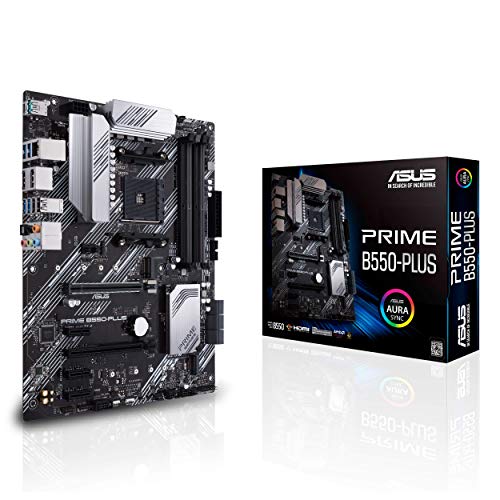
ASUS Prime AM4 ATX Motherboard
Best for: full-size ATX AM4 desktop builds
- Ethernet Speed
- 1GbE (what this guide is about)
- CPU Socket
- AM4
- Form Factor
- ATX
- PCIe Version
- PCIe 4.0
- M.2 Slots
- 2
- Dimensions
- 12.9 × 10.4 × 2.09 inches
This ASUS Prime board gives you an ATX build option centered on the AMD AM4 socket and PCIe 4.0 connectivity. It features a 1Gb LAN port for wired networking, dual M.2 slots for solid-state storage, and dedicated VRM and chipset heatsinks. Display outputs include HDMI 2.1 and DisplayPort 1.2. It suits you if you want a full-size platform for a Ryzen 5000 or 3rd Gen Ryzen processor without moving to compact cases.
Pros
- 1Gb LAN port with LANGuard hardware protection
- PCIe 4.0 x16 slot and dual M.2 NVMe storage slots
- Dedicated VRM and chipset heatsinks
- HDMI 2.1 and DisplayPort 1.2 video outputs
Cons
- No integrated wireless networking listed
- Limits wired transfer speeds to standard 1GbE
Good fit if
- You want a full-size ATX board for a Ryzen 5000 or 3rd Gen CPU.
- You rely on a standard 1GbE wired Ethernet connection.
- You plan to install dual M.2 NVMe solid-state drives.
Skip if
- You need built-in Wi-Fi out of the box.
- You require multi-gigabit LAN speeds higher than 1GbE.
- You build inside a compact microATX or Mini-ITX case.
Verdict: ASUS Prime B550 ATX AM4 Motherboard delivers standard 1GbE networking, PCIe 4.0 support, and dual M.2 slots on a full-size ATX layout. It provides essential connectivity and solid cooling for AM4-based Ryzen systems.

ASRock Micro-ATX AM4 Motherboard
Best for: basic AM4 builds with legacy display needs
- Ethernet Speed
- 1GbE (what this guide is about)
- CPU Socket
- AM4
- Form Factor
- Micro-ATX
- Memory Type
- DDR4
- PCIe Version
- PCIe 4.0
- M.2 Slots
- 1
This micro-ATX board provides a standard 1GbE LAN port for dependable wired networking alongside an AM4 socket for AMD Ryzen 3000, 4000, and 5000 series processors. You get a PCIe 4.0 x16 slot, one M.2 slot, and four SATA3 connectors for your drives. It suits you if you need a compact, baseline setup with HDMI, DVI-D, and VGA video outputs for legacy or multi-monitor desktop configurations.
Pros
- Gigabit LAN port with integrated electrical spike protection
- PCIe 4.0 x16 slot for modern graphics cards
- Three display outputs: HDMI, DVI-D, and VGA
- Hyper M.2 slot supporting both PCIe Gen4x4 and SATA3 modes
Cons
- Provides only two DDR4 memory slots
- Limited to a single M.2 storage slot
Good fit if
- You need 1GbE networking paired with legacy VGA or DVI-D monitor outputs.
- You run an AMD Ryzen 3000, 4000, or 5000 series processor in a micro-ATX case.
- You only require two DDR4 memory modules and one M.2 drive.
Skip if
- You need more than one M.2 slot for high-speed solid-state storage.
- You plan to install four DDR4 DIMM modules for higher memory capacity.
Verdict: ASRock AM4 Micro-ATX Motherboard delivers core 1GbE connectivity and PCIe 4.0 capability in a compact footprint. It serves straightforward AM4 desktop configurations that do not require multiple M.2 drives or four RAM slots.

Gigabyte AM4 Micro-ATX Motherboard
Best for: compact AM4 builds with 1GbE networking
- Ethernet Speed
- 1GbE (what this guide is about)
- CPU Socket
- AM4
- Form Factor
- MicroATX
- Memory Type
- DDR4
- PCIe Version
- PCIe 3.0
- M.2 Slots
- 1
This GIGABYTE board gives you a compact Micro-ATX platform built around the AMD AM4 socket. It features standard 1GbE LAN for dependable wired networking alongside a single PCIe 3.0 x16 expansion slot. Storage runs through one NVMe PCIe 3.0 x4 M.2 slot and dual-channel DDR4 memory across two DIMMs. It suits you if you need a focused, basic gaming setup with wired connectivity.
Pros
- Integrated 1GbE LAN port
- NVMe PCIe 3.0 x4 M.2 slot
- Compact Micro-ATX form factor
- 4+3 phases digital PWM power delivery
Cons
- Limited to two DDR4 DIMM slots
- Only one M.2 storage slot
- Uses PCIe 3.0 rather than PCIe 4.0
Good fit if
- You build an AMD AM4 system with standard 1GbE networking.
- You need a compact Micro-ATX board with a single PCIe 3.0 x16 slot.
- You plan to use no more than two DDR4 memory modules.
Skip if
- You need four memory slots for higher DDR4 capacity.
- You require multiple M.2 solid-state drives.
- You want PCIe 4.0 interface support.
Verdict: GIGABYTE Micro-ATX AM4 Motherboard provides essential 1GbE wired connectivity and core AM4 support in a space-saving footprint. It serves as a sensible foundation when your build requires only two memory sticks and a single NVMe drive.

GIGABYTE AM4 Multi-Display Motherboard
Best for: AM4 builds needing triple display outputs
- Ethernet Speed
- 1GbE (what this guide is about)
- CPU Socket
- AM4
- Memory Type
- DDR4
- PCIe Version
- PCIe 3.0
- Power Phases
- 4+3
- Dimensions
- 8.07 × 9.61 × 1.38 inches
This board provides an AM4 socket for AMD Ryzen processors alongside a 1GbE gaming network connection with bandwidth management. You get two DDR4 DIMM slots, an NVMe PCIe 3.0 x4 M.2 connector, and a 4+3 phase digital VRM. With HDMI, DVI-D, and D-sub outputs, it handles multi-display setups directly from compatible processors. It suits you if you need a straightforward AM4 platform for daily work or entry-level gaming.
Pros
- Includes HDMI, DVI-D, and D-sub video outputs
- Features 1GbE network connection with bandwidth management
- Equipped with an NVMe PCIe 3.0 x4 M.2 connector
- Supports addressable LEDs and RGB strips via RGB FUSION 2.0
Cons
- Limited to two DDR4 DIMM memory slots
- Restricted to PCIe 3.0 data transfer speeds
- Offers only a single M.2 storage connector
Good fit if
- You need multiple display outputs including D-sub and DVI-D.
- You plan to run an AMD Ryzen 3000, 4000, or 5000 series processor.
- You want a wired 1GbE network connection with bandwidth management.
Skip if
- You require PCIe 4.0 or faster expansion bandwidth.
- You need more than two DDR4 slots for memory expansion.
- You want built-in Wi-Fi connectivity.
Verdict: GIGABYTE AM4 DDR4 Motherboard delivers essential AM4 connectivity with 1GbE networking and flexible triple display options. It gives you a reliable base for standard computing tasks and basic Ryzen system configurations.

GIGABYTE Gaming X V2 AM4 ATX Motherboard
Best for: wired AMD AM4 desktop gaming builds
- Ethernet Speed
- 1GbE (what this guide is about)
- CPU Socket
- AM4
- Form Factor
- ATX
- Memory Type
- DDR4
- PCIe Version
- PCIe 4.0
- M.2 Slots
- 2
This Gigabyte ATX board pairs AMD B550 architecture with standard 1GbE wired networking for AM4 builds. You get an AM4 socket supporting Ryzen 3000, 4000, and 5000 series processors, alongside four DDR4 memory slots. Expansion includes a PCIe 4.0 x16 slot, one PCIe 4.0 M.2 connector, and a second M.2 slot operating at PCIe 3.0. It suits desktop builders who want reliable Gigabit Ethernet and full-sized ATX spacing.
Pros
- Digital Twin 10+3 power phase design with VRM heatsink
- Dedicated PCIe 4.0 x16 expansion slot and PCIe 4.0 M.2 connector
- Integrated 1GbE LAN and Bluetooth 5.3 connectivity
- Q-Flash Plus allows BIOS updates without CPU, RAM, or GPU
Cons
- Second M.2 storage slot is limited to PCIe 3.0 bandwidth
- No integrated Wi-Fi networking included
- Restricted to DDR4 memory rather than DDR5
Good fit if
- You build with an AMD Ryzen 3000, 4000, or 5000 series processor.
- You rely on a wired 1GbE connection and need four DDR4 RAM slots.
- You want full ATX spacing with dedicated PCIe 4.0 support.
Skip if
- You plan to build on the newer AM5 socket with DDR5 memory.
- You require integrated Wi-Fi networking out of the box.
- You need two PCIe 4.0 M.2 solid-state drive slots.
Verdict: Gigabyte B550 Gaming ATX Motherboard provides steady 1GbE networking, four DDR4 slots, and PCIe 4.0 support for AM4 systems. It delivers a solid full-sized foundation if you prioritize wired networking and multi-drive storage.
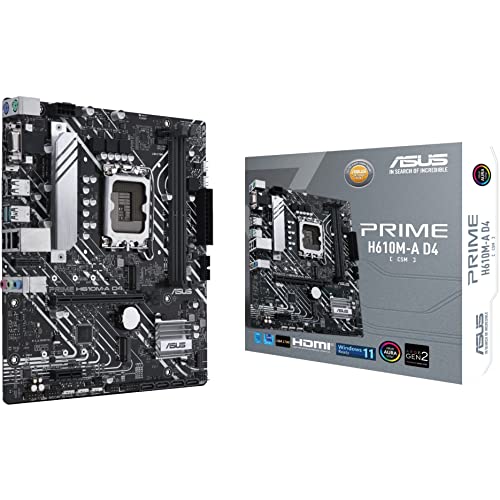
ASUS Prime Micro-ATX DDR4 Motherboard
Best for: commercial 12th Gen Intel business workstations
- Ethernet Speed
- 1GbE (what this guide is about)
- CPU Socket
- LGA 1700
- Chipset
- H610
- Form Factor
- Micro-ATX
- Memory Type
- DDR4
- PCIe Version
- PCIe 4.0
This micro-ATX board features an Intel LGA 1700 socket paired with an Intel 1 Gb Ethernet port for wired local networking. It supports 12th Gen Intel Core processors and uses DDR4 memory alongside PCIe 4.0 expansion and dual M.2 slots. Built for commercial deployments, it includes hardware-monitoring tools such as ASUS Control Center Express and self-recovering BIOS technology. This setup fits your workspace if you require standard 1GbE connectivity and corporate IT management.
Pros
- Intel 1 Gb Ethernet port
- PCIe 4.0 support with two M.2 slots
- Rear USB 3.2 Gen 2 Type-A port
- Self-recovering BIOS and dedicated LPC debug header
- Moisture-resistant protective coating
Cons
- Limited to DDR4 memory rather than DDR5
- CPU support specified only for 12th Gen Intel processors
- Network bandwidth capped at 1GbE
Good fit if
- You need a commercial LGA 1700 board with Intel 1 Gb Ethernet connectivity.
- You plan to build a micro-ATX system using 12th Gen Intel processors and DDR4 RAM.
- You require IT management features like ASUS Control Center Express and a self-recovering BIOS.
Skip if
- You require network speeds faster than 1GbE.
- You plan to use DDR5 memory.
- You need an AMD processor platform.
Verdict: ASUS Prime Micro-ATX LGA 1700 Motherboard delivers reliable 1GbE networking and commercial monitoring tools for 12th Gen Intel systems on DDR4 memory. It serves as a dependable micro-ATX foundation for business endpoints.

GIGABYTE Micro-ATX AM4 DDR4 Motherboard
Best for: compact AM4 builds with 1GbE networking
- Ethernet Speed
- 1GbE (what this guide is about)
- CPU Socket
- AM4
- Chipset
- B550
- Form Factor
- Micro-ATX
- Memory Type
- DDR4
- PCIe Version
- PCIe 4.0
This Micro-ATX board pairs AMD AM4 socket support with 1GbE wired networking. It features four DDR4 memory slots, a PCIe 4.0 x16 slot, and two M.2 connectors, including one PCIe 4.0 interface. Built with a 3+3 digital VRM design and chipset heatsinks, it handles Ryzen 5000, 4000, and 3000 series processors. It suits you if you need compact AM4 expansion with reliable Gigabit LAN and dual solid-state drives.
Pros
- Integrated 1GbE wired network port
- PCIe 4.0 support on the primary x16 and M.2 slots
- Four DDR4 DIMM slots with XMP support
- Dual M.2 slots for multiple storage drives
Cons
- No integrated Wi-Fi
- Modest 3+3 power phase design
- Secondary M.2 slot runs at PCIe 3.0 speeds
Good fit if
- You build with a Ryzen 3000, 4000, or 5000 series AM4 processor.
- You need 1GbE wired networking and room for four DDR4 memory sticks.
- You want two onboard M.2 storage slots in a Micro-ATX case.
Skip if
- You require built-in Wi-Fi out of the box.
- You need a heavier power delivery design than 3+3 phases.
Verdict: GIGABYTE B550 Micro-ATX Motherboard provides reliable 1GbE networking, four DDR4 slots, and dual M.2 storage on the AM4 platform. It is a straightforward option for wired Micro-ATX setups that do not require onboard wireless.

GIGABYTE Micro-ATX Intel LGA 1700 Motherboard
Best for: basic Intel LGA 1700 DDR4 builds
- Ethernet Speed
- 1GbE (what this guide is about)
- CPU Socket
- LGA 1700
- Chipset
- H610
- Form Factor
- Micro ATX
- Memory Type
- DDR4
- PCIe Version
- PCIe 4.0
View on Amazon: GIGABYTE Micro-ATX Intel LGA 1700 Motherboard
This Gigabyte board is a Micro-ATX platform designed for 12th and 13th Generation Intel Core processors on the LGA 1700 socket. It features a Realtek 1GbE network interface for steady wired connections, alongside dual-channel DDR4 memory support across two DIMM slots. With a PCIe 4.0 expansion slot and a PCIe 3.0 x4 M.2 connector, it suits you if you need a standard, compact desktop build for daily computing.
Pros
- Realtek 1GbE LAN port
- Supports 12th and 13th Gen Intel Core processors
- PCIe 4.0 primary expansion support
- 6+1+1 hybrid digital VRM design
Cons
- Limited to two DDR4 DIMM memory slots
- Only one NVMe PCIe 3.0 x4 M.2 connector
Good fit if
- You want a dedicated Realtek 1GbE wired network port.
- You use a 12th or 13th Gen Intel Core CPU on the LGA 1700 socket.
- You plan to build with DDR4 memory in a Micro-ATX chassis.
Skip if
- You require more than two DDR4 memory slots for your setup.
- You need multiple onboard M.2 solid-state drive slots.
Verdict: Gigabyte Intel LGA 1700 Micro-ATX Motherboard provides essential Realtek 1GbE connectivity and PCIe 4.0 support for entry-level Intel desktop builds. It offers a straightforward layout for users working with DDR4 memory and a single M.2 drive.

GIGABYTE AORUS Elite Micro-ATX AM4 Motherboard
Best for: compact AM4 builds needing 1GbE and Wi-Fi
- Ethernet Speed
- 1GbE (what this guide is about)
- CPU Socket
- AM4
- Form Factor
- mATX
- Memory Type
- DDR4
- PCIe Version
- PCIe 4.0
- M.2 Slots
- 2
View on Amazon: GIGABYTE AORUS Elite Micro-ATX AM4 Motherboard
This Micro-ATX motherboard pairs AMD AM4 socket support with a 1GbE LAN port and onboard Wi-Fi 6E. It features a digital 5+3 power phase design, four DDR4 memory slots, and one PCIe 4.0 x16 expansion slot. Storage options include one PCIe 4.0 M.2 slot and one PCIe 3.0 M.2 connector. It suits you if you want compact Ryzen 5000-series hardware with reliable wired networking and current wireless connectivity.
Pros
- Integrated 1GbE LAN and Wi-Fi 6E with Bluetooth 5.3
- PCIe 4.0 support on the primary x16 slot and main M.2 connector
- Four DDR4 DIMM slots with XMP memory support
- Q-Flash Plus enables BIOS updates without installing a CPU or RAM
Cons
- Secondary M.2 slot is limited to PCIe 3.0 speeds
- Restricted to older DDR4 RAM instead of DDR5
- Includes only two USB 3.2 Gen 1 ports
Good fit if
- You need a 1GbE Ethernet connection alongside Wi-Fi 6E wireless
- You plan to run an AMD Ryzen 3000, 4000, or 5000 series CPU with DDR4
- You want a Micro-ATX board with dual M.2 solid-state drive slots
Skip if
- You require 2.5GbE or faster wired networking speeds
- You are building a newer platform that requires an AM5 socket and DDR5
- You need both M.2 slots to run at PCIe 4.0 bandwidth
Verdict: Gigabyte Aorus Elite AM4 Micro-ATX Motherboard provides a solid foundation with 1GbE networking, Wi-Fi 6E, and PCIe 4.0 for Ryzen desktop builds. It offers practical expansion in a compact form factor without moving to newer socket architectures.

GIGABYTE Mini-ITX DDR5 Intel Motherboard
Best for: compact DDR5 Intel builds needing 1GbE LAN
- Ethernet Speed
- 1GbE (what this guide is about)
- CPU Socket
- LGA 1700
- Chipset
- H610
- Form Factor
- Mini-ITX
- Memory Type
- DDR5
- PCIe Version
- PCIe 4.0
This GIGABYTE Mini-ITX board provides a compact LGA 1700 platform designed for 12th and 13th Gen Intel processors. It pairs an Intel 1GbE LAN controller with two DDR5 memory slots and a PCIe 4.0 expansion slot. If you are building a small-form-factor desktop that requires standard gigabit networking and modern memory support without taking up excess chassis space, this board fits your setup.
Pros
- Intel 1GbE LAN network connection
- Compact Mini-ITX form factor
- DDR5 memory support across two DIMM slots
- PCIe 4.0 hardware interface
Cons
- Single M.2 slot restricted to PCIe 3.0 x4
- Two DIMM slots limit memory expansion
- 4+1+1 power phase design
Good fit if
- You need a Mini-ITX board with an Intel 1GbE network interface.
- You plan to run 12th or 13th Gen Intel CPUs with DDR5 memory.
- You only require a single NVMe M.2 drive for storage.
Skip if
- You need multiple M.2 slots for storage.
- You require PCIe 4.0 speeds on your NVMe storage drives.
Verdict: GIGABYTE Mini-ITX Intel DDR5 Motherboard delivers 1GbE connectivity and DDR5 compatibility in a space-saving footprint. It offers a straightforward base for compact 12th and 13th Gen Intel builds that rely on a single M.2 drive.
Specifications side by side
| Spec | Biostar Intel H310 Micro-ATX Motherboard | ASUS ROG Strix AM4 ATX Motherboard | GIGABYTE Eagle ATX AM5 Motherboard | MSI MPG Micro-ATX Wi-Fi Motherboard | ASUS Prime Micro-ATX Commercial Motherboard | ASUS Prime AM4 ATX Motherboard | ASRock Micro-ATX AM4 Motherboard | Gigabyte AM4 Micro-ATX Motherboard | GIGABYTE AM4 Multi-Display Motherboard | GIGABYTE Gaming X V2 AM4 ATX Motherboard | ASUS Prime Micro-ATX DDR4 Motherboard | GIGABYTE Micro-ATX AM4 DDR4 Motherboard | GIGABYTE Micro-ATX Intel LGA 1700 Motherboard | GIGABYTE AORUS Elite Micro-ATX AM4 Motherboard | GIGABYTE Mini-ITX DDR5 Intel Motherboard |
|---|---|---|---|---|---|---|---|---|---|---|---|---|---|---|---|
| CPU Socket | not specified | AM4 | AM5, LGA 1718 | LGA 1200 | AM4 | AM4 | AM4 | AM4 | AM4 | AM4 | LGA 1700 | AM4 | LGA 1700 | AM4 | LGA 1700 |
| Chipset | Intel H310 | AMD X570 | B650 | Z490 | not specified | not specified | not specified | not specified | not specified | not specified | H610 | B550 | H610 | not specified | H610 |
| Form Factor | MicroATX | ATX | ATX | Micro-ATX | Micro ATX | ATX | Micro-ATX | MicroATX | not specified | ATX | Micro-ATX | Micro-ATX | Micro ATX | mATX | Mini-ITX |
| Memory Type | not specified | DDR4 | DDR5 | DDR4 | not specified | not specified | DDR4 | DDR4 | DDR4 | DDR4 | DDR4 | DDR4 | DDR4 | DDR4 | DDR5 |
| PCIe Version | not specified | PCIe 4.0 | PCIe 5.0, PCIe 4.0 | not specified | PCIe 4.0 | PCIe 4.0 | PCIe 4.0 | PCIe 3.0 | PCIe 3.0 | PCIe 4.0 | PCIe 4.0 | PCIe 4.0 | PCIe 4.0 | PCIe 4.0 | PCIe 4.0 |
| M.2 Slots | not specified | 2 | 3 | not specified | not specified | 2 | 1 | 1 | not specified | 2 | 2 | 2 | 1 | 2 | 1 |
| Wi-Fi Standard | not specified | not specified | Wi-Fi 6E | Wi-Fi 6 | not specified | not specified | not specified | not specified | not specified | not specified | not specified | not specified | not specified | Wi-Fi 6E | not specified |
| Ethernet Speed | Gigabit LAN | Gigabit | GbE | Gigabit, 2.5G | 1Gb LAN | 1Gb LAN | Gigabit LAN | 1GbE | GbE | GbE | 1 Gb | GbE | 1 GbE | GbE | GbE |
| Power Phases | not specified | not specified | 12+2+2 | not specified | not specified | not specified | 6 | 4+3 | 4+3 | 10+3 | not specified | 3+3 | 6+1+1 | 5+3 | 4+1+1 |
| Wi-Fi | not specified | not specified | Wi-Fi 6E | Wi-Fi 6 | not specified | not specified | not specified | not specified | not specified | not specified | not specified | not specified | not specified | Wi-Fi 6E | not specified |
| Use Case | not specified | Gaming | not specified | Gaming | Commercial | not specified | not specified | Gaming | not specified | Gaming | Commercial | not specified | not specified | not specified | not specified |
| Dimensions | 0.98 × 8.9 × 6.73 inches | 13.3 × 10.7 × 2.68 inches | 3.23 × 10.7 × 13.4 inches | 9.6 × 9.6 × 2 inches | 10.4 × 2.03 × 10.6 inches | 12.9 × 10.4 × 2.09 inches | 11 × 9.5 × 2.5 inches | 10.4 × 9.25 × 2.04 inches | 8.07 × 9.61 × 1.38 inches | 10.6 × 3.14 × 13.2 inches | 8.3 × 9.6 × 3 inches | 10.4 × 10.4 × 2.12 inches | 10.4 × 10.4 × 2.13 inches | 9.61 × 9.61 × 1.38 inches | 8.74 × 7.09 × 2.56 inches |
| Weight | 1.34 pounds | 2.2 pounds | 3.87 pounds | 4.41 pounds | 1.31 pounds | 2.09 pounds | 1.54 pounds | 15.5 ounces | 1.01 pounds | 3.26 pounds | 2.12 pounds | 1.68 pounds | not specified | not specified | 1.3 pounds |
| Model | H310MHP 3.0 | ROG STRIX X570-F GAMING | B650 EAGLE AX | MPG Z490M GAMING EDGE WIFI | PRIME B550M-A/CSM | PRIME B550-PLUS | B550M-HDV | A520M S2H | A520M S2H | B550 GAMING X V2 | ROG MAXIMUS Z690 EXTREME | B550M K | H610M S2H V2 DDR4 | B550M AORUS ELITE AX | H610I |
| Size | not specified | ROG X570-F|DDR4|WiFi | ATX | mATX | Micro ATX | ATX | not specified | Pack of 1 | Standard | ATX | Micro-ATX | DDR4 | mATX | not specified | mATX | not specified |
| Color | not specified | not specified | Black | not specified | not specified | not specified | not specified | Multicolor | Black | not specified | not specified | Multicolor | Multicolor | not specified | not specified |
Is 1GbE Networking Worth It?
Standard 1GbE wired networking provides a steady local connection running at gigabit transfer rates. This wired interface supports routine gaming, business tasks, and daily internet access without depending on wireless signal stability. Motherboards with 1GbE appear across platforms from older Intel sockets to modern AMD AM5 builds. Choosing 1GbE gives you a dedicated LAN port suited for typical home or workplace routers. It delivers reliable physical connectivity whenever your local network infrastructure operates within standard gigabit limits.
Worth it if
- You connect directly to standard gigabit routers or switches for daily tasks and gaming.
- You prefer a dependable wired Ethernet connection over wireless connectivity.
- You choose AM4, AM5, or Intel platforms that match standard gigabit local network hardware.
Skip it if
- You run a high-speed network environment that requires 2.5GbE or faster transfer rates.
- You connect to networks exclusively over Wi-Fi and do not plug in Ethernet cables.
How We Selected 1GbE Motherboards
You find motherboards with 1GbE networking selected directly from published technical specifications. A model is included when its Amazon listing explicitly identifies 1GbE Ethernet speed in the product title or feature bullet points. Each entry represents an individual product line, showing only one variant per family. All product details come directly from official specifications without physical handling.
The guide lists products in stock first, then by Amazon sales rank, placing better-selling products first. Published hardware specifications like form factor, CPU socket, and memory type help you evaluate the right model across the 15 picks. Availability details refresh at least daily on the page.
How to Choose a 1GbE Motherboard
-
Check Case Form Factor
You need to confirm that your PC case matches the motherboard form factor. Full-size ATX boards offer more expansion slots and surface area for components, requiring standard mid-tower or full-tower chassis. Micro-ATX boards use a squarer footprint that fits inside compact enclosures while preserving essential expansion slots. If you plan to build a small desktop, check the chassis specifications before deciding. For example, the Biostar Intel H310 Micro-ATX Motherboard fits into smaller cases that cannot accommodate larger ATX alternatives.
-
Compare PCIe Generation Standards
Check the PCIe revision on the motherboard specifications to ensure proper throughput for expansion cards and high-speed storage. Motherboards with PCIe 3.0 provide baseline bandwidth for entry-level builds. Upgrading to PCIe 4.0 doubles that lane bandwidth, which benefits newer graphics cards and faster solid-state drives. Advanced motherboards even support PCIe 5.0 lanes for high-speed hardware. For instance, the GIGABYTE Eagle ATX AM5 Motherboard features both PCIe 5.0 and PCIe 4.0 support, giving you modern expansion headroom compared to older PCIe 3.0 hardware configurations.
-
Evaluate Integrated Wireless Needs
While every motherboard here includes standard 1GbE wired networking, you should verify whether you also need onboard wireless connectivity. Purely wired boards require a physical network cable to access local networks and the internet. If you cannot route an Ethernet line to your desk, pick a board with built-in Wi-Fi. Generations range from older Wi-Fi 5 to newer Wi-Fi 6 and Wi-Fi 6E standards. For example, the GIGABYTE AORUS Elite Micro-ATX AM4 Motherboard integrates Wi-Fi 6E, offering modern wireless connectivity alongside its primary 1GbE Ethernet port.
-
Review Commercial Management Capabilities
Identify whether your system serves general home computing or a dedicated business deployment. Commercial motherboards prioritize stability, remote IT monitoring tools, and specialized hardware safeguards designed for enterprise offices. Gaming motherboards emphasize enhanced thermal cooling, audio solutions, and multi-slot expansion. If you manage networked office PCs, look for specific commercial management features in the listing specs. The ASUS Prime Micro-ATX Commercial Motherboard, for instance, includes remote IT management tools built specifically for stable workplace workstations running continuous business software over local 1GbE networks.
-
Verify Multi-Monitor Video Outputs
If you plan to use an integrated processor GPU instead of a discrete graphics card, inspect the rear I/O display ports. Standard motherboards provide one or two video outputs, which limits multi-monitor desktop configurations. Specialized models include three video connections, allowing you to run several screens directly from processor graphics. For multi-display productivity workstations, review the exact display ports specified on the listing. For example, the GIGABYTE AM4 Multi-Display Motherboard provides triple display outputs, letting you hook up three monitors simultaneously without installing a dedicated expansion graphics card.
-
Assess Storage Expansion Slots
Evaluate how many solid-state drives your setup requires before selecting a board. Basic motherboards often supply only a single M.2 slot, which limits future drive additions unless you use SATA cables. Higher-tier models incorporate dual M.2 slots, often equipped with heatsinks to keep operating temperatures regulated under sustained data transfers. If your workload involves handling large media files or multiple operating systems across separate drives, check the drive slot count. For example, the ASUS Prime AM4 ATX Motherboard includes dual M.2 slots alongside its standard 1GbE networking layout.
Frequently asked questions
Can a 1GbE motherboard handle online gaming?
Yes, a 1GbE motherboard handles competitive online gaming without issues. Most multiplayer titles require low latency rather than massive bandwidth, usually using under ten megabits per second. The ASUS ROG Strix AM4 ATX Motherboard and the MSI MPG Micro-ATX Wi-Fi Motherboard pair dedicated 1GbE networking with gaming-oriented chipsets to maintain stable wired connections during play.
Do motherboards with 1GbE ports also support Wi-Fi?
Some 1GbE motherboards include built-in Wi-Fi, while others rely solely on wired Ethernet. For example, the GIGABYTE Eagle ATX AM5 and GIGABYTE AORUS Elite Micro-ATX AM4 feature integrated Wi-Fi 6E alongside 1GbE. The MSI MPG Micro-ATX provides Wi-Fi 6. However, standard options like the ASUS Prime AM4 ATX Motherboard provide only the wired 1GbE interface.
Can you run DDR5 memory on a 1GbE motherboard?
Yes, you can run DDR5 memory on select 1GbE motherboards. While many 1GbE models rely on DDR4 memory, modern boards support DDR5. For example, the GIGABYTE Eagle ATX AM5 Motherboard and the GIGABYTE Mini-ITX DDR5 Intel Motherboard both feature standard 1GbE wired connectivity alongside DDR5 memory support for current-generation processor architectures.
What Ethernet cable is required for a 1GbE motherboard?
You need a Category 5e (Cat 5e) or Category 6 (Cat 6) Ethernet cable to achieve full 1GbE speeds. Both cable standards support bandwidth up to 1000 megabits per second over runs up to 100 meters. Plugging either cable into your 1GbE motherboard port and a gigabit router will deliver maximum rated local network speeds.
Are 1GbE motherboards available in the Mini-ITX form factor?
Yes, you can find 1GbE networking on Mini-ITX motherboards. The GIGABYTE Mini-ITX DDR5 Intel Motherboard pairs an integrated 1GbE LAN port with an ultra-compact footprint measuring 7.09 by 8.74 inches. This configuration lets you build space-saving small-form-factor systems on the LGA 1700 platform without needing larger micro-ATX or ATX motherboard dimensions.
Will a 1GbE motherboard limit your internet download speeds?
A 1GbE motherboard will only limit your download speed if your internet plan exceeds 1 gigabit per second. The integrated 1GbE controller maxes out at theoretical speeds of 1000 Mbps. For internet tiers at or below 1 Gbps, the motherboard accommodates your connection completely without causing a hardware bottleneck on your downloads.
Which PCIe generations are supported on 1GbE motherboards?
PCIe support varies by motherboard model rather than the 1GbE network port. For example, the Gigabyte AM4 Micro-ATX Motherboard uses PCIe 3.0. In contrast, boards like the ASRock Micro-ATX AM4 Motherboard support PCIe 4.0. The GIGABYTE Eagle ATX AM5 Motherboard provides both PCIe 4.0 and PCIe 5.0 lanes while maintaining standard 1GbE Ethernet.