Best Motherboards Under $500: 8 Spec-Based Picks
As an Amazon Associate we earn from qualifying purchases. Links on this page are affiliate links.
Selecting the best motherboard under 500 requires balancing socket compatibility, expansion slots, and thermal designs for your specific hardware. We compared 8 models based on the specifications published on the listings to identify clear hardware trade-offs. The Supermicro Mini-ITX Intel Xeon Motherboard leads the list because it includes a built-in eight-core processor and supports up to 128GB of ECC memory on a compact Mini-ITX board.
This guide helps you decide which socket type, DDR memory standard, and PCIe generation fit your processing requirements and chassis size.
Quick picks
The best fit for you
- You need a compact low-power server build Supermicro Mini-ITX Intel Xeon Motherboard Its Mini-ITX form factor features an integrated eight-core processor and supports up to 128GB of ECC memory.
- You want an Intel LGA 1700 desktop build MSI MPG Z790 Edge WiFi ATX Motherboard It provides an LGA 1700 socket, DDR5 memory support, PCIe 5.0 bandwidth, and 2.5GbE Ethernet.
- You need an AM5 setup with USB4 connectivity ASUS ROG Crosshair X670E ATX Motherboard It features dual USB4 ports, an AM5 socket, DDR5 memory support, and PCIe 5.0 storage compatibility.
- You want an AM4 gaming board with wireless networking GIGABYTE X570 AORUS Elite Wi-Fi ATX Motherboard It provides integrated Wi-Fi 5, an AMD X570 chipset, PCIe 4.0 support, and DDR4 memory compatibility.
Our 8 picks

Supermicro Mini-ITX Intel Xeon Motherboard
Best for: compact low-power ECC server builds
- Chipset
- System on Chip
- Form Factor
- Mini-ITX
- Memory Type
- DDR4
- Dimensions
- 7 × 7 × 2.5 inches
This Supermicro Mini-ITX board includes an integrated eight-core Intel Xeon D-1540 processor with a 45W TDP. It features four DDR4 memory slots supporting up to 128GB of ECC registered RAM, along with six onboard SATA3 ports. If you build compact, low-power network servers or storage nodes requiring enterprise-grade memory support in a small footprint, this integrated platform suits your setup.
Pros
- Includes an integrated eight-core Intel Xeon D-1540 processor with 45W TDP
- Supports up to 128GB ECC/REG DDR4 memory across four DIMM slots
- Provides six SATA3 ports via the integrated SoC
- Compact Mini-ITX form factor measuring 6.7 by 6.7 inches
Cons
- Processor is integrated and cannot be upgraded
- Memory speeds max out at DDR4-2133
- Unbuffered memory capacity capped at 64GB
Good fit if
- You need an embedded eight-core Xeon processor with low 45W power consumption.
- You require ECC registered DDR4 memory support up to 128GB in a Mini-ITX chassis.
- You plan to connect up to six drives via onboard SATA3 ports.
Skip if
- You want an interchangeable CPU socket to upgrade your processor later.
- You need memory speeds beyond DDR4-2133.
Verdict: Supermicro Mini-ITX Intel Xeon Motherboard provides a space-efficient server foundation with its built-in eight-core processor and support for 128GB of ECC memory. It delivers reliable multi-drive SATA connectivity for low-draw deployments.

ASUS ROG Strix AM4 ATX Motherboard
Best for: AM4 builds needing reliable 1GbE networking
- CPU Socket
- AM4
- Chipset
- AMD X570
- Form Factor
- ATX
- Memory Type
- DDR4
- PCIe Version
- PCIe 4.0
- M.2 Slots
- 2
This ATX board pairs an AMD X570 chipset and AM4 socket with PCIe 4.0 expansion for your storage and graphics cards. You get dual M.2 slots with dedicated heatsinks, USB 3.2 Gen 2 ports, and Intel Gigabit Ethernet. It handles second- and third-generation Ryzen processors directly, though Ryzen 5000 chips require a BIOS update. You will find it suits your build if you run DDR4 memory and standard 1GbE wired networking.
Pros
- Intel Gigabit Ethernet with LANGuard protection
- PCIe 4.0 support across dual M.2 slots and expansion slots
- Active PCH heatsink and MOS heatsink with 8mm heat pipe
- USB 3.2 Gen 2 Type-A and Type-C connectivity
Cons
- Networking caps out at 1GbE speeds
- Requires a BIOS update to support Ryzen 5000 series processors
- Limited to DDR4 memory
Good fit if
- You run an AMD AM4 processor and DDR4 memory modules.
- You need PCIe 4.0 bandwidth for graphics and dual M.2 storage.
- You rely on a reliable 1GbE wired network connection.
Skip if
- You need network speeds higher than 1GbE.
- You plan to build with DDR5 memory.
- You want out-of-the-box Ryzen 5000 support without updating the BIOS.
Verdict: ASUS ROG Strix AM4 ATX Motherboard delivers dependable PCIe 4.0 connectivity, dual heatsink-cooled M.2 slots, and stable 1GbE networking for AM4 gaming builds. It gives you balanced DDR4 platform specs if you do not require multi-gigabit LAN speeds.

MSI MPG X570 Gaming Plus ATX Motherboard
Best for: AM4 Ryzen builds needing PCIe 4.0
- CPU Socket
- AM4
- Chipset
- AMD X570
- Form Factor
- ATX
- Memory Type
- DDR4
- PCIe Version
- PCIe 4.0
- Dimensions
- 12 × 9.6 × 2.5 inches
The MSI MPG X570 Gaming Plus is an ATX board built on the AMD X570 chipset and AM4 socket. You get PCIe 4.0 support, DDR4 memory speeds up to 4400 MHz (OC), and M.2 storage connectivity. Cooling relies on a dedicated Frozr heatsink fan for the chipset. It fits you if you run 2nd or 3rd Gen AMD Ryzen processors and need standard ATX expansion.
Pros
- PCIe 4.0 expansion support
- DDR4 memory support up to 4400+ MHz (OC)
- Pre-installed I/O shield for ESD protection
- Frozr heatsink with propeller blade fan and double ball bearings
Cons
- No integrated Wi-Fi listed in specifications
- Active chipset cooling fan required for operation
Good fit if
- You use an AM4 2nd or 3rd Gen AMD Ryzen processor.
- You need PCIe 4.0 throughput alongside DDR4 memory support.
Skip if
- You require factory-integrated Wi-Fi.
- You plan to build with an Intel CPU or DDR5 RAM.
Verdict: MSI MPG X570 Gaming Plus ATX Motherboard provides PCIe 4.0 connectivity and high-speed DDR4 support for AM4 desktop systems. It delivers core X570 capabilities with dedicated active chipset cooling.
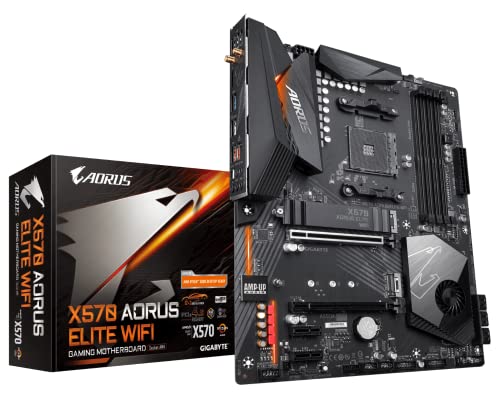
GIGABYTE X570 AORUS Elite Wi-Fi ATX Motherboard
Best for: AMD Ryzen DDR4 builds needing Wi-Fi 5
- Chipset
- X570
- Form Factor
- ATX
- Memory Type
- DDR4
- PCIe Version
- PCIe 4.0
- M.2 Slots
- 2
- Wi-Fi Standard
- 802.11ac
View on Amazon: GIGABYTE X570 AORUS Elite Wi-Fi ATX Motherboard
The GIGABYTE X570 AORUS Elite Wi-Fi is an ATX motherboard built on the AMD X570 chipset. It supports AMD 2nd and 3rd Gen Ryzen processors and features PCIe 4.0 support alongside integrated Wi-Fi 5. With four DDR4 DIMM slots, dual M.2 slots, and a 12+2 phase digital VRM, it suits you when you build a compatible AM4 gaming setup.
Pros
- 12+2 phases digital VRM solution with DrMOS
- Dual NVMe PCIe 4.0/3.0 x4 M.2 slots with one thermal guard
- Built-in Intel Dual Band 802.11ac Wi-Fi
- Four DDR4 DIMM slots supporting dual-channel memory
Cons
- Wireless connectivity limited to Wi-Fi 5 standard
- Includes a thermal guard for only one of the two M.2 slots
Good fit if
- You use an AMD 2nd or 3rd Gen Ryzen processor.
- You need an ATX motherboard with built-in Wi-Fi 5 and PCIe 4.0 support.
- You plan to install dual-channel DDR4 memory across up to four slots.
Skip if
- You require newer Wi-Fi 6 or Wi-Fi 6E networking standards.
- You want integrated heatsinks for both M.2 slots.
Verdict: GIGABYTE X570 AORUS Elite Wi-Fi ATX Motherboard provides PCIe 4.0 lanes, dual M.2 connectors, and integrated Wi-Fi 5 for 2nd and 3rd Gen AMD Ryzen systems. It delivers solid power handling and standard ATX expandability for DDR4 gaming builds.

ASRock Rack Micro-ATX AM4 Server Motherboard
Best for: compact AMD AM4 server builds
- CPU Socket
- AM4
- Chipset
- AMD X570
- Form Factor
- Micro-ATX
- Memory Type
- DDR4
- Use Case
- Server
- Dimensions
- 11.9 × 11.1 × 2.76 inches
View on Amazon: ASRock Rack Micro-ATX AM4 Server Motherboard
This Micro-ATX server board from ASRock Rack pairs an AMD X570 chipset with the AM4 PGA 1331 socket. It supports 3rd Gen AMD Ryzen processors and 2nd Gen Ryzen processors with Radeon graphics under a 105W power design. With four DDR4 DIMM slots and SATA3 plus USB 3.2 connectivity, it gives you a dedicated server foundation for compact rackmount or tower deployments.
Pros
- Native server layout on the AMD X570 chipset
- Four DDR4 DIMM slots with 2DPC support
- Compact Micro-ATX form factor
- Integrated SATA3 and USB 3.2 connectivity
Cons
- Maximum CPU power design is limited to 105W
- Processor support limited to 3rd Gen Ryzen and 2nd Gen Ryzen with Radeon Graphics
- DDR4 memory support rather than newer DDR5
Good fit if
- You need a dedicated Micro-ATX motherboard for a server deployment.
- You use a compatible AM4 AMD Ryzen processor rated up to 105W.
- You want four DDR4 DIMM slots for your memory setup.
Skip if
- You plan to run processors that require more than a 105W power design.
- You require the newer DDR5 memory standard.
Verdict: ASRock Rack AM4 Micro-ATX Server Motherboard delivers a dedicated server platform with four DDR4 slots on the AMD X570 chipset. It provides reliable connectivity for AM4 setups capped at a 105W power design.

ASUS ROG Strix PCIe 5.0 ATX Motherboard
Best for: PCIe 5.0 storage and AM5 gaming rigs
- CPU Socket
- AM5
- Chipset
- AMD X670
- Form Factor
- ATX
- Memory Type
- DDR5
- PCIe Version
- PCIe 5.0
- M.2 Slots
- 4
This ATX motherboard equips your build with an AMD AM5 socket and an 18+2 power stage delivery design. You get support for DDR5 memory alongside two PCIe 5.0 expansion slots and three PCIe 5.0 M.2 slots for fast storage configurations. Built-in networking includes WiFi 6E and a 2.5 Gb Ethernet port. It suits you if you plan an advanced AM5 build with multiple high-speed storage drives.
Pros
- 18+2 power stage delivery with 8+8 pin ProCool II connectors
- Three onboard PCIe 5.0 M.2 slots out of four total M.2 slots
- Two PCIe 5.0 expansion slots
- Integrated WiFi 6E and 2.5 Gb Ethernet
Cons
- Requires a BIOS update for Ryzen 9000 and 8000 series processors
- Limited to 2.5 Gb Ethernet rather than faster multi-gigabit options
Good fit if
- You run an AMD AM5 processor and need robust 18+2 power delivery.
- You plan to install multiple PCIe 5.0 M.2 solid-state drives.
- You want two PCIe 5.0 expansion slots for add-in cards.
Skip if
- You need out-of-the-box support for Ryzen 9000 or 8000 CPUs without updating firmware.
- You require an Intel CPU socket or an older AM4 configuration.
Verdict: ASUS ROG Strix AM5 ATX Motherboard delivers expansive PCIe 5.0 bandwidth across both storage and expansion slots with robust 18+2 power phases. It gives your AM5 system extensive connectivity for multiple modern drives and high-end components.

ASUS ROG Crosshair X670E ATX Motherboard
Best for: AM5 systems needing extensive storage and USB4
- CPU Socket
- AM5
- Chipset
- AMD X670
- Form Factor
- ATX
- Memory Type
- DDR5
- PCIe Version
- PCIe 5.0
- M.2 Slots
- 5
This ATX motherboard runs on the AMD X670 chipset with an AM5 socket for Ryzen 7000, 8000, and 9000 series processors. You get DDR5 memory support, an 18 + 2 power stage design rated at 110A, and PCIe 5.0 expansion capability. It includes five M.2 slots, onboard Wi-Fi 6E, dual USB4 Type-C ports, and 2.5 Gb Ethernet. This board suits you if you need heavy power delivery and extensive high-speed storage slots.
Pros
- 18 + 2 teamed power stages rated for 110A
- Five M.2 slots with PCIe 5.0 support
- Dual onboard USB4 Type-C ports
- Wi-Fi 6E and 2.5 Gb Ethernet connectivity
Cons
- Requires a BIOS update for Ryzen 8000 and 9000 series processors
- Networking tops out at 2.5 Gb Ethernet instead of 10 Gb
Good fit if
- You plan to run an AMD AM5 processor with DDR5 memory.
- You need up to five M.2 drives using PCIe 5.0 speeds.
- You want high-speed external connectivity via dual USB4 Type-C ports.
Skip if
- You use an Intel processor or an older AM4 socket CPU.
- You want immediate Ryzen 9000 support without performing a BIOS update.
Verdict: ASUS ROG Crosshair AM5 ATX Motherboard delivers robust 18 + 2 power delivery and extensive PCIe 5.0 storage options for AM5 builds. It provides high-speed throughput with dual USB4 ports and Wi-Fi 6E.

MSI MPG Z790 Edge WiFi ATX Motherboard
Best for: high-performance Intel LGA 1700 desktop builds
- CPU Socket
- LGA 1700
- Chipset
- Z790
- Form Factor
- ATX
- Memory Type
- DDR5
- PCIe Version
- PCIe 5.0
- Wi-Fi Standard
- Wi-Fi 6E
The MSI Z790 Edge WiFi ATX Motherboard provides an LGA 1700 socket for Intel 12th, 13th, and 14th Gen processors. It features DDR5 memory support reaching up to 7200+(OC) MHz alongside a high-bandwidth PCIe 5.0 expansion slot. Network connectivity includes built-in Wi-Fi 6E and a 2.5 GbE Ethernet port. Equipped with a 16+1+1 phase power delivery design and USB 3.2 Gen 2x2, it fits your needs for modern high-performance desktop builds.
Pros
- PCIe 5.0 primary expansion slot
- Supports DDR5 memory up to 7200+(OC) MHz
- 16+1+1 Duet Rail power system with dual 8-pin connectors
- High-speed networking with Wi-Fi 6E and 2.5 GbE LAN
Cons
- M.2 storage interfaces use PCIe 4.0 rather than PCIe 5.0
- Full ATX form factor does not fit compact Mini ITX or Micro ATX cases
Good fit if
- You plan to run an Intel 12th, 13th, or 14th Gen processor.
- You want high-speed DDR5 memory up to 7200+(OC) MHz.
- You need both 2.5 GbE wired networking and Wi-Fi 6E wireless support.
Skip if
- You are building an AMD AM4 or AM5 desktop system.
- You need a smaller chassis motherboard size like Micro ATX or Mini ITX.
Verdict: MSI Z790 Edge WiFi ATX Motherboard delivers PCIe 5.0 capability, DDR5 support, and robust 16+1+1 power delivery for LGA 1700 systems. It provides fast wired and wireless connectivity for high-end Intel desktop configurations.
Specifications side by side
| Spec | Supermicro Mini-ITX Intel Xeon Motherboard | ASUS ROG Strix AM4 ATX Motherboard | MSI MPG X570 Gaming Plus ATX Motherboard | GIGABYTE X570 AORUS Elite Wi-Fi ATX Motherboard | ASRock Rack Micro-ATX AM4 Server Motherboard | ASUS ROG Strix PCIe 5.0 ATX Motherboard | ASUS ROG Crosshair X670E ATX Motherboard | MSI MPG Z790 Edge WiFi ATX Motherboard |
|---|---|---|---|---|---|---|---|---|
| CPU Socket | not specified | AM4 | AM4 | not specified | AM4 | AM5 | AM5 | LGA 1700 |
| Chipset | System on Chip | AMD X570 | AMD X570 | X570 | AMD X570 | AMD X670 | AMD X670 | Z790 |
| Form Factor | Mini-ITX | ATX | ATX | ATX | Micro-ATX | ATX | ATX | ATX |
| Memory Type | DDR4 | DDR4 | DDR4 | DDR4 | DDR4 | DDR5 | DDR5 | DDR5 |
| PCIe Version | not specified | PCIe 4.0 | PCIe 4.0 | PCIe 4.0 | not specified | PCIe 5.0 | PCIe 5.0 | PCIe 5.0 |
| M.2 Slots | not specified | 2 | not specified | 2 | not specified | 4 | 5 | not specified |
| Wi-Fi Standard | not specified | not specified | not specified | 802.11ac | not specified | WiFi 6E | Wi-Fi 6E | Wi-Fi 6E |
| Ethernet Speed | not specified | Gigabit | not specified | not specified | not specified | 2.5 Gb | 2.5 Gb | 2.5 GbE |
| Power Phases | not specified | not specified | not specified | 12+2 | not specified | 18+2 | 18+2 | 16+1+1 |
| Wi-Fi | not specified | not specified | not specified | Wi-Fi 5 | not specified | Wi-Fi 6E | Wi-Fi 6E | Wi-Fi 6E |
| Use Case | not specified | Gaming | not specified | Gaming | Server | Gaming | not specified | Gaming |
| Dimensions | 7 × 7 × 2.5 inches | 13.3 × 10.7 × 2.68 inches | 12 × 9.6 × 2.5 inches | 13.2 × 10.6 × 3.14 inches | 11.9 × 11.1 × 2.76 inches | 13.5 × 10.8 × 3.1 inches | 12.5 × 4.5 × 14.5 inches | 12 × 9.6 × 2.5 inches |
| Weight | not specified | 2.2 pounds | 3.31 pounds | 12.3 ounces | 2.2 pounds | 9.75 pounds | 8.35 pounds | 4.5 pounds |
| Model | X10SDV-F-O | ROG STRIX X570-F GAMING | 7C37-004R | 889523018729 | X570D4U-2L2T | ROG STRIX X670E-E GAMING WIFI | ROG CROSSHAIR X670E HERO | MPG Z790 Edge |
| Size | not specified | ROG X570-F|DDR4|WiFi | 1 | not specified | not specified | X670E-E|M.2x4|WiFi6E|| | ROG X670E HERO|DDR5||WIFI 6E | ATX |
| Color | not specified | not specified | not specified | not specified | not specified | BLACK | BLACK | not specified |
Hardware Trade-offs Under $500 Motherboards
When you shop Under $500, you must balance varying networking speeds and platform generations. While newer AM5 and LGA 1700 ATX models introduce DDR5 and Wi-Fi 6E, several listed options keep you on DDR4 memory, PCIe 4.0, or Wi-Fi 5. Built-in wired networking also varies, with certain models providing 1GbE or 2.5GbE Ethernet rather than faster connections. Additionally, specialized hardware brings strict limits, such as a 105W power design on Micro-ATX server models that restricts your CPU choices.
- Ethernet speeds capped at 1GbE on certain ATX boards
- Wireless support restricted to Wi-Fi 5 or omitted
- Power design limited to 105W on Micro-ATX server hardware
- Memory type restricted to DDR4 on legacy sockets
If your workstation setup requires dedicated backup power, you can review specifications for a generator under 500 to evaluate wattage limits.
How We Picked These Motherboards
To assemble this guide, we evaluate motherboard listings categorized Under $500. Every detail comes directly from published manufacturer specifications and feature sheets, as we do not physically handle the hardware. We include only one size or variant per product family to keep options distinct.
The guide displays products in stock first. Because live data refreshes at least daily, motherboards move in or out of this guide as listings change over time. This approach ensures you evaluate currently available hardware purely on factual dimensions, chipsets, and verified board capabilities.
How to Choose the Right Motherboard
-
Match Form Factor to Chassis
Check your chassis dimensions before choosing a motherboard form factor. ATX options deliver standard layout space for multiple expansion cards and coolers. If you build inside a space-constrained or rack enclosure, smaller dimensions become mandatory. Compact options like the Supermicro Mini-ITX Intel Xeon Motherboard measure just 7 inches by 7 inches to fit tightly confined spaces. Micro-ATX bridges the gap by reducing vertical height while maintaining multi-slot flexibility. Verify your PC case specifications confirm clearance for the exact board length and width prior to installation.
-
Check Wired Ethernet Port Speeds
Examine the integrated local area network controller speed based on your home or office infrastructure. Standard 1GbE ports handle ordinary broadband connections, typical web browsing, and common online gaming needs without bottlenecks. If you transfer massive files across a high-speed local network or run networked attached storage, step up to faster controllers. The MSI MPG Z790 Edge WiFi ATX Motherboard includes a 2.5GbE port, doubling standard network bandwidth over compatible cat5e or cat6 cabling. Check that your router or local switch supports higher bandwidth before prioritizing multi-gigabit hardware.
-
Review Wi-Fi Protocol Generations
Inspect the onboard wireless standard if you cannot connect your build directly via an Ethernet cable. The GIGABYTE X570 AORUS Elite Wi-Fi ATX Motherboard includes Wi-Fi 5, which supplies sufficient throughput for streaming and general use on legacy 5GHz networks. Modern configurations feature Wi-Fi 6E, unlocking access to dedicated 6GHz bands with lower latency in congested wireless environments. Match the motherboard specification to your current access point capabilities. Choosing a model with newer wireless standards ensures you take full advantage of updated router hardware without adding external adapter cards.
-
Evaluate Power Phase Delivery
Look at the power phase configuration if you plan to run demanding multi-core desktop processors under prolonged heavy compute loads. Higher phase counts divide electrical current efficiently, keeping operating temperatures controlled around the CPU socket area. For high-draw processors, the ASUS ROG Strix PCIe 5.0 ATX Motherboard provides an 18+2 power phase architecture to ensure stable voltage regulation. Basic power designs work well for standard daily computing tasks. Pick robust power stages when your workload involves extended rendering sessions, sustained compilation tasks, or unlocked multi-threaded hardware operations.
-
Identify Intended Use Case
Determine whether your rig functions primarily as a desktop gaming platform or a dedicated server infrastructure. Server-oriented boards prioritize system stability and thermal limits rather than high-clocked overclocking features or complex onboard audio. For instance, the ASRock Rack Micro-ATX AM4 Server Motherboard targets continuous operation, featuring an AMD X570 layout capped to a 105W power design envelope. Gaming motherboards prioritize audio chipsets, aggressive styling, and expansion slot spacing for graphics cards. Select server platforms for non-stop compute or storage builds, and choose gaming boards for interactive visual workloads.
-
Verify High-Speed External Connectivity
Check external port specifications if your workflow depends on fast external solid-state drives or high-resolution displays. Standard motherboards supply legacy USB ports, but top-tier desktop models provide next-generation interfaces. The ASUS ROG Crosshair X670E ATX Motherboard features dual USB4 ports, delivering extreme data transfer rates for compatible external NVMe storage arrays or external docking stations. If you only connect simple peripherals like keyboards, mice, and basic external hard drives, standard USB ports suffice. Prioritize boards with USB4 when moving large media libraries to external devices regularly.
Frequently asked questions
Which motherboards support USB4 ports?
The ASUS ROG Crosshair X670E ATX Motherboard includes dual USB4 ports for high-speed external connectivity. This board pairs those ports with an AM5 socket, DDR5 memory support, and an 18 + 2 power delivery layout. It also provides integrated Wi-Fi 6E networking and PCIe 5.0 storage capabilities for your high-throughput components.
Can you run an AMD AM4 processor in a dedicated server build?
Yes, the ASRock Rack Micro-ATX AM4 Server Motherboard is built specifically for AMD AM4 server deployments. It utilizes the AMD X570 chipset and provides four DDR4 memory slots within a compact Micro-ATX footprint. You must pair it with a processor that fits its 105W power design specification to ensure stable operation.
Which motherboard includes an integrated processor?
The Supermicro Mini-ITX Intel Xeon Motherboard comes with a built-in eight-core processor pre-installed on the board. This design eliminates the need to purchase or mount a separate CPU. It operates on DDR4 memory, supports up to 128GB of ECC RAM, and provides multi-drive SATA connectivity for compact system configurations.
What power phase design is featured on high-end AM5 motherboards?
Both the ASUS ROG Strix PCIe 5.0 ATX Motherboard and the ASUS ROG Crosshair X670E ATX Motherboard feature an 18 + 2 power phase delivery design. This heavy-duty power stage configuration helps supply clean, stable current to demanding AM5 processors under heavy multi-threaded workloads or long computing sessions in high-performance desktop systems.
Which motherboard offers 2.5GbE wired network connectivity?
The MSI MPG Z790 Edge WiFi ATX Motherboard provides a built-in 2.5GbE Ethernet port for high-speed local network connections. Along with fast wired networking, this Intel LGA 1700 board features integrated Wi-Fi 6E, PCIe 5.0 expansion lanes, DDR5 memory capability, and a 16+1+1 power phase layout for gaming and heavy workloads.
What cooling solution does the MSI MPG X570 Gaming Plus utilize?
The MSI MPG X570 Gaming Plus ATX Motherboard utilizes dedicated active cooling directly over the AMD X570 chipset. This fan-assisted heatsink configuration actively expels heat generated by PCIe 4.0 data lanes. The board supports AM4 processors, DDR4 system memory, and standard ATX chassis mounting for your desktop build.
Which AM4 motherboard provides integrated Wi-Fi 5?
The GIGABYTE X570 AORUS Elite Wi-Fi ATX Motherboard features built-in Wi-Fi 5 wireless networking directly out of the box. Running on the AMD X570 chipset, it supports 2nd and 3rd Generation AMD Ryzen processors, DDR4 memory modules, PCIe 4.0 lane speeds, and dual M.2 solid-state drive connectors for gaming installations.