Best Motherboards for Gaming in 2026: 15 Picks Ranked by Specs
As an Amazon Associate we earn from qualifying purchases. Links on this page are affiliate links.
Choosing among the best motherboards for gaming comes down to matching your processor socket, memory type, and expansion needs. This guide compares 15 models based strictly on the specifications published on their product listings.
The MSI MPG LGA 1700 DDR5 ATX Motherboard leads the rankings because it pairs an Intel LGA 1700 socket with PCIe 5.0 lanes, DDR5 support, 2.5GbE networking, and Wi-Fi 6E. These comparisons help you decide which socket, form factor, and slot configuration fits your gaming setup.
Our top pick: MSI Gaming Plus ATX DDR5 Motherboard.
Quick picks
The best fit for you
- You want the best overall Intel LGA 1700 gaming motherboard MSI Gaming Plus ATX DDR5 Motherboard It offers PCIe 5.0, DDR5 support, and 2.5GbE networking in an ATX form factor.
- You need the most compact Micro-ATX DDR5 gaming option Gigabyte Micro-ATX DDR5 Gaming Motherboard It delivers DDR5 compatibility and PCIe 4.0 connectivity in a space-saving Micro-ATX layout.
- You are building a high-end Intel LGA 1700 gaming rig ASUS ROG Maximus DDR5 ATX Motherboard It provides robust 20+1 power delivery, five M.2 slots, and PCIe 5.0 capabilities.
- You want an AMD AM5 gaming motherboard with strong power delivery ASUS TUF Gaming AM5 ATX Motherboard It features 14 power stages, DDR5 compatibility, and PCIe 5.0 support for AM5 builds.
- You need an Intel gaming board with four M.2 slots ASUS TUF Gaming PCIe 5.0 ATX Motherboard It provides PCIe 5.0 connectivity, a 16+1 power delivery design, and four M.2 slots.
Our 15 picks

MSI Gaming Plus ATX DDR5 Motherboard
Best for: Intel LGA 1700 gaming builds with DDR5
- Use Case
- Gaming (what this guide is about)
- CPU Socket
- LGA 1700
- Chipset
- Z790
- Form Factor
- ATX
- Memory Type
- DDR5
- PCIe Version
- PCIe 5.0
This is an ATX motherboard built on the Intel Z790 chipset with an LGA 1700 socket. It supports 12th, 13th, and 14th Gen Intel processors alongside DDR5 memory and PCIe 5.0 expansion bandwidth. For networking, you get integrated Wi-Fi 6E and a 2.5Gbps Ethernet port. It suits your build if you want current Intel gaming support, modern memory standards, and high-speed local connectivity.
Pros
- PCIe 5.0 expansion support
- Wi-Fi 6E and 2.5Gbps Ethernet networking
- DDR5 memory compatibility
- Supports Intel 12th, 13th, and 14th Gen processors
Cons
- ATX form factor does not fit compact microATX or mini-ITX cases
- LGA 1700 socket does not support AMD processors
- Does not support older DDR4 memory kits
Good fit if
- You use a 12th, 13th, or 14th Gen Intel processor.
- You plan to run DDR5 memory and PCIe 5.0 hardware.
- You need both 2.5GbE wired and Wi-Fi 6E wireless networking.
Skip if
- You plan to build with an AMD processor socket.
- You need a small form factor microATX or mini-ITX board.
- You want to carry over DDR4 RAM from an older build.
Verdict: MSI Z790 Gaming Plus WiFi ATX Motherboard delivers PCIe 5.0 capability, DDR5 support, and 2.5GbE networking for Intel LGA 1700 systems. It gives you modern platform features in a full-size ATX form factor.

MSI MPG LGA 1700 DDR5 ATX Motherboard
Best for: Intel gaming builds needing PCIe 5.0
- Use Case
- Gaming (what this guide is about)
- CPU Socket
- LGA 1700
- Form Factor
- ATX
- Memory Type
- DDR5
- PCIe Version
- PCIe 5.0
- Wi-Fi Standard
- Wi-Fi 6E
The MSI MPG Z790 Edge WiFi is an ATX gaming motherboard built for 12th and 13th Generation Intel Core processors on the LGA 1700 socket. It pairs DDR5 memory support with PCIe 5.0 bandwidth for modern components and high-speed storage. Built-in Wi-Fi 6E and 2.5 Gbps Ethernet deliver fast wired and wireless networking. This board suits you if you want fast throughput for an Intel gaming build.
Pros
- PCIe 5.0 expansion support
- DDR5 memory compatibility
- Integrated Wi-Fi 6E and 2.5Gbps LAN
- Multiple M.2 storage slots
Cons
- Renewed product rather than factory-new
- Full ATX form factor does not fit smaller cases
Good fit if
- You plan to run an Intel 12th or 13th Gen processor.
- You want DDR5 memory and PCIe 5.0 hardware compatibility.
- You need Wi-Fi 6E and 2.5Gbps Ethernet on board.
Skip if
- You use an AMD processor.
- You need a compact micro-ATX or mini-ITX board.
- You prefer a brand-new unit instead of a renewed model.
Verdict: MSI MPG Z790 Edge WiFi ATX Motherboard provides PCIe 5.0 bandwidth and DDR5 compatibility for Intel gaming setups. It delivers strong wired and wireless networking alongside multiple M.2 slots.

ASUS TUF Gaming AM5 ATX Motherboard
Best for: AMD AM5 gaming builds needing DDR5
- Use Case
- Gaming (what this guide is about)
- CPU Socket
- Socket AM5 (LGA 1718)
- Form Factor
- ATX
- Memory Type
- DDR5
- PCIe Version
- PCIe 5.0
- Wi-Fi Standard
- WiFi 6
The ASUS TUF Gaming AM5 ATX Motherboard gives you a foundation for AMD Ryzen 7000 series processors using the AM5 socket. You get modern performance standards, including support for DDR5 system memory and a PCIe 5.0 interface. Networking features include built-in Wi-Fi 6 and a 2.5 Gb Ethernet port. With 14 power stages supplying the CPU, this ATX board suits builders who want current AMD hardware without extra legacy baggage.
Pros
- 14 power stages for CPU power delivery
- PCIe 5.0 support for modern expansion cards
- 2.5 Gb Ethernet and integrated Wi-Fi 6
- Native DDR5 memory compatibility
Cons
- Wi-Fi standard limited to Wi-Fi 6 rather than Wi-Fi 6E
- Incompatible with older DDR4 memory modules
Good fit if
- You build a gaming system around an AMD Ryzen 7000 AM5 processor.
- You want DDR5 memory and PCIe 5.0 support on an ATX layout.
- You need both 2.5 Gb wired LAN and Wi-Fi 6 connectivity.
Skip if
- You plan to build with an Intel processor.
- You want to carry over existing DDR4 RAM sticks.
- You require the Wi-Fi 6E standard for wireless networking.
Verdict: ASUS TUF Gaming AM5 ATX Motherboard delivers core AMD AM5 features with 14 power stages, DDR5 compatibility, and PCIe 5.0 support. It provides balanced high-speed wired and wireless networking for standard ATX gaming builds.
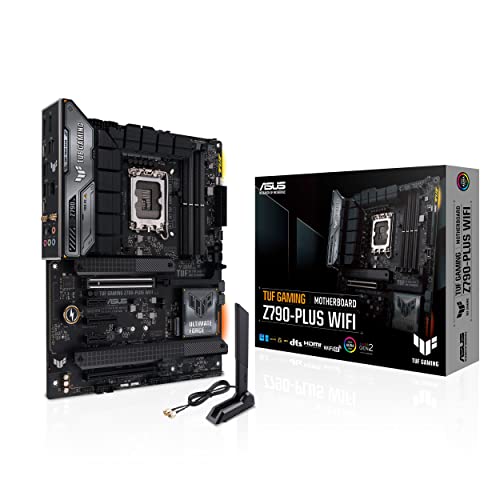
ASUS TUF Gaming PCIe 5.0 ATX Motherboard
Best for: Intel gaming builds needing four M.2 slots
- Use Case
- Gaming (what this guide is about)
- CPU Socket
- LGA 1700
- Chipset
- Z790
- Form Factor
- ATX
- Memory Type
- DDR5
- PCIe Version
- PCIe 5.0
This ATX motherboard features the Intel Z790 chipset and an LGA 1700 socket, supporting 12th, 13th, and 14th Generation Intel processors. You get DDR5 memory support, a PCIe 5.0 expansion slot, and four onboard M.2 slots for fast storage drives. It also includes 2.5GbE wired networking, Wi-Fi 6, and a 16+1 power phase design. It suits you if you want a solid base for a modern Intel gaming setup.
Pros
- PCIe 5.0 support for graphics cards
- Four dedicated M.2 slots for high-speed storage
- 16+1 power phase VRM design
- Integrated Wi-Fi 6 and 2.5GbE Ethernet
Cons
- Wi-Fi standard is Wi-Fi 6 rather than newer protocols
- LGA 1700 socket limits compatibility to Intel 12th, 13th, and 14th Gen CPUs
- ATX dimensions require a mid-tower or full-tower chassis
Good fit if
- You plan to run an Intel 12th, 13th, or 14th Gen processor.
- You want to utilize DDR5 memory and high-speed PCIe 5.0 hardware.
- You need four M.2 slots to install several solid-state drives.
Skip if
- You are building an AMD AM4 or AM5 gaming system.
- You need a smaller Micro ATX or Mini-ITX motherboard.
Verdict: ASUS TUF Gaming Z790 DDR5 ATX delivers PCIe 5.0 connectivity, a 16+1 power delivery design, and four M.2 slots for Intel desktop builds. It provides reliable 2.5GbE and Wi-Fi 6 networking for dedicated gaming configurations.

MSI Tomahawk ATX DDR5 Motherboard
Best for: Intel LGA 1700 DDR5 gaming builds
- Use Case
- Gaming (what this guide is about)
- CPU Socket
- LGA 1700
- Form Factor
- ATX
- Memory Type
- DDR5
- PCIe Version
- PCIe 5.0
- Wi-Fi Standard
- Wi-Fi 6E
The MSI MAG Tomahawk WiFi ATX Motherboard gives you a modern foundation for 12th and 13th Gen Intel gaming builds. It features the LGA 1700 socket, DDR5 memory support, and a PCIe 5.0 expansion slot for high-bandwidth graphics cards. Integrated Wi-Fi 6E handles wireless networking on supported bands. Built to the standard ATX form factor, this board suits you if you want fast DDR5 speeds and modern connectivity in a standard case.
Pros
- PCIe 5.0 expansion standard
- Fast DDR5 memory support
- Integrated Wi-Fi 6E wireless networking
- Supports 12th and 13th Gen Intel LGA 1700 CPUs
Cons
- Full ATX form factor does not fit compact Micro-ATX cases
- Requires DDR5 memory and lacks DDR4 compatibility
- LGA 1700 socket is incompatible with AMD processors
Good fit if
- You build with a 12th or 13th Gen Intel Core processor.
- You plan to use DDR5 memory and PCIe 5.0 hardware.
- You want built-in Wi-Fi 6E connectivity out of the box.
Skip if
- You plan to run an AMD Ryzen gaming processor.
- You want to reuse an existing kit of DDR4 RAM.
- You need a smaller Micro-ATX or Mini-ITX form factor.
Verdict: MSI MAG Tomahawk WiFi ATX Motherboard delivers PCIe 5.0 and Wi-Fi 6E capability for your 12th or 13th Gen Intel gaming setup. It is a solid standard-size choice if you are building exclusively with DDR5 memory.

ASUS TUF Gaming AM5 ATX Motherboard
Best for: AMD Ryzen 7000 DDR5 gaming builds
- Use Case
- Gaming (what this guide is about)
- CPU Socket
- AM5
- Form Factor
- ATX
- Memory Type
- DDR5
- PCIe Version
- PCIe 5.0
- M.2 Slots
- 4
The ASUS TUF Gaming AM5 ATX Motherboard pairs AMD AM5 socket support with PCIe 5.0 readiness. You get four M.2 slots for high-speed storage, 16 power stages for Ryzen 7000 processors, and DDR5 memory support. Integrated 2.5 Gb Ethernet and Wi-Fi 6E handle networking needs. It fits your build if you want an ATX platform ready for high-bandwidth components without complex expansion requirements.
Pros
- PCIe 5.0 support
- Four M.2 storage slots
- 16 power stages
- Wi-Fi 6E and 2.5 Gb Ethernet
Cons
- Requires DDR5 memory
- Compatible only with AM5 socket CPUs
- Full ATX size does not fit smaller cases
Good fit if
- You plan to build an AMD AM5 system with Ryzen 7000 series processors.
- You need four M.2 slots for storage drives.
- You want built-in Wi-Fi 6E and 2.5 Gb Ethernet connectivity.
Skip if
- You use an Intel processor instead of AMD socket AM5.
- You plan to reuse existing DDR4 memory modules.
- You need a compact Micro-ATX or Mini-ITX motherboard.
Verdict: ASUS TUF Gaming AM5 ATX Motherboard delivers PCIe 5.0 support, four M.2 slots, and a 16-stage power delivery design for socket AM5 gaming systems.

NZXT N7 Z790 ATX Gaming Motherboard
Best for: Intel 12th and 13th Gen gaming builds
- Use Case
- Gaming (what this guide is about)
- Chipset
- Intel Z790
- Form Factor
- ATX
- Wi-Fi Standard
- WiFi 6E
- Dimensions
- 15.1 × 12.1 × 3.9 inches
The NZXT N7 Z790 ATX Gaming Motherboard is an Intel Z790 gaming motherboard built for desktop systems. It features the Intel Z790 chipset and supports 12th and 13th Gen Intel processors. For networking, it includes integrated Wi-Fi 6E connectivity. The ATX form factor provides room for your gaming components in a black finish. This motherboard suits you if you want a full-size Intel gaming platform with modern Wi-Fi.
Pros
- Intel Z790 chipset
- Integrated Wi-Fi 6E
- ATX form factor
- Supports 12th and 13th Gen Intel CPUs
Cons
- CPU support listed only for 12th and 13th Gen Intel processors
- ATX dimensions require a compatible mid-tower or full-tower case
Good fit if
- You plan to build with a 12th or 13th Gen Intel processor.
- You want built-in Wi-Fi 6E on an ATX motherboard.
Skip if
- You are using an AMD processor.
- You need a compact micro-ATX or Mini-ITX motherboard.
Verdict: NZXT N7 Z790 ATX Gaming Motherboard provides an Intel Z790 foundation with built-in Wi-Fi 6E for standard desktop builds. It offers reliable specs if you are pairing it with a 12th or 13th Gen Intel CPU.

MSI MPG X570 Gaming Edge ATX Motherboard
Best for: AM4 gaming builds using PCIe 4.0
- Use Case
- Gaming (what this guide is about)
- CPU Socket
- AM4
- Chipset
- X570
- Form Factor
- ATX
- Memory Type
- DDR4
- PCIe Version
- PCIe 4.0
The MSI MPG X570 Gaming Edge WiFi is an ATX gaming motherboard built for the AMD AM4 platform. It supports 2nd and 3rd Gen AMD Ryzen processors alongside DDR4 memory and PCIe 4.0 expansion. You get integrated Wi-Fi 5 networking, M.2 storage support, and an active FROZR heatsink fan for chipset cooling. This board suits you if you use an AM4 Ryzen setup with PCIe 4.0 components.
Pros
- PCIe 4.0 support for graphics cards and M.2 drives
- Onboard Wi-Fi 5 (802.11ac) with MU-MIMO support
- FROZR heatsink with dedicated fan for chipset thermal control
- Factory-installed I/O shield for electrostatic discharge protection
Cons
- Wi-Fi standard limited to Wi-Fi 5 rather than Wi-Fi 6
- Memory support limited to DDR4 with no DDR5 compatibility
- Processor compatibility limited to AMD AM4 socket hardware
Good fit if
- You use a 2nd or 3rd Gen AMD Ryzen AM4 processor.
- You want PCIe 4.0 expansion lanes for M.2 storage and graphics.
- You need onboard Wi-Fi without installing a separate add-in card.
Skip if
- You plan to build with newer AMD AM5 or Intel processors.
- You require DDR5 system memory support.
- You need faster Wi-Fi 6 or Wi-Fi 6E networking standards.
Verdict: MSI MPG X570 Gaming Edge WiFi Motherboard delivers PCIe 4.0 bandwidth and integrated wireless connectivity for AM4 gaming configurations. Its active FROZR cooling and pre-installed I/O shield make it a reliable foundation for compatible AMD Ryzen systems.
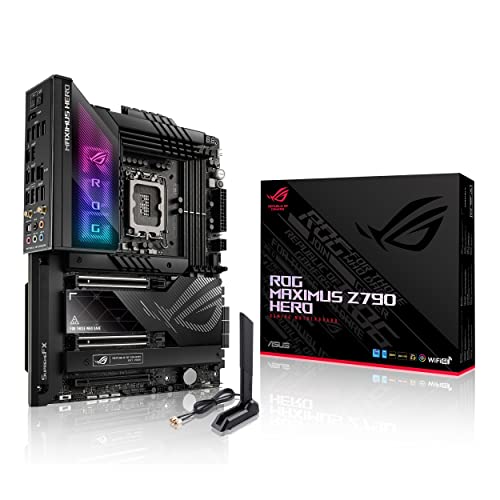
ASUS ROG Maximus DDR5 ATX Motherboard
Best for: high-end Intel LGA 1700 gaming builds
- Use Case
- Gaming (what this guide is about)
- CPU Socket
- LGA 1700
- Form Factor
- ATX
- Memory Type
- DDR5
- PCIe Version
- PCIe 5.0
- M.2 Slots
- 5
The ASUS ROG Maximus Z790 Hero ATX Motherboard gives you a high-end foundation for 12th, 13th, and 14th Gen Intel Core processors. It features a robust 20+1 power-stage architecture rated at 90 amps, alongside PCIe 5.0 readiness and DDR5 support. With five onboard M.2 storage slots, Wi-Fi 6E, and 2.5GbE networking, this ATX board suits gamers seeking maximum storage flexibility and stable power delivery for demanding Intel-based desktop setups.
Pros
- 20+1 power stages rated for 90A
- Five M.2 slots with dedicated heatsinks
- PCIe 5.0 and DDR5 memory support
- Wi-Fi 6E and Intel 2.5Gb Ethernet onboard
Cons
- Uses Wi-Fi 6E instead of Wi-Fi 7
- Supports only LGA 1700 socket CPUs
- Substantial weight at 9.3 pounds
Good fit if
- You plan to run a 12th, 13th, or 14th Gen Intel Core processor.
- You need extensive high-speed storage across five M.2 drives.
- You want heavy-duty 20+1 power delivery for high-draw hardware.
Skip if
- You plan to build with an AMD socket or Intel LGA 1851 CPU.
- You require the newer Wi-Fi 7 networking standard.
Verdict: ASUS ROG Maximus Z790 Hero ATX Motherboard provides robust 20+1 power delivery, five M.2 slots, and PCIe 5.0 capabilities for high-performance LGA 1700 systems. It suits demanding gaming rigs requiring broad storage capacity and stable power.

Gigabyte Micro-ATX DDR5 Gaming Motherboard
Best for: compact Micro-ATX DDR5 gaming builds
- Use Case
- Gaming (what this guide is about)
- Chipset
- AMD A620
- Form Factor
- Micro ATX
- Memory Type
- DDR5
- PCIe Version
- PCIe 4.0
- Dimensions
- 9.61 × 9.61 × 1.38 inches
The Gigabyte Micro ATX DDR5 Motherboard gives you an AMD A620 platform built around a compact 9.61 by 9.61-inch footprint. You get support for DDR5 system memory and PCIe 4.0 expansion lanes, fitting gaming hardware into smaller computer chassis. It also provides USB Type-C connectivity for external peripherals. This board suits you if you want a streamlined, space-saving desktop configuration for gaming without the bulk of standard full-sized ATX hardware.
Pros
- Micro-ATX form factor measuring 9.61 by 9.61 inches
- Native support for DDR5 system memory
- PCIe 4.0 expansion bus support
- USB Type-C port connectivity
Cons
- Lacks PCIe 5.0 support
- No integrated Wi-Fi specified in hardware data
Good fit if
- You want a compact Micro-ATX form factor for smaller cases.
- You plan to run DDR5 memory with PCIe 4.0 hardware.
Skip if
- You require PCIe 5.0 interface speeds.
- You need built-in Wi-Fi hardware directly on the board.
Verdict: Gigabyte Micro ATX DDR5 Motherboard delivers core AMD A620 features and DDR5 compatibility in a space-saving Micro-ATX layout. It provides PCIe 4.0 connectivity for targeted, compact gaming setups.

GIGABYTE AORUS LGA 1151 ATX Motherboard
Best for: 8th Gen Intel triple-M.2 gaming builds
- Use Case
- Gaming (what this guide is about)
- CPU Socket
- LGA1151
- Chipset
- Z370
- Form Factor
- ATX
- M.2 Slots
- 3
- Ethernet Speed
- Gigabit LAN
This ATX gaming motherboard runs on the Intel Z370 chipset with an LGA 1151 socket designed for 8th Generation Intel Core processors. You get three M.2 storage slots with thermal guards and dual Gigabit Ethernet ports through Killer E2500 and Intel controllers. Front and rear USB 3.1 Gen 2 Type-C ports provide fast peripheral connections. It suits you if you build an 8th Gen Intel gaming rig.
Pros
- Three M.2 storage slots with M.2 Thermal Guard cooling
- Dual Gigabit LAN with Killer E2500 and Intel controllers
- Front and rear USB 3.1 Gen 2 Type-C connections
- Integrated ESS Sabre DAC audio hardware
Cons
- Limits CPU compatibility to 8th Generation Intel Core chips
- No integrated Wi-Fi networking listed
Good fit if
- You run an 8th Generation Intel Core LGA 1151 processor.
- You need three M.2 slots for high-speed storage.
- You require dual wired Gigabit Ethernet connections.
Skip if
- You need integrated Wi-Fi included on the motherboard.
- You plan to run a newer generation Intel processor.
Verdict: Gigabyte AORUS Gaming 7 ATX Motherboard delivers triple M.2 slots and dual wired Gigabit controllers for 8th Gen Intel builds. It handles high-speed storage and wired networking effectively within the Z370 platform.

MSI MPG Z390 Gaming Edge AC ATX Motherboard
Best for: Existing 8th/9th Gen Intel gaming builds
- Use Case
- Gaming (what this guide is about)
- CPU Socket
- LGA 1151
- Chipset
- Z390
- Form Factor
- ATX
- Memory Type
- DDR4
- M.2 Slots
- 2
This ATX motherboard supports Intel 8th and 9th Gen processors via the LGA 1151 socket. It uses DDR4 memory, reaching speeds up to 4400 MHz when overclocked. The board includes two M.2 slots and Turbo USB 3.1 Gen 2 ports. Built-in Wi-Fi and Mystic Light RGB features round out the package. It suits gamers building with older Intel CPUs who need solid connectivity.
Pros
- Supports 8th and 9th Gen Intel Core processors
- Dual channel DDR4 memory up to 4400 MHz (OC)
- Two M.2 slots with Intel Optane Memory support
- Built-in Wi-Fi connectivity
- Mystic Light RGB with 29 effects
Cons
- Uses older LGA 1151 socket, not compatible with newer CPUs
- DDR4 memory only, no support for DDR5
- Wi-Fi AC standard, lacking Wi-Fi 6E speeds
Good fit if
- You are upgrading an existing 8th or 9th Gen Intel system
- You prefer DDR4 memory for budget reasons
- You need ATX form factor with built-in Wi-Fi
Skip if
- You want to use the latest 12th, 13th, or 14th Gen Intel CPUs
- You require DDR5 memory support
- You need Wi-Fi 6E or newer wireless standards
Verdict: MSI MPG Z390 Gaming Edge AC fits gamers sticking with 8th or 9th Gen Intel CPUs who want reliable DDR4 performance and built-in wireless. It is not suitable for those seeking modern socket compatibility or faster Wi-Fi standards.

MSI Gaming Pro Carbon ATX Motherboard
Best for: 8th and 9th Gen Intel gaming builds
- Use Case
- Gaming (what this guide is about)
- CPU Socket
- LGA 1151
- Chipset
- Z390
- Form Factor
- ATX
- Memory Type
- DDR4
- M.2 Slots
- 2
The MSI MPG Z390 ATX Motherboard gives you a dedicated platform for 8th and 9th Generation Intel Core processors on the LGA 1151 socket. It features an ATX layout supporting dual-channel DDR4 memory up to 4400 MHz, two Turbo M.2 slots for solid-state storage, and multi-GPU SLI or CrossFire setups. This board suits you if you want to build or maintain a gaming system using compatible 8th or 9th Gen Intel hardware.
Pros
- Supports dual-channel DDR4 memory up to 4400(OC) MHz
- Two Turbo M.2 slots with M.2 Shield Frozr heatsink
- Multi-GPU support for SLI and CrossFire configurations
- Built-in Turbo USB 3.1 Gen2 and pre-installed I/O shield
Cons
- Limited to older 8th and 9th Gen Intel processors
- No integrated Wi-Fi adapter included
- Restricted to DDR4 memory speeds without DDR5 support
Good fit if
- You use an 8th or 9th Generation Intel Core processor.
- You run a multi-GPU configuration requiring SLI or CrossFire support.
- You want DDR4 memory overclocking headroom up to 4400 MHz.
Skip if
- You plan to use a 10th Gen or newer Intel processor.
- You require factory-integrated Wi-Fi connectivity.
- You want to build with next-generation DDR5 memory.
Verdict: MSI MPG Z390 ATX Motherboard provides solid dual M.2 storage options and high DDR4 memory ceilings for LGA 1151 systems. It delivers reliable multi-GPU readiness for compatible 8th and 9th Gen Intel gaming builds.

MSI LGA 1151 ATX Motherboard with Wi-Fi
Best for: 8th and 9th Gen Intel gaming builds
- Use Case
- Gaming (what this guide is about)
- CPU Socket
- LGA 1151
- Chipset
- Z390
- Form Factor
- ATX
- Memory Type
- DDR4
- M.2 Slots
- 2
The MSI MPG Z390 Gaming PRO Carbon AC ATX Motherboard provides an LGA 1151 socket for 8th and 9th Generation Intel processors. It pairs an Intel Z390 chipset with dual-channel DDR4 memory support reaching up to 4400(OC) MHz. You get two Turbo M.2 slots for solid-state storage and integrated 802.11ac Wi-Fi. This board suits you if you are building or maintaining a gaming system around compatible Intel hardware.
Pros
- Supports dual-channel DDR4 memory up to 4400(OC) MHz
- Two Turbo M.2 slots with M.2 Shield Frozr cooling
- Integrated Intel 802.11ac Wi-Fi and Turbo USB 3.1 Gen 2
- Pre-installed I/O shielding
Cons
- Socket LGA 1151 limits CPU compatibility to 8th and 9th Gen Intel processors
- Includes only two M.2 slots for solid-state storage
Good fit if
- You use an 8th or 9th Generation Intel Core, Pentium Gold, or Celeron CPU.
- You want DDR4 memory support capable of 4400(OC) MHz speeds.
- You plan to run multi-GPU configurations using SLI or CrossFireX.
Skip if
- You plan to build with modern LGA 1700 or AMD AM5 processors.
- You require DDR5 system memory for your build.
Verdict: MSI MPG Z390 Gaming PRO Carbon AC ATX Motherboard delivers dependable Z390 connectivity with dual M.2 slots, fast memory tuning, and multi-GPU readiness. It serves as a dedicated foundation for 8th and 9th Gen Intel gaming rigs.

GIGABYTE AORUS Z390 ATX Motherboard
Best for: 8th and 9th Gen Intel gaming builds
- Use Case
- Gaming (what this guide is about)
- CPU Socket
- LGA1151
- Chipset
- Z390
- Form Factor
- ATX
- Memory Type
- DDR4
- M.2 Slots
- 2
The Gigabyte Z390 Aorus Pro Wi-Fi is an ATX gaming motherboard built for 8th and 9th Gen Intel Core processors on the LGA1151 socket. It features a 12+1 phase digital VRM design, dual-channel DDR4 memory across four DIMM slots, and two M.2 slots with heatsinks. You get integrated 802.11ac Wi-Fi and Intel Gigabit Ethernet, making it suitable if you run compatible Intel chips for desktop gaming.
Pros
- 12+1 phase digital VRM with DrMOS
- Dual M.2 slots with Thermal Guard heatsinks
- Onboard Intel 802.11ac 2x2 Wi-Fi and Bluetooth 5
- ALC1220-VB audio with WIMA capacitors
Cons
- Restricted to older 8th and 9th Gen Intel processors
- Wireless connectivity limited to 802.11ac standard
- Ethernet capped at 1 Gbps speed
Good fit if
- You use an 8th or 9th Gen Intel Core processor.
- You want built-in Wi-Fi and Bluetooth on an ATX board.
- You run up to two M.2 NVMe solid-state drives.
Skip if
- You plan to run a 10th Gen or newer Intel processor.
- You require 2.5 Gbps or faster wired Ethernet.
Verdict: Gigabyte Z390 Aorus Pro Wi-Fi Motherboard delivers reliable power delivery and onboard wireless connectivity for 8th and 9th Gen Intel builds. It handles gaming storage and peripherals well through dual M.2 slots and robust analog audio.
Specifications side by side
| Spec | MSI Gaming Plus ATX DDR5 Motherboard | MSI MPG LGA 1700 DDR5 ATX Motherboard | ASUS TUF Gaming AM5 ATX Motherboard | ASUS TUF Gaming PCIe 5.0 ATX Motherboard | MSI Tomahawk ATX DDR5 Motherboard | ASUS TUF Gaming AM5 ATX Motherboard | NZXT N7 Z790 ATX Gaming Motherboard | MSI MPG X570 Gaming Edge ATX Motherboard | ASUS ROG Maximus DDR5 ATX Motherboard | Gigabyte Micro-ATX DDR5 Gaming Motherboard | GIGABYTE AORUS LGA 1151 ATX Motherboard | MSI MPG Z390 Gaming Edge AC ATX Motherboard | MSI Gaming Pro Carbon ATX Motherboard | MSI LGA 1151 ATX Motherboard with Wi-Fi | GIGABYTE AORUS Z390 ATX Motherboard |
|---|---|---|---|---|---|---|---|---|---|---|---|---|---|---|---|
| CPU Socket | LGA 1700 | LGA 1700 | Socket AM5 (LGA 1718) | LGA 1700 | LGA 1700 | AM5 | not specified | AM4 | LGA 1700 | not specified | LGA1151 | LGA 1151 | LGA 1151 | LGA 1151 | LGA1151 |
| Chipset | Z790 | not specified | not specified | Z790 | not specified | not specified | Intel Z790 | X570 | not specified | AMD A620 | Z370 | Z390 | Z390 | Z390 | Z390 |
| Form Factor | ATX | ATX | ATX | ATX | ATX | ATX | ATX | ATX | ATX | Micro ATX | ATX | ATX | ATX | ATX | ATX |
| Memory Type | DDR5 | DDR5 | DDR5 | DDR5 | DDR5 | DDR5 | not specified | DDR4 | DDR5 | DDR5 | not specified | DDR4 | DDR4 | DDR4 | DDR4 |
| PCIe Version | PCIe 5.0 | PCIe 5.0 | PCIe 5.0 | PCIe 5.0 | PCIe 5.0 | PCIe 5.0 | not specified | PCIe 4.0 | PCIe 5.0 | PCIe 4.0 | not specified | not specified | not specified | not specified | not specified |
| M.2 Slots | not specified | not specified | not specified | 4 | not specified | 4 | not specified | not specified | 5 | not specified | 3 | 2 | 2 | 2 | 2 |
| Wi-Fi Standard | Wi-Fi 6E | Wi-Fi 6E | WiFi 6 | not specified | Wi-Fi 6E | WiFi 6E | WiFi 6E | not specified | Wi-Fi 6E | not specified | not specified | not specified | not specified | 802.11ac | 802.11ac |
| Ethernet Speed | 2.5Gbps | 2.5Gbps LAN | 2.5 Gb | not specified | not specified | 2.5 Gb | not specified | not specified | 2.5 GbE | not specified | Gigabit LAN | not specified | not specified | not specified | Gigabit |
| Power Phases | not specified | not specified | 14 | 16+1 | not specified | 16 | not specified | not specified | 20+1 | not specified | not specified | not specified | not specified | not specified | 12+1 |
| Wi-Fi | Wi-Fi 6E | Wi-Fi 6E | Wi-Fi 6 | Wi-Fi 6 | Wi-Fi 6E | Wi-Fi 6E | Wi-Fi 6E | Wi-Fi 5 | Wi-Fi 6E | not specified | not specified | not specified | not specified | not specified | not specified |
| Use Case | Gaming | Gaming | Gaming | Gaming | Gaming | Gaming | Gaming | Gaming | Gaming | Gaming | Gaming | Gaming | Gaming | Gaming | Gaming |
| Dimensions | not specified | 2.76 × 1.97 × 0.39 inches | 10.8 × 2.9 × 13.3 inches | 10.7 × 2.75 × 14 inches | 12 × 9.6 × 2.5 inches | 10.8 × 2.9 × 13.3 inches | 15.1 × 12.1 × 3.9 inches | 12 × 9.6 × 2.5 inches | 12.2 × 4.5 × 14.6 inches | 9.61 × 9.61 × 1.38 inches | 13.2 × 10.6 × 3.14 inches | 12 × 9.6 × 1.2 inches | 12 × 9.6 × 1.2 inches | 12 × 9.6 × 1.2 inches | 13.2 × 10.6 × 3.14 inches |
| Weight | not specified | 3.92 pounds | 1 pounds | 2.91 pounds | not specified | 4.45 pounds | not specified | 4.1 pounds | 9.3 pounds | 1.96 pounds | 4.15 pounds | 3.3 pounds | 3.3 pounds | 3.3 pounds | 3.09 pounds |
| Size | ATX | not specified | not specified | not specified | ATX | not specified | not specified | 1 | Z790 Hero|M.2 x5|WiFi 6E| | not specified | not specified | ATX | ATX | ATX | not specified |
| Color | Black | Black | not specified | BLACK | not specified | not specified | Black | not specified | BLACK | not specified | not specified | not specified | not specified | not specified | not specified |
| Model | MSI Z790 GAMING PLUS WIFI-AMZ | Z790 | B650-PLUS | TUF GAMING Z790-PLUS WIFI | MAG Z790 Tomahawk WiFi | TUF GAMING X670E-PLUS WIFI | N7-Z79XT-B1 | MSI MPG X570 Gaming Edge WiFi | ROG MAXIMUS Z790 HERO | A620M GAMING X | Z370 AORUS Gaming 7 | 007B17-002R | MPG Z390 GAMING PRO CARBON | MPG Z390 Gaming PRO Carbon AC | Z390 AORUS PRO WIFI |
Is a gaming motherboard worth it?
A gaming-designated motherboard focuses on expanded hardware connectivity and sustained power delivery. These boards provide robust power designs, ranging from 12 to 20+1 power stages, alongside active or specialized cooling. They prioritize fast storage expansion, with specific models supplying up to four or five M.2 slots. You also gain high-bandwidth networking, including 2.5GbE Ethernet ports and integrated Wi-Fi 6 or 6E controllers. If your daily computing does not demand multiple NVMe storage drives or heavy multi-stage power delivery, these specialized specifications will remain unused during standard desktop operation.
Worth it if
- You need multiple M.2 slots to house several high-speed storage drives.
- You require 2.5GbE Ethernet or Wi-Fi 6E for high-bandwidth local networking.
- You utilize multi-stage power delivery designs up to 20+1 stages for demanding hardware.
Skip it if
- You only require standard gigabit networking without Wi-Fi 6 or 2.5GbE hardware.
- You run a basic single-drive setup that does not need three or more M.2 slots.
How We Picked Gaming Motherboards
To select these motherboards, we identify models where the listing explicitly specifies gaming in the title or feature list. All details come directly from published manufacturer specifications, and we do not physically handle or test the boards. Only one model or size variant per product family is included to keep choices clear across platforms.
We arrange the 15 picks with in-stock products first, followed by Amazon sales rank to place better-selling boards higher. Key published specs like socket type, PCIe revision, memory generation, and form factor allow you to match each board directly to your 2026 gaming build needs.
How to Choose a Gaming Motherboard
-
Select the Right Form Factor
Your PC case size determines which motherboard dimensions fit inside your chassis. Standard ATX boards measure larger and offer space for additional expansion slots and onboard components. If you build a compact gaming computer, you need a smaller board. The Gigabyte Micro-ATX DDR5 Gaming Motherboard provides a 9.61-inch by 9.61-inch Micro-ATX footprint that fits tighter spaces. Check your case specifications to ensure it accepts standard ATX or Micro-ATX hardware before you finalize your hardware selection.
-
Check PCIe Version Support
PCI Express revisions determine the data transfer bandwidth available for your graphics card and high-speed expansion cards. Boards on this list offer either PCIe 4.0 or PCIe 5.0 connectivity. If you want the highest available bus bandwidth for current hardware, choose a model with PCIe 5.0 support, such as the MSI MPG LGA 1700 DDR5 ATX Motherboard. If your graphics card uses standard PCIe 4.0 speeds, a PCIe 4.0 board meets your requirements. Review your graphics hardware specifications to determine whether you require PCIe 5.0 throughput.
-
Count Available M.2 Slots
Gaming installations require fast storage, and M.2 NVMe drives mount directly onto the motherboard without cables. Different models supply varying numbers of M.2 slots depending on the board layout. If you maintain a large library of games, look for boards offering four or five slots, like the ASUS ROG Maximus DDR5 ATX Motherboard, which provides five onboard M.2 connections. Other options supply two or three slots. Count how many separate NVMe solid-state drives you plan to install so you do not run out of onboard drive slots.
-
Compare Wireless Networking Standards
Integrated wireless networking eliminates the need for add-in cards when you cannot connect via Ethernet. The models on this list range from Wi-Fi 5 up to Wi-Fi 6E. For modern multi-band home networks, a Wi-Fi 6E motherboard like the MSI Tomahawk ATX DDR5 Motherboard supports newer 6GHz bands alongside standard 2.4GHz and 5GHz channels. If you have an older router or use a Wi-Fi 6 access point, a Wi-Fi 6 or Wi-Fi 5 board remains compatible. Match the board specification to your household router capabilities.
-
Evaluate Wired Ethernet Speed
If you use a wired local network for online gaming and file transfers, verify the onboard LAN controller speed. Motherboards on this list feature either Gigabit Ethernet or 2.5GbE ports. A 2.5GbE port, present on the ASUS TUF Gaming PCIe 5.0 ATX Motherboard, enables data rates up to 2.5 gigabits per second when connected to compatible multi-gig switches or routers. If your home network operates entirely on standard Gigabit equipment, standard Gigabit ports deliver full compatibility without requiring 2.5GbE hardware. Check your switch hardware specifications.
-
Review Power Delivery Design
Power delivery configurations manage electrical stability from your power supply to the processor. Listed motherboards specify configurations ranging from 12-phase designs up to 20+1 power stages. If you run entry-level processors, a balanced 12-phase setup, such as on the Gigabyte X570 Gaming X ATX Motherboard, provides steady voltage. If you install top-tier multi-core gaming processors under heavy loads, boards with 16 or 20+1 stages offer expanded current headroom. Compare the power stage count against the power demands of your chosen processor before choosing a model.
Frequently asked questions
Which motherboard supports the latest DDR5 memory for Intel processors?
The MSI Gaming Plus ATX DDR5 Motherboard supports DDR5 memory for Intel LGA 1700 systems. It also includes PCIe 5.0 capability and Wi-Fi 6E connectivity. This combination ensures you have modern expansion speeds and high-performance networking for your gaming build.
Can I use DDR4 RAM with any of these gaming motherboards?
Yes, the MSI MPG X570 Gaming Edge ATX Motherboard supports DDR4 memory for AM4 sockets. Additionally, several older Intel models like the MSI MPG Z390 Gaming Edge AC also utilize DDR4. You must match the RAM type to the specific socket and chipset requirements.
Which board offers the most M.2 storage slots for gaming?
The ASUS ROG Maximus DDR5 ATX Motherboard provides five M.2 slots. This extensive storage capacity suits demanding gaming rigs that require broad storage options. It pairs this with robust power delivery and PCIe 5.0 capabilities for high-performance Intel LGA 1700 systems.
What is the smallest form factor available for a DDR5 gaming motherboard?
The Gigabyte Micro-ATX DDR5 Gaming Motherboard offers a compact Micro-ATX layout. It delivers DDR5 compatibility and PCIe 4.0 connectivity in a space-saving design. This makes it ideal for targeted, compact gaming setups where case size is a primary constraint.
Do these motherboards include built-in wireless networking?
Most models include integrated Wi-Fi, with standards ranging from Wi-Fi 5 to Wi-Fi 6E. For example, the MSI Gaming Plus features Wi-Fi 6E, while the MSI MPG X570 uses Wi-Fi 5. Always check the specific Wi-Fi specification in the attributes to ensure compatibility with your network.
Which motherboard is best for AMD AM5 gaming builds?
The ASUS TUF Gaming AM5 ATX Motherboard is designed for AMD AM5 gaming builds. It delivers core AM5 features with DDR5 compatibility and PCIe 5.0 support. It provides balanced high-speed wired and wireless networking for standard ATX gaming configurations.
Does the top-rated motherboard support 2.5GbE networking?
Yes, the MSI Gaming Plus ATX DDR5 Motherboard supports 2.5GbE networking. This faster wired connection complements its PCIe 5.0 capability and DDR5 support. It delivers modern platform features in a full-size ATX form factor for Intel LGA 1700 systems.