Best Motherboards for Commercial in 2026: 7 Picks Ranked by Specs
As an Amazon Associate we earn from qualifying purchases. Links on this page are affiliate links.
Choosing the best motherboards for commercial builds requires focusing on platform stability, processor sockets, and management features. We compared 7 models based on the specifications published on the listings to identify dependable options for business environments.
The ASUS Prime Micro-ATX Commercial Motherboard takes the top spot by offering an AM4 socket with ECC memory support for stable fleet deployment. This guide helps you choose the right form factor, socket, and memory standard for your office infrastructure.
Quick picks
The best fit for you
- You deploy commercial fleets with socket AM4 processors ASUS Prime Micro-ATX Commercial Motherboard It features an AM4 socket, micro-ATX form factor, and PCIe 4.0 support for standardized workstation fleets.
- You need remote DASH management on LGA 1200 systems ASUS Pro Micro-ATX LGA 1200 Motherboard This micro-ATX board supports LGA 1200 CPUs with integrated DASH remote enterprise management tools.
- You need DDR5 memory for LGA 1700 builds ASUS Pro Micro-ATX DDR5 Motherboard It includes an LGA 1700 socket and native DDR5 memory support for commercial office builds.
- You want multi-threaded power for heavy commercial workloads AMD Ryzen 9 ASUS Prime Micro-ATX Bundle The bundle supplies a 12-core, 24-thread Ryzen 9 processor built on a micro-ATX platform.
Our 7 picks

ASUS Prime Micro-ATX Commercial Motherboard
Best for: fleet deployment with AM4 commercial systems
- Use Case
- Commercial (what this guide is about)
- CPU Socket
- AM4
- Form Factor
- Micro ATX
- PCIe Version
- PCIe 4.0
- Ethernet Speed
- 1Gb LAN
- Dimensions
- 10.4 × 2.03 × 10.6 inches
This micro-ATX board fits AMD AM4 processors, making it a foundation for commercial workstation deployments. You get PCIe 4.0 expansion, ECC memory support, and 1Gb LAN for standard office networking. Video ports include HDMI 2.1, DVI, and D-Sub, accommodating legacy and modern monitors without adapters. It suits system builders who need Corporate Stable Model life-cycle management, remote administration via ASUS Control Center Express, and stable hardware protection.
Pros
- PCIe 4.0 support for expansion cards and high-speed storage
- Triple display outputs featuring HDMI 2.1, DVI, and D-Sub
- ASUS Control Center Express included for IT endpoint management
- Corporate Stable Model program offering up to 36-month supply longevity
Cons
- Networking speed is capped at 1Gb LAN
- Limited to AM4 socket processors rather than AM5
Good fit if
- You need centralized IT management tools like ASUS Control Center Express.
- You deploy systems built around 3rd Gen AMD Ryzen AM4 processors.
- You connect to legacy displays via DVI or D-Sub without separate adapters.
Skip if
- You need network speeds higher than 1Gb LAN.
- You plan to build using Intel or newer AMD AM5 processors.
Verdict: ASUS Prime Micro-ATX AM4 Motherboard provides reliable commercial features like ECC memory support, multi-display connectivity, and centralized IT management. It is a solid choice if you maintain a fleet of AM4 workstations.

ASUS Pro Micro-ATX LGA 1200 Motherboard
Best for: Harsh commercial environments needing remote management
- Use Case
- Commercial (what this guide is about)
- CPU Socket
- LGA 1200
- Form Factor
- mATX
- PCIe Version
- PCIe 4.0
- Ethernet Speed
- 1 Gb
- Dimensions
- 9.6 × 9.6 × 1.5 inches
This micro-ATX commercial motherboard fits Intel 10th and 11th Gen processors using the LGA 1200 socket. You get PCIe 4.0 support for expansion cards, Intel 1 Gb Ethernet, and a moisture-resistant coating for demanding operating environments. It also includes an SMBUS header for DASH LAN remote management and an ASUS self-recovering BIOS. It suits you if you need reliable hardware management tools and physical protection for a standard commercial workstation.
Pros
- Self-recovering BIOS technology with automated backup restore
- Moisture-resistant coating for harsh environments
- SMBUS header supporting DASH LAN remote IT management
- PCIe 4.0 support with Intel 1 Gb Ethernet
Cons
- Limited to older Intel LGA 1200 socket CPUs
- Networking capped at 1 Gb Ethernet speed
Good fit if
- You use 10th or 11th Gen Intel Core processors.
- You require DASH LAN remote IT management via an SMBUS header.
- You deploy systems in humid or harsh operating settings.
Skip if
- You plan to build with newer Intel LGA 1700 or AMD platforms.
- You need multi-gigabit Ethernet connectivity.
Verdict: ASUS Pro Intel LGA 1200 Micro-ATX Motherboard provides dedicated enterprise maintenance tools, including automated BIOS recovery and DASH remote support, for 10th and 11th Gen Intel deployments.
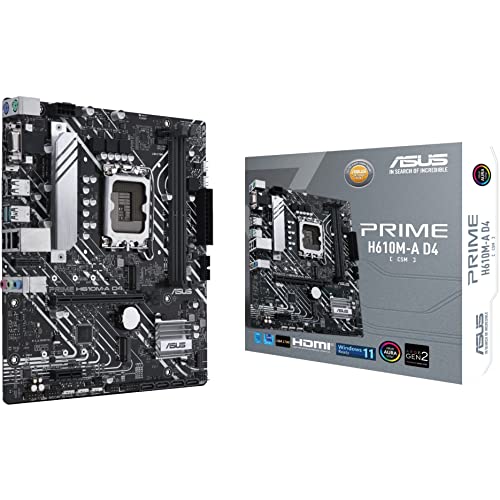
ASUS Prime Micro-ATX DDR4 Motherboard
Best for: budget-conscious commercial 12th Gen Intel office builds
- Use Case
- Commercial (what this guide is about)
- CPU Socket
- LGA 1700
- Chipset
- H610
- Form Factor
- Micro-ATX
- Memory Type
- DDR4
- PCIe Version
- PCIe 4.0
This micro-ATX commercial motherboard runs on the Intel LGA 1700 socket with the H610 chipset and DDR4 memory support. It offers business-focused features, including ASUS Corporate Stable Model lifecycle tracking, self-recovering BIOS technology, and an integrated moisture-resistant coating. With two M.2 slots and Intel 1 Gb Ethernet, it gives you essential system expansion and connectivity. It suits your workplace if you need a stable, entry-level Intel platform for standard office deployments.
Pros
- ASUS Corporate Stable Model program with up to 36-month supply and EOL notices
- Self-recovering BIOS technology for automatic recovery from a verified backup
- Two M.2 storage slots and PCIe 4.0 connectivity
- Moisture-resistant coating to protect hardware in harsh environments
- Dedicated LPC header and debug card with LCD display for troubleshooting
Cons
- Supports DDR4 memory rather than DDR5
- Ethernet speed tops out at 1 Gb
- Socket support in published specs focuses on 12th Gen Intel processors
Good fit if
- You need a commercial LGA 1700 motherboard that works with DDR4 RAM.
- You want centralized IT monitoring via ASUS Control Center Express.
- You require component protection against humid or harsh operating environments.
Skip if
- You require high-speed networking beyond 1 Gb Ethernet.
- You plan to build with newer DDR5 memory modules.
Verdict: ASUS Prime Micro-ATX DDR4 Motherboard provides dependable LGA 1700 commercial support with dedicated IT management tools and hardware safeguards. It delivers core business functionality without the added complexity of higher-tier chipsets.

ASUS Pro Micro-ATX DDR5 Motherboard
Best for: Intel business builds requiring DDR5 memory
- Use Case
- Commercial (what this guide is about)
- CPU Socket
- LGA 1700
- Form Factor
- Micro-ATX
- Memory Type
- DDR5
- PCIe Version
- PCIe 4.0
- M.2 Slots
- 2
This micro-ATX commercial motherboard supports 12th and 13th Gen Intel processors on the LGA 1700 socket. It features DDR5 memory support, PCIe 4.0 expansion, and two PCIe 4.0 M.2 slots for solid-state storage. Built-in management includes ASUS Control Center Express, a self-recovering BIOS, and TPM security. If you need modern Intel processing and fast DDR5 memory for business workstations or managed office deployments, this board fits your requirements.
Pros
- Intel LGA 1700 socket compatible with 12th and 13th Gen Core CPUs
- DDR5 memory and PCIe 4.0 support
- Two PCIe 4.0 M.2 storage slots
- ASUS Control Center Express software for remote IT management
- Hardware security via TPM and self-recovering BIOS
Cons
- No PCIe 5.0 support listed
- Limited to two M.2 storage slots
- Not compatible with older DDR4 memory
Good fit if
- You build around 12th or 13th Gen Intel CPUs using DDR5 memory.
- You need integrated IT management software and hardware-level TPM protection.
- You want a compact micro-ATX platform with two PCIe 4.0 M.2 slots.
Skip if
- You want to reuse existing DDR4 memory modules.
- You require an AMD AM4 or AM5 socket configuration.
- You need more than two onboard M.2 storage drives.
Verdict: ASUS Pro Micro-ATX DDR5 Motherboard provides stable commercial administration tools paired with DDR5 performance for LGA 1700 Intel systems. It delivers reliable security and monitoring specs suitable for enterprise deployments.

ASUS Prime Micro-ATX LGA 1851 Motherboard
Best for: managed commercial Intel Core Ultra PC deployments
- Use Case
- Commercial (what this guide is about)
- CPU Socket
- LGA 1851
- Chipset
- Intel H810
- Form Factor
- mATX
- Memory Type
- DDR5
- PCIe Version
- PCIe 4.0
This micro-ATX board features an Intel H810 chipset and an LGA 1851 socket designed for Intel Core Ultra Series 2 processors. For commercial deployments, you get ASUS Corporate Stable Model lifecycle support alongside ASUS Control Center Express for remote IT monitoring and BIOS updates. It also supplies DDR5 memory slots, a PCIe 4.0 interface, and 1 GbE networking. It suits you if you need a managed, modern Intel workstation deployment.
Pros
- LGA 1851 socket compatible with Intel Core Ultra Series 2 processors
- ASUS Corporate Stable Model support with Control Center Express IT monitoring
- Equipped with DDR5 memory support and a PCIe 4.0 slot
- 6+1+1 power stages paired with VRM and PCH heatsinks
Cons
- Wired networking is limited to 1 GbE with no built-in Wi-Fi
- Expansion bus limited to PCIe 4.0 rather than PCIe 5.0
Good fit if
- You need an LGA 1851 platform for Intel Core Ultra Series 2 desktop processors.
- You manage commercial fleets requiring centralized IT monitoring and remote BIOS updates.
- You build micro-ATX office workstations using DDR5 memory.
Skip if
- You require network speeds faster than 1 GbE or integrated wireless connectivity.
- You need PCIe 5.0 support for faster expansion hardware.
Verdict: ASUS Prime Micro-ATX LGA 1851 Motherboard delivers core IT management tools and next-generation Intel processor support for commercial deployments. It handles standard office workloads reliably through DDR5 memory and PCIe 4.0 connectivity.

AMD Ryzen 9 ASUS Prime Micro-ATX Bundle
Best for: high-demand commercial multi-threaded workstation builds
- Use Case
- Commercial (what this guide is about)
- CPU Socket
- AM5
- Form Factor
- Micro-ATX
- Memory Type
- DDR5
- PCIe Version
- PCIe 5.0
- Ethernet Speed
- 2.5 GbE
This bundle pairs a 12-core AMD Ryzen 9 desktop processor with a microATX commercial motherboard. It delivers 24 processing threads, boost speeds up to 5.6 GHz, DDR5 memory support, and a PCIe 5.0 M.2 slot for storage. With built-in 2.5Gb Ethernet and front USB Type-C connectivity, it suits you if you need high-thread performance for commercial workstations.
Pros
- 12 cores and 24 processing threads with 5.6 GHz max boost
- PCIe 5.0 M.2 slot for fast storage
- Realtek 2.5Gb Ethernet port
- Support for DDR5 memory and front USB 3.2 Gen 1 Type-C
Cons
- No integrated Wi-Fi listed in specifications
- Micro-ATX footprint offers fewer expansion slots than standard ATX
- Requires DDR5 memory with no DDR4 backward compatibility
Good fit if
- You need 12 cores and 24 threads for heavy commercial workloads.
- You want PCIe 5.0 storage speeds and 2.5Gb wired networking.
- You are building around the AMD AM5 socket and DDR5 memory.
Skip if
- You need built-in Wi-Fi connectivity without adding an adapter.
- You need multiple full-length expansion cards that require standard ATX.
- You plan to reuse existing DDR4 memory sticks.
Verdict: AMD Ryzen 9 ASUS Prime Micro-ATX Bundle provides 12-core processing power and PCIe 5.0 storage support for demanding business systems. It delivers high-speed commercial connectivity in a space-saving microATX form factor.

ASUS Prime Micro-ATX AM5 Motherboard
Best for: commercial AMD AM5 office desktop deployments
- Use Case
- Commercial (what this guide is about)
- CPU Socket
- AM5
- Form Factor
- mATX
- Memory Type
- DDR5
- PCIe Version
- PCIe 4.0
- M.2 Slots
- 2
This micro-ATX commercial motherboard brings the AMD AM5 socket and DDR5 memory support to professional deployments. It features dual M.2 storage slots, PCIe 4.0 connectivity, and 1Gb Ethernet for standard networking tasks. IT managers benefit from ASUS Corporate Stable Model lifecycle support and centralized endpoint management tools. If you need a standardized platform for AMD Ryzen 7000 series desktop processors in business environments, this board delivers practical hardware fundamentals.
Pros
- Supports AMD AM5 socket and Ryzen 7000 series processors
- Provides DDR5 memory compatibility and dual M.2 slots
- Includes ASUS Corporate Stable Model support with up to 36-month supply
- Equipped with front-panel USB 3.2 Gen 1 Type-C support
Cons
- Limits wired networking to 1Gb Ethernet
- Lacks PCIe 5.0 expansion support
- Does not include integrated Wi-Fi hardware
Good fit if
- You need an AM5 platform for AMD Ryzen 7000 desktop processors.
- You deploy office systems requiring corporate supply longevity.
- You require DDR5 memory alongside dual M.2 storage drives.
Skip if
- You require 2.5GbE or faster wired networking speeds.
- You need built-in Wi-Fi connectivity on the motherboard.
- You plan to run PCIe 5.0 graphics or storage hardware.
Verdict: ASUS Prime AM5 Micro-ATX Motherboard delivers dependable commercial management features alongside AMD AM5 and DDR5 support. It provides essential modern connectivity and stable deployment support for standardized office desktop builds.
Specifications side by side
| Spec | ASUS Prime Micro-ATX Commercial Motherboard | ASUS Pro Micro-ATX LGA 1200 Motherboard | ASUS Prime Micro-ATX DDR4 Motherboard | ASUS Pro Micro-ATX DDR5 Motherboard | ASUS Prime Micro-ATX LGA 1851 Motherboard | AMD Ryzen 9 ASUS Prime Micro-ATX Bundle | ASUS Prime Micro-ATX AM5 Motherboard |
|---|---|---|---|---|---|---|---|
| CPU Socket | AM4 | LGA 1200 | LGA 1700 | LGA 1700 | LGA 1851 | AM5 | AM5 |
| Chipset | not specified | not specified | H610 | not specified | Intel H810 | not specified | not specified |
| Form Factor | Micro ATX | mATX | Micro-ATX | Micro-ATX | mATX | Micro-ATX | mATX |
| Memory Type | not specified | not specified | DDR4 | DDR5 | DDR5 | DDR5 | DDR5 |
| PCIe Version | PCIe 4.0 | PCIe 4.0 | PCIe 4.0 | PCIe 4.0 | PCIe 4.0 | PCIe 5.0 | PCIe 4.0 |
| M.2 Slots | not specified | not specified | 2 | 2 | not specified | not specified | 2 |
| Ethernet Speed | 1Gb LAN | 1 Gb | 1 Gb | not specified | 1 GbE | 2.5 GbE | 1Gb |
| Power Phases | not specified | not specified | not specified | not specified | 6+1+1 | not specified | not specified |
| Use Case | Commercial | Commercial | Commercial | Commercial | Commercial | Commercial | Commercial |
| Series | not specified | not specified | not specified | not specified | not specified | Ryzen 9 | not specified |
| Core Count | not specified | not specified | not specified | not specified | not specified | 12 Cores | not specified |
| Thread Count | not specified | not specified | not specified | not specified | not specified | 24 Threads | not specified |
| Dimensions | 10.4 × 2.03 × 10.6 inches | 9.6 × 9.6 × 1.5 inches | 8.3 × 9.6 × 3 inches | 10.2 × 10.6 × 2.03 inches | 9.6 × 8.7 × 1.5 inches | not specified | 9.6 × 9.6 × 1.39 inches |
| Weight | 1.31 pounds | 1.86 pounds | 2.12 pounds | 2 pounds | 1.1 pounds | not specified | 1.6 pounds |
| Size | Micro ATX | Q570M-C-CSM | Micro-ATX | DDR4 | Micro-ATX|Pro B760M-CT-CSM|M.2x2 | H810M-E|M.2x2 | not specified | PRIME A620M-A-CSM |
| Model | PRIME B550M-A/CSM | Q570M-C/CSM | ROG MAXIMUS Z690 EXTREME | Pro B760M-CT-CSM | PRIME H810M-E-CSM | ASUS Prime B650M-A-CSM | PRIME A620M-A-CSM |
| Color | not specified | not specified | not specified | BLACK | BLACK | AMD Ryzen 9 7900X + ASUS PRIME B650M-A-CSM | BLACK |
Is a Commercial Motherboard Worth It?
Commercial motherboards integrate administration tools and hardware safeguards designed for business operations. Centralized IT management tools and DASH support allow you to handle remote monitoring and enterprise maintenance tasks. Dedicated specifications such as automated BIOS recovery, ECC memory support, and hardware safeguards protect your platform stability during daily office workloads. Multi-display connectivity also gives you native output for multiple workstation screens. These features simplify fleet management by allowing you to diagnose, secure, and maintain systems without requiring direct physical access to every machine.
Worth it if
- You need centralized IT management tools to monitor and maintain multiple office workstations remotely.
- You require hardware reliability features such as automated BIOS recovery and ECC memory support.
- You need built-in multi-display connectivity to power multiple monitors across workplace desks.
Skip it if
- You are building a single personal computer that does not require remote maintenance or centralized administrative tools.
- You do not need business-specific features like ECC memory compatibility, automated BIOS recovery, or specialized hardware safeguards.
For kitchen workstation setups, you can evaluate the best mandolines for commercial using blade and frame specifications.
How We Chose Commercial Motherboards
We identified products for this guide by finding models with a commercial use case stated in their title or feature list. All details come directly from specifications and feature lists published on the listings. Products are not physically handled. We include only one variant per product family across the 7 selections. You can compare options across AM4, AM5, LGA 1200, and LGA 1700 sockets in the Micro-ATX form factor.
We list products in stock first. To help you evaluate choices for business builds, we reviewed published specifications for DDR4 and DDR5 memory, PCIe 4.0 connectivity, and 1GbE Ethernet speeds. Product stock and pricing refresh on the page at least daily.
How to Choose a Commercial Motherboard
-
Check Physical Board Dimensions
Micro-ATX motherboards fit into compact business enclosures, but exact measurements vary between models. You should measure your chassis interior before selection. For example, the ASUS Pro Micro-ATX DDR5 Motherboard lists dimensions of 10.6 inches in width and 10.2 inches in length. Other models feature smaller footprints, such as 8.7 inches by 9.6 inches. Checking depth and clearance guarantees your power supply cables, drive brackets, and front panel headers align properly inside standardized office cases without physical interference during your system assembly.
-
Verify Ethernet Network Speeds
Commercial office networks rely on stable local connectivity for file sharing and centralized client communication. You need to inspect the wired Ethernet speed listed on the specification sheet. Models like the ASUS Prime Micro-ATX Commercial Motherboard include a 1GbE network interface. A 1GbE controller suits standard business environments running typical office software, cloud applications, and internal database queries over standard local area networks. Confirm that your network infrastructure switches match this speed specification to avoid throughput bottlenecks across your deployed office systems.
-
Evaluate PCIe Bus Generations
Expansion bus support determines how quickly add-in cards communicate with the system. You should check the PCIe version supported by the motherboard. Several commercial boards, including the ASUS Prime Micro-ATX AM5 Motherboard, provide PCIe 4.0 support for compatible add-in expansion cards and high-speed components. PCIe 4.0 doubles the data transfer bandwidth compared to older PCIe 3.0 interfaces. If your commercial workflow requires dedicated expansion cards such as multi-display adapters or specialized add-in controllers, choosing PCIe 4.0 ensures proper operating bandwidth.
-
Review Remote Management Tools
System upkeep across multiple workstations requires remote administration tools to minimize physical service calls. You should verify whether the motherboard lists specific enterprise maintenance specifications. The ASUS Pro Micro-ATX LGA 1200 Motherboard features automated BIOS recovery and DASH remote support for out-of-band maintenance. These features allow IT administrators to monitor system health and resolve boot issues remotely over the network. If you maintain hardware in difficult-to-reach locations or isolated commercial environments, prioritizing integrated remote diagnostic specifications reduces physical troubleshooting time significantly.
-
Select Memory Type Standard
Motherboard platforms require specific system RAM architectures that cannot be interchanged. You need to check whether the board specifies DDR4 or DDR5 memory compatibility. The ASUS Prime Micro-ATX DDR4 Motherboard utilizes DDR4 memory modules, which suits businesses maintaining an existing stock of DDR4 RAM. Newer platforms deploy DDR5 memory modules for increased memory data bandwidth. Confirm your memory modules match the board specification exactly, because DDR4 modules will not physically seat or function in DDR5 slots due to differing notch positions.
-
Consider Integrated Processor Bundles
Workstations handling heavy calculations require higher core counts, and purchasing an integrated bundle simplifies component matching. You should examine whether a motherboard package provides a pre-selected central processing unit. The AMD Ryzen 9 ASUS Prime Micro-ATX Bundle includes a 12-core, 24-thread processor paired directly with the board. This configuration suits demanding multi-threaded business applications, compiling tasks, or local data crunching. Checking the specified core and thread counts ensures your processing capacity meets your software requirements right out of the box without separate CPU procurement.
Frequently asked questions
What form factor do commercial motherboards typically use?
You will find that all commercial motherboards in this guide use the Micro-ATX form factor. This compact footprint allows deployment across space-constrained office towers and smaller business enclosures without sacrificing standard expansion slots. Despite sharing the Micro-ATX profile, individual board measurements vary, such as the ASUS Pro Micro-ATX DDR5 at 10.6 inches wide and the ASUS Prime LGA 1851 at 8.7 inches wide.
Which commercial motherboards support DDR5 memory?
Several options support modern DDR5 memory, including the ASUS Pro Micro-ATX DDR5 Motherboard, the ASUS Prime Micro-ATX LGA 1851 Motherboard, and the ASUS Prime Micro-ATX AM5 Motherboard. DDR5 provides higher memory bandwidth for intensive commercial multitasking and enterprise computing workloads. If your setup requires older DDR4 memory instead, you can look toward LGA 1700 DDR4 platforms like the ASUS Prime Micro-ATX DDR4 Motherboard.
Can you use AMD processors in commercial desktop motherboards?
Yes, you can run AMD processors on multiple commercial boards depending on your socket generation. The ASUS Prime Micro-ATX Commercial Motherboard supports the AM4 socket for standard fleet workstations. If you require newer hardware, the ASUS Prime Micro-ATX AM5 Motherboard supports socket AM5 chips. Demanding business setups can utilize the AMD Ryzen 9 ASUS Prime bundle, which includes a 12-core, 24-thread Ryzen 9 processor.
What PCIe generation do most commercial motherboards support?
Most commercial options in this guide provide PCIe 4.0 connectivity for expansion cards and storage drives. Models such as the ASUS Prime Micro-ATX Commercial, ASUS Pro LGA 1200, and ASUS Prime LGA 1851 utilize PCIe 4.0 lanes to handle modern business workloads. For systems requiring even faster throughput, the AMD Ryzen 9 ASUS Prime Micro-ATX Bundle lists support for high-speed PCIe 5.0 storage devices.
What processor sockets are available for Intel commercial motherboards?
You have three distinct Intel socket generations available across the listed commercial motherboards. The ASUS Pro LGA 1200 Motherboard accommodates 10th and 11th Gen Intel chips. For 12th Gen processors and other compatible units, you can choose LGA 1700 boards like the ASUS Prime DDR4 or ASUS Pro DDR5 models. Next-generation Core Ultra deployments use the LGA 1851 socket on the ASUS Prime Micro-ATX LGA 1851.
What network speeds do commercial motherboards offer for office networks?
Commercial motherboards on this list commonly provide 1GbE Ethernet speeds for local area network connectivity. Models such as the ASUS Prime Micro-ATX Commercial Motherboard, ASUS Prime Micro-ATX DDR4 Motherboard, and ASUS Prime Micro-ATX AM5 Motherboard include 1GbE network ports. This specification supports stable gigabit connections suited for daily commercial tasks, office intranet communication, and standardized enterprise cloud infrastructure access.
Is high-core-count multi-threading supported on commercial motherboards?
Yes, commercial builds can handle demanding multi-threaded workloads if you select a compatible high-performance platform. The AMD Ryzen 9 ASUS Prime Micro-ATX Bundle provides 12 cores and 24 threads alongside its ASUS Prime B650M-A-CSM board. This configuration allows you to execute multi-threaded commercial applications, compile code, and process compute-heavy tasks efficiently while retaining the space-saving footprint of a Micro-ATX form factor.