Biostar Mini ITX Integrated AMD DDR3 Motherboard vs Biostar LGA 1151 8 GPU (2026): Key Differences
As an Amazon Associate we earn from qualifying purchases. Links on this page are affiliate links.
You are looking at the biostar mini itx integrated amd ddr3 motherboard vs lga 1151 8 GPU. Both boards come from Biostar, but they serve different goals. The first is a compact AMD board for small builds. The second is a large Intel server board for mining. They differ in socket, memory, and size. This guide breaks down those specs to help you pick the right hardware for your specific needs.
Key differences
| Aspect | Biostar Mini ITX Integrated AMD DDR3 Motherboard | Biostar LGA 1151 8 GPU Server Board |
|---|---|---|
| CPU Socket | AMD | LGA1151 |
| Form Factor | mITX | Large (20 x 10 inches) |
| Memory Type | DDR3 | DDR4 |
| Chipset | Not listed | Intel 300 Series |
| Use Case | General Mini ITX | Server |
Which one should you choose?
Choose Biostar Mini ITX Integrated AMD DDR3 Motherboard if
- You need a small form factor build
- You are using AMD processors
- You prefer DDR3 memory
Choose Biostar LGA 1151 8 GPU Server Board if
- You are building a mining rig
- You need Intel LGA1151 support
- You require DDR4 memory
Verdict: Choose the AMD board if you want a compact, general-purpose mini ITX system. Pick the Intel server board if you are building a specialized mining rig that requires eight GPUs and DDR4 memory. The choice depends entirely on your processor platform and physical space constraints.
Key Differences Between Boards
cpu socket
Product A uses an integrated AMD design, meaning the processor is built directly into the board. You cannot upgrade the CPU later. Product B features an LGA1151 socket, which accepts Intel 8th and 9th Gen processors. This socket allows you to choose specific CPUs and replace them as technology improves. The LGA1151 option offers much greater flexibility for your system's core processing power. You can swap chips without buying a new motherboard. The integrated AMD solution is fixed and less adaptable.
form factor
Product A is a Mini ITX board with dimensions of 6.69 inches by 6.69 inches. This compact size fits easily into small cases and portable builds. Product B is significantly larger, measuring 20 inches by 10 inches. This large form factor is designed for server racks or mining rigs that require space for multiple components. If you need a small desktop PC, Product A is the only choice. Product B requires a large chassis that can accommodate its substantial footprint. The size difference dictates the type of case you must buy.
memory type
Product A supports DDR3 memory modules. This is an older standard that is generally slower and less efficient than modern alternatives. Product B uses DDR4 memory, which offers higher speeds and better power efficiency. DDR4 is the current standard for most Intel systems. If you plan to run modern software or need faster data access, Product B is superior. DDR3 may limit performance in newer applications. The memory technology difference affects overall system speed and compatibility with newer components.
gpu support
Product B is explicitly designed to support eight GPUs. This makes it ideal for cryptocurrency mining or heavy parallel computing tasks. The board includes multiple PCIe slots to accommodate these graphics cards. Product A does not have this capability. It is a standard integrated motherboard with limited expansion options for discrete graphics. If you need to run multiple graphics cards for rendering or mining, Product B is the clear winner. Product A is not built for such intensive multi-GPU workloads.
use case
Product A is suited for basic computing tasks in a compact space. It is good for home servers or lightweight desktops. Product B is labeled as a server board. It is built for high-density computing and mining operations. The two boards serve completely different audiences. You should choose Product A if you want a small, simple PC. Choose Product B if you are building a specialized server or mining rig. The intended use case drives the hardware design and feature set of each board.
Which Motherboard Fits Your Build
Small form factor AMD users
You need a compact mITX board with integrated AMD graphics. This board measures 6.69 by 4.09 inches and uses DDR3 memory. The processor is built directly onto the board, so you cannot upgrade the CPU later. It is ideal for tight spaces where a small footprint matters most.
Intel server or mining setups
You require a large server board with eight GPU slots for mining or compute tasks. This board uses an LGA1151 socket for Intel 8th and 9th Gen processors and supports DDR4 memory. It is designed for the Intel 300 Series chipset and fits standard rack or tower server environments.
Budget desktop builders
You want a simple, low-cost system for basic computing tasks. This board integrates the CPU and graphics, removing the need for a separate video card. It uses older DDR3 memory, which is widely available. The small size makes it easy to fit into existing small cases.
Multi-GPU workstation users
You need extensive expansion for multiple graphics cards. This board supports eight GPUs, making it suitable for rendering or cryptocurrency mining. The large dimensions accommodate these cards and necessary cooling. The LGA1151 socket allows you to choose from various Intel processors based on your specific performance needs.
The products compared

Biostar Mini ITX Integrated AMD DDR3 Motherboard
Best for: Compact AMD systems with DDR3 memory
- Form Factor
- mITX
- Memory Type
- DDR3
- Dimensions
- 6.69 × 6.69 × 4.09 inches
- Weight
- 1.15 pounds
View on Amazon: Biostar Mini ITX Integrated AMD DDR3 Motherboard Affiliate link
This Biostar A68N-2100K is a Mini ITX motherboard designed for AMD processors using DDR3 memory. It measures 6.69 by 6.69 inches and weighs 1.15 pounds. The board supports older AMD platforms. It suits users building compact systems with legacy components. The form factor allows for small case compatibility. DDR3 support limits modern upgrade paths.
Pros
- Mini ITX form factor for compact builds
- Supports DDR3 memory modules
- Compact dimensions of 6.69 inches square
Cons
- Uses older DDR3 memory standard
- Limited to AMD integrated platforms
- No mention of modern connectivity options
Good fit if
- You need a small form factor motherboard
- You are using DDR3 memory
- You are building with older AMD CPUs
Skip if
- You require DDR4 or DDR5 support
- You need LGA 1151 socket compatibility
- You are building a multi-GPU system
Verdict: Biostar A68N-2100K Mini ITX DDR3 Board fits users needing a compact AMD motherboard with DDR3 support. It is suitable for legacy builds or small cases.
Biostar LGA 1151 8 GPU Server Board
Best for: multi-GPU mining rigs with Intel CPUs
- CPU Socket
- LGA1151
- Chipset
- Intel 300 Series
- Memory Type
- DDR4
- Use Case
- Server
- Dimensions
- 20 × 10 × 2 inches
View on Amazon: Biostar LGA 1151 8 GPU Server Board Affiliate link
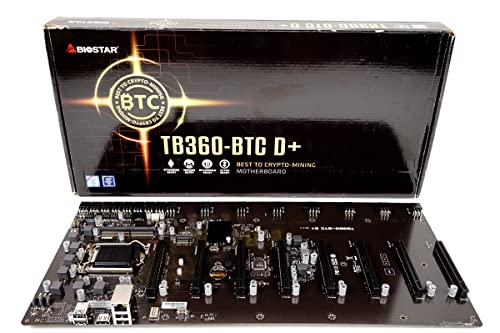
This Biostar TB360-BTC D+ is an LGA1151 motherboard built for Intel 8th and 9th Gen processors. It uses DDR4 SODIMM memory and supports up to eight GPUs. The board measures 20 by 10 by 2 inches. It targets server and mining use cases. You will need compatible components for this specific socket and memory type.
Pros
- Supports Intel 8th and 9th Gen CPUs via LGA1151 socket
- Compatible with DDR4 SODIMM memory modules
- Designed to support eight GPUs for mining
- Uses Intel 300 Series chipset
Cons
- Requires DDR4 SODIMM memory instead of standard DIMMs
- Targeted specifically at server and mining use cases
- Limited to Intel 8th and 9th Gen processors
Good fit if
- You are building a dedicated GPU mining rig
- You need support for eight graphics cards
- You are using Intel 8th or 9th Gen CPUs
Skip if
- You require standard DDR4 DIMM memory slots
- You plan to use AMD processors
- You need a board for general consumer desktop use
Verdict: Biostar TB360-BTC D+ LGA1151 Mining Board is a specialized solution for users building high-GPU-count mining rigs with Intel 8th or 9th Gen processors. It fits your needs if you prioritize multi-GPU support over standard desktop features.
Specifications side by side
| Spec | Biostar Mini ITX Integrated AMD DDR3 Motherboard | Biostar LGA 1151 8 GPU Server Board |
|---|---|---|
| CPU Socket | not stated | LGA1151 |
| Chipset | not stated | Intel 300 Series |
| Form Factor | mITX | not stated |
| Memory Type | DDR3 | DDR4 |
| Use Case | not stated | Server |
| Dimensions | 6.69 × 6.69 × 4.09 inches | 20 × 10 × 2 inches |
| Weight | 1.15 pounds | not stated |
| Model | A68N-2100K | TB360-BTC D+ |
Frequently asked questions
Does the Biostar Mini ITX AMD board support DDR4 memory?
No, it does not. The Biostar A68N-2100K is designed specifically for DDR3 memory modules. You must use DDR3 RAM to ensure compatibility. This limitation is typical for older integrated AMD platforms. It does not support the newer DDR4 standard found in modern Intel systems.
Can I upgrade the CPU on the Biostar LGA 1151 mining board?
Yes, you can. This board features an LGA 1151 socket, which accepts Intel 8th and 9th Gen processors. Unlike the integrated AMD model, you can remove and replace the CPU. This allows for potential upgrades within the supported processor generation range.
What is the physical size of the Biostar Mini ITX motherboard?
The board measures 6.69 inches in width and height, with a height of 4.09 inches. It weighs 1.15 pounds. This Mini ITX form factor is designed for small cases. It offers a compact footprint suitable for builds where space is limited.
Is the Biostar LGA 1151 board suitable for a standard desktop PC?
It is specialized for server or mining use cases. The board is designed for multi-GPU rigs rather than standard desktop tasks. While it supports Intel CPUs, its features prioritize GPU connectivity over typical desktop convenience. You should consider it only for specific high-GPU-count builds.
Does the AMD board have an LGA socket for CPU installation?
No, it does not have an LGA socket. The AMD board uses an integrated design, meaning the processor is built directly onto the motherboard. You cannot install a separate CPU. This contrasts with the LGA 1151 board, which uses a standard socket.
What is the length of the Biostar LGA 1151 server board?
The board is 20 inches long. It also measures 10 inches in width and 2 inches in height. This large form factor is necessary to accommodate multiple GPU slots. It is significantly larger than standard desktop motherboards and requires a compatible case.