ASUS ROG Maximus DDR5 ATX Motherboard Review: Specs, Pros and Cons
As an Amazon Associate we earn from qualifying purchases. Links on this page are affiliate links.
This asus rog maximus z790 hero review covers the ASUS ROG Maximus DDR5 ATX Motherboard, a high-end platform for Intel’s 14th, 13th, and 12th Gen Core processors. It features an LGA 1700 socket and supports PCIe 5.0 for next-generation storage and graphics. The board also includes DDR5 memory slots, providing the bandwidth needed for modern gaming and content creation tasks. With five M.2 slots and robust power delivery, it is built for enthusiasts who demand speed and expansion. This guide explains how these specifications translate into real-world performance and setup flexibility for your PC build.
What stands out
- 20+1 teamed power stages rated for 90 A provide stable power for high-end CPUs.
- Five M.2 slots offer extensive storage expansion with dedicated heatsinks for thermal management.
- Onboard Wi-Fi 6E and Bluetooth 5.2 ensure fast, low-latency wireless connectivity.
- Intel 2.5Gb Ethernet supports high-speed wired networking for gaming and file transfers.
- Includes AI Overclocking and AI Cooling II tools for automated system optimization.
Who it fits
Good fit for
This motherboard suits enthusiasts building high-performance gaming PCs or content creation workstations using Intel 12th, 13th, or 14th Gen processors. If you need multiple fast NVMe drives, the five M.2 slots are ideal. Gamers who want low-latency wireless connections will appreciate Wi-Fi 6E and Bluetooth 5.2. The robust power delivery handles demanding CPUs, while the AI tools simplify setup. It is best for users who prioritize speed, connectivity, and advanced thermal management in an ATX form factor.
Who should skip it
You should look elsewhere if you are building a budget PC or using older Intel processors not supported by the LGA 1700 socket. The ATX form factor requires a mid-tower or full-tower case, so small-form-factor builders will find it too large. If you do not need Wi-Fi 6E or 2.5Gb Ethernet, the integrated networking may be unnecessary. Users seeking a simpler setup without advanced AI tuning tools might prefer a more basic model. The focus on high-end specs makes it less suitable for casual office builds.
Verdict: The ASUS ROG Maximus Z790 Hero is a powerful, feature-rich motherboard for high-end Intel builds. Its extensive connectivity and robust power delivery make it a strong choice for enthusiasts.
Key specs explained
CPU Socket: LGA 1700
This socket holds Intel’s 12th, 13th, and 14th Gen Core processors. You can use older or newer chips from these generations without changing the motherboard. It ensures compatibility with a wide range of high-performance CPUs. If you plan to upgrade your processor later within these generations, this socket provides flexibility and future-proofing for your build.
Memory Type: DDR5
DDR5 is the latest standard for system memory, offering higher bandwidth and efficiency than previous generations. This allows for faster data transfer between your CPU and RAM, which benefits gaming and heavy workloads. You must purchase DDR5 modules, as older DDR4 sticks will not fit. This ensures your system runs at peak performance levels for demanding applications.
PCIe Version: PCIe 5.0
PCIe 5.0 doubles the data transfer speeds of PCIe 4.0 for compatible components. This is ideal for future graphics cards and ultra-fast NVMe SSDs. While current devices may not fully utilize this speed, it prepares your system for next-generation hardware. If you buy high-end storage or GPUs now, this interface ensures you are not bottlenecked by older connection standards.
Power Phases: 20+1
The 20+1 power phases deliver stable electricity to the CPU and other components. More phases spread the electrical load, reducing heat and improving efficiency under heavy stress. This robust power delivery is essential for high-end processors that draw significant current. It ensures consistent performance during gaming or rendering tasks without voltage drops or thermal throttling.
Wi-Fi Standard: Wi-Fi 6E
Wi-Fi 6E adds a 6 GHz band to your wireless connections, reducing interference and latency. This provides a more stable and faster wireless experience for gaming and streaming. You benefit from lower ping times and higher throughput compared to older Wi-Fi standards. This is particularly useful if you place your PC near other wireless devices or in a crowded network environment.
Design and build quality
The listing describes the ASUS ROG Maximus Z790 Hero as an ATX motherboard with a black finish. Its physical dimensions are 12.2 inches by 14.6 inches. The board weighs 9.3 pounds. This mass suggests substantial internal components and heavy shielding. You will need a case that supports standard ATX form factors to accommodate its size. The weight indicates a robust chassis designed to protect sensitive circuitry during transport and installation.
Thermal management is a key part of the design. According to the listing, the board includes VRM heatsinks and an integrated aluminum I/O cover. These elements help dissipate heat from the power delivery system. There are also triple M.2 heatsinks and dual embedded backplates for storage drives. A high-conductivity thermal pad connects critical components. This setup helps maintain stable temperatures under load, which is essential for sustained performance in gaming or heavy workloads. The ROG Water-Cooling Zone is also present for custom loop builders.
Power delivery is rated for 90 A per phase across 20+1 teamed stages. ProCool II connectors and MicroFine alloy chokes support this robust solution. This configuration ensures clean power reaches the CPU, even during intense tasks. The layout prioritizes stability and thermal efficiency. You get a platform built for high-end Intel processors. The materials and structure aim to support demanding usage scenarios without compromising reliability.
Setup and everyday use
Setting up this motherboard involves installing an Intel 12th, 13th, or 14th Gen Core processor into the LGA 1700 socket. You will need DDR5 memory modules to populate the memory slots. The listing highlights a robust 20+1 power stage design rated for 90 amps. This configuration supports high-power CPUs under load. You should connect the ProCool II power connectors to ensure stable power delivery. The board includes AI Overclocking and AI Cooling II tools. These features help you configure system performance and thermal management without manual tuning. You can use AI Networking to prioritize traffic for gaming sessions. The integrated Intel 2.5Gb Ethernet port provides a wired connection for low-latency data transfer. Wireless connectivity is handled by onboard Wi-Fi 6E and Bluetooth V5.2. This allows you to link peripherals and access networks without additional cards. Storage expansion is supported by five M.2 slots. The listing notes triple M.2 heatsinks and dual embedded backplates. These components help manage heat from high-speed NVMe drives during intensive tasks. The VRM heatsinks and integrated aluminum I/O cover assist in dissipating heat from the power delivery system. You can also utilize the ROG Water-Cooling Zone if you plan to install custom liquid cooling loops. Two-Way AI Noise-Cancelation is included to improve audio clarity during calls or voice chats. The board is designed for gaming use cases. Its specifications suggest it is built to handle demanding workloads and high frame rates. You get a platform that balances raw performance with automated software utilities for easier management.
Before you buy this motherboard
You need a compatible Intel 12th, 13th, or 14th Gen Core processor to use this LGA 1700 board. DDR5 memory is required, so verify your modules match the supported speeds. The 20+1 power stages handle high-end CPUs, but ensure your power supply unit provides sufficient wattage for stable operation. Check your case dimensions, as the ATX form factor and 14.6-inch height may not fit smaller chassis. The integrated Wi-Fi 6E and Bluetooth 5.2 reduce the need for expansion cards, but confirm your router supports Wi-Fi 6E for full benefits. This model sits alongside other Hero variants like the Z890 series. Consider if you need the latest LGA 1851 socket or stick with the proven 1700 platform. Regular BIOS updates may be necessary for new CPU support. Keep drivers current for optimal performance with GameFirst VI and AI Cooling II features.
Check before you buy
- Verify your CPU is 12th, 13th, or 14th Gen Intel Core
- Ensure your case fits the 14.6-inch ATX height
- Confirm your power supply handles the 20+1 phase load
- Check if your router supports Wi-Fi 6E
The product at a glance
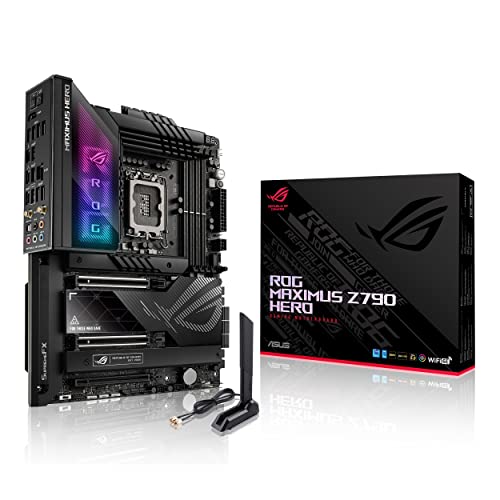
ASUS ROG Maximus DDR5 ATX Motherboard
Best for: high-end Intel gaming and storage-heavy builds
- CPU Socket
- LGA 1700
- Form Factor
- ATX
- Memory Type
- DDR5
- PCIe Version
- PCIe 5.0
- M.2 Slots
- 5
- Wi-Fi Standard
- Wi-Fi 6E
View on Amazon: ASUS ROG Maximus DDR5 ATX Motherboard Affiliate link
This is an ATX motherboard built for Intel 12th, 13th, and 14th Gen processors on the LGA 1700 socket. It supports DDR5 memory and PCIe 5.0 for high-speed components. The board features a robust 20+1 power stage design and includes Wi-Fi 6E along with 2.5Gb Ethernet. You get five M.2 slots for storage expansion. It suits users who need a reliable foundation for gaming and heavy multitasking.
Pros
- Supports Intel 12th, 13th, and 14th Gen CPUs via LGA 1700 socket
- 20+1 power stages rated for 90 A for stable performance
- Includes Wi-Fi 6E and 2.5Gb Ethernet connectivity
- Provides five M.2 slots for storage expansion
- Features AI Overclocking and AI Cooling II tools
Cons
- Heavy build at 9.3 pounds
- Limited to Wi-Fi 6E instead of newer Wi-Fi 7
- Requires DDR5 memory which may increase system cost
Good fit if
- You are building a high-end gaming PC with Intel 13th or 14th Gen
- You need extensive M.2 storage options for large files
- You want integrated Wi-Fi 6E and fast wired networking
Skip if
- You prefer the latest Wi-Fi 7 standard
- You are building with AMD processors
- You need a smaller form factor than ATX
Verdict: ASUS ROG Maximus Z790 Hero ATX delivers a powerful platform for Intel 14th Gen users who prioritize storage capacity and connectivity. It is ideal for builders who need a stable power delivery system and modern networking standards.
Specifications side by side
| Spec | ASUS ROG Maximus DDR5 ATX Motherboard |
|---|---|
| CPU Socket | LGA 1700 |
| Form Factor | ATX |
| Memory Type | DDR5 |
| PCIe Version | PCIe 5.0 |
| M.2 Slots | 5 |
| Wi-Fi Standard | Wi-Fi 6E |
| Ethernet Speed | 2.5 GbE |
| Power Phases | 20+1 |
| Wi-Fi | Wi-Fi 6E |
| Use Case | Gaming |
| Dimensions | 12.2 × 4.5 × 14.6 inches |
| Weight | 9.3 pounds |
| Size | Z790 Hero|M.2 x5|WiFi 6E| |
| Color | BLACK |
| Model | ROG MAXIMUS Z790 HERO |
Frequently asked questions
Does the ASUS ROG Maximus support DDR5 memory?
Yes, this motherboard is built for DDR5 memory modules. It does not support older DDR4 RAM, so you must purchase DDR5 sticks to populate the slots. This ensures you get the latest memory speeds and bandwidth available for modern Intel processors.
What CPU socket does this motherboard use?
It uses the LGA 1700 socket. This allows you to install Intel 12th, 13th, or 14th Gen Core processors. You can mix and match chips from these generations as long as they fit the LGA 1700 standard. It is not compatible with AMD CPUs.
Is Wi-Fi included on this motherboard?
Yes, it features built-in Wi-Fi 6E support. You do not need to buy a separate wireless card for modern connectivity. It also includes 2.5GbE Ethernet for high-speed wired connections. This combination provides fast and reliable networking for gaming and large file transfers.
What is the form factor of this board?
The ASUS ROG Maximus is an ATX motherboard. It measures 12.2 inches by 14.6 inches and weighs 9.3 pounds. This standard size fits most mid-tower and full-tower PC cases. Ensure your case supports ATX dimensions before purchasing to guarantee proper installation and airflow.
Does it support PCIe 5.0?
Yes, the board supports PCIe 5.0 technology. This allows for faster data transfer rates with compatible graphics cards and storage devices. You can future-proof your build by using next-generation components that take advantage of this increased bandwidth for improved performance.
Is this motherboard good for gaming?
Yes, it is designed for high-end Intel gaming and storage-heavy builds. The robust power delivery and modern connectivity options suit demanding gaming rigs. It provides the stability and speed needed for intensive gaming sessions and high-resolution content creation tasks.