Supermicro Mini-ITX Celeron Motherboard or Supermicro Mini-ITX LGA 1700 Server Motherboard? Which Supermicro Model to Buy
As an Amazon Associate we earn from qualifying purchases. Links on this page are affiliate links.
You are deciding between the supermicro x10sba l b intel celeron j1900 vs mbd x13scl if o intel lga. Both are Mini-ITX motherboards from Supermicro, designed for compact builds. The main difference lies in their era and capabilities. One uses an older Celeron J1900 processor with DDR3 memory, while the other supports modern LGA-1700 CPUs and DDR5 RAM. This choice defines whether you need legacy compatibility or current server performance.
Key differences
| Aspect | Supermicro Mini-ITX Celeron Motherboard | Supermicro Mini-ITX LGA 1700 Server Motherboard |
|---|---|---|
| CPU Socket | Intel Celeron J1900 | LGA-1700 |
| Memory Type | DDR3 | DDR5 |
| PCIe Version | not listed | PCIe 5.0 |
| Chipset | not listed | Intel C262 |
| Use Case | not listed | Server |
Which one should you choose?
Choose Supermicro Mini-ITX Celeron Motherboard if
- You need a low-power, integrated solution for legacy systems.
- You require a compact build with DDR3 memory support.
- You are building a simple network appliance with 2GbE.
Choose Supermicro Mini-ITX LGA 1700 Server Motherboard if
- You need modern server performance with LGA-1700 processors.
- You require high-speed DDR5 memory and PCIe 5.0 expansion.
- You need advanced RAID options and ECC memory support.
Verdict: Choose the X10SBA-L-B if you need a simple, low-power platform for legacy or lightweight tasks. Pick the MBD-X13SCL-IF-O for modern server workloads requiring high speed and expansion. Your decision depends on whether you prioritize current technology or established simplicity.
Comparing Two Supermicro Mini-ITX Options
CPU Socket
Product A, the Supermicro Mini-ITX Celeron Motherboard, uses a fixed Intel Celeron J1900 processor. You cannot upgrade the CPU on this board, as it is soldered directly to the motherboard. This limits your processing power to the capabilities of that specific older chip. Product B, the Supermicro Mini-ITX LGA 1700 Server Motherboard, features an LGA-1700 socket. This allows you to install various Intel processors, including Xeon 6300-series, E-2400 series, or Pentium models. The socket design gives you the flexibility to choose a CPU that matches your specific performance needs.
Memory Type
The memory technologies differ significantly between these two boards. Product A supports DDR3 memory. DDR3 is an older standard that offers lower bandwidth and higher power consumption compared to modern alternatives. Product B supports DDR5 memory, specifically DDR5-4800MHz. DDR5 provides much faster data transfer rates and improved efficiency. Product B also supports up to 64GB of ECC Unbuffered DIMM memory across its two slots. This error-correcting code memory is vital for server stability. If you need high-speed data processing or large memory capacity for virtualization, Product B is the clear choice.
PCIe Version
Expansion capabilities depend on the PCIe version supported by the motherboard. Product A does not list specific PCIe generation details in the provided data, but it is an older platform. Product B, the Supermicro Mini-ITX LGA 1700 Server Motherboard, features a PCIe 5.0 x16 slot. PCIe 5.0 offers double the bandwidth of PCIe 4.0, allowing for significantly faster data transfer to graphics cards or high-end NVMe storage devices. It also includes two SlimSAS connectors that can support PCIe 4.0 devices. For modern expansion cards and storage, Product B provides superior connectivity standards.
Ethernet Speed
Network connectivity is a key specification for server and storage builds. Product A, the Supermicro Mini-ITX Celeron Motherboard, lists 2GbE Ethernet speed. This provides a solid baseline for network traffic. The data for Product B does not explicitly state its Ethernet speed. While both boards are Mini-ITX, the lack of explicit network speed data for Product B prevents a direct comparison on this specific metric. You may need to check the full technical manual for Product B to confirm its network ports. Based on the available data, Product A has a confirmed network speed advantage.
Use Case
The intended use case distinguishes these motherboards. Product A is built around the Celeron J1900, which is suitable for lightweight tasks, basic networking, or simple embedded applications. It is a complete solution for low-power, fixed-function builds. Product B is explicitly labeled as a Server Motherboard. It supports server-grade CPUs and ECC memory, making it ideal for running virtual machines, database servers, or network-attached storage. The LGA-1700 socket and modern chipset allow for more complex and demanding workloads. If you are building a server, Product B is designed for that purpose.
Choose the right Supermicro Mini-ITX board
Users needing modern server performance
The Supermicro Mini-ITX LGA 1700 Server Motherboard supports Intel Xeon and Pentium processors in an LGA-1700 socket. It features DDR5 memory up to 64GB and PCIe 5.0 connectivity. This board offers significant upgrades in speed and expandability for modern server applications compared to older platforms.
Budget-conscious embedded system builders
The Supermicro Mini-ITX Celeron Motherboard integrates the Intel Celeron J1900 processor. It uses DDR3 memory and includes 2GbE Ethernet. This fixed-processor design is suitable for simple, low-power embedded tasks where high performance is not required, providing a straightforward solution for basic computing needs.
Developers requiring ECC memory support
If your project demands data integrity, the LGA 1700 model supports ECC Unbuffered DIMM. It handles up to 64GB of DDR5-4800MHz memory. This specification ensures stable operation for critical server workloads, a feature absent in the older Celeron-based board which lacks ECC support in its DDR3 configuration.
The products compared

Supermicro Mini-ITX Celeron Motherboard
Best for: compact dual-ethernet server builds
- Form Factor
- Mini-ITX
- Memory Type
- DDR3
- Ethernet Speed
- 2GbE
- Dimensions
- 13 × 10 × 2 inches
- Weight
- 4 pounds
View on Amazon: Supermicro Mini-ITX Celeron Motherboard Affiliate link
The Supermicro X10SBA-L-B is a Mini-ITX motherboard built around the Intel Celeron J1900 processor running at 2.42GHz. It uses DDR3 memory and includes dual Gigabit Ethernet ports. This board measures 10 by 13 inches and weighs 4 pounds. It suits users who need a compact, reliable server foundation with basic networking capabilities for light workloads.
Pros
- Intel Celeron J1900 CPU at 2.42GHz
- Mini-ITX form factor for small cases
- Dual Gigabit Ethernet ports
- DDR3 memory support
Cons
- Uses older DDR3 memory standard
- Powered by entry-level Celeron J1900 processor
- Heavier at 4 pounds compared to modern boards
Good fit if
- You need a compact Mini-ITX server board
- You require dual Gigabit Ethernet connectivity
- You are building a low-power NAS or router
Skip if
- You need the latest DDR4 or DDR5 memory support
- You require high-performance computing for heavy tasks
- You want a lighter, more modern LGA 1700 platform
Verdict: Supermicro X10SBA-L-B Mini-ITX Celeron Board is a solid choice for users prioritizing compact size and dual Ethernet ports over raw processing power. It fits well in small form factor enclosures for basic server duties.
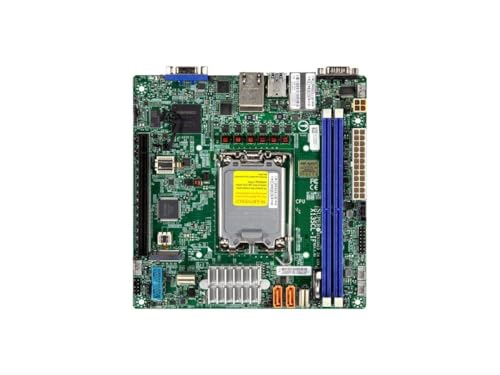
Supermicro Mini-ITX LGA 1700 Server Motherboard
Best for: Compact Intel LGA 1700 servers needing ECC memory
- CPU Socket
- LGA-1700
- Chipset
- Intel C262
- Form Factor
- Mini-ITX
- Memory Type
- DDR5
- PCIe Version
- PCIe 5.0
- Use Case
- Server
View on Amazon: Supermicro Mini-ITX LGA 1700 Server Motherboard Affiliate link
This Supermicro Mini-ITX motherboard uses an LGA 1700 socket for Intel Xeon, Pentium, or Celeron processors. It supports up to 64GB of DDR5-4800MHz ECC memory across two slots. The board features one PCIe 5.0 x16 slot and two SlimSAS connectors for high-speed storage. It is designed for server workloads requiring reliable ECC memory and modern I/O.
Pros
- Supports Intel Xeon 6300-series and E-2400 Series CPUs
- Includes one PCIe 5.0 x16 expansion slot
- Offers up to 64GB DDR5-4800MHz ECC Unbuffered DIMM support
- Features two SlimSAS connectors for flexible storage connectivity
Cons
- Only two DIMM slots limit maximum memory capacity compared to larger boards
- Weighs 3 pounds, which is heavier than typical consumer Mini-ITX boards
- Lacks standard SATA ports, relying on SlimSAS and SATA3 via controller
Good fit if
- You need ECC memory for data integrity in a server build
- You want PCIe 5.0 bandwidth for modern graphics or NVMe cards
- You are building a compact Intel LGA 1700 server
Skip if
- You require more than two memory slots for high capacity
- You need standard SATA ports without using the C262 controller
- You prefer a lighter board for portable or small form factor cases
Verdict: Supermicro Mini-ITX LGA 1700 Server Board is ideal for users building compact servers that require ECC memory and PCIe 5.0 speeds. It fits those prioritizing data reliability and modern connectivity over standard consumer features.
Specifications side by side
| Spec | Supermicro Mini-ITX Celeron Motherboard | Supermicro Mini-ITX LGA 1700 Server Motherboard |
|---|---|---|
| CPU Socket | not stated | LGA-1700 |
| Chipset | not stated | Intel C262 |
| Form Factor | Mini-ITX | Mini-ITX |
| Memory Type | DDR3 | DDR5 |
| PCIe Version | not stated | PCIe 5.0 |
| Ethernet Speed | 2GbE | not stated |
| Use Case | not stated | Server |
| Dimensions | 13 × 10 × 2 inches | not stated |
| Weight | 4 pounds | 3 pounds |
| Model | MBD-X10SBA | X13SCL-IF |
Frequently asked questions
What is the maximum RAM capacity for the Supermicro Mini-ITX LGA 1700 Server Motherboard?
This board supports up to 64GB of DDR5 memory. It uses an LGA 1700 socket compatible with Intel Xeon and Pentium processors. The DDR5 type ensures higher bandwidth and efficiency compared to older standards, making it suitable for demanding server workloads that require substantial data throughput and reliability.
Does the Supermicro Mini-ITX Celeron Motherboard support CPU upgrades?
No, you cannot upgrade the CPU on this board. The Intel Celeron J1900 processor is soldered directly to the motherboard. This fixed configuration limits your processing power to the capabilities of that specific chip. You must select this model if you are satisfied with its built-in performance levels.
Which Supermicro board is better for dual Ethernet connectivity?
The Supermicro Mini-ITX Celeron Motherboard is the better choice for dual Ethernet needs. It is specifically noted as a solid option for compact dual-ethernet server builds. This feature makes it ideal for network appliances or routers where multiple network interfaces are required in a small form factor enclosure.
What form factor do both Supermicro motherboards share?
Both motherboards share the Mini-ITX form factor. This compact size measures 10 inches by 13 inches. It allows you to build smaller systems that fit into tight spaces. The Celeron model weighs 4 pounds, while the LGA 1700 version is lighter at 3 pounds, offering flexibility in chassis selection.
Can I use ECC memory with the Supermicro Mini-ITX LGA 1700 Server Motherboard?
Yes, this motherboard is designed for ECC memory support. It is ideal for users building compact servers that require data reliability. The inclusion of ECC helps prevent data corruption during intensive server tasks. This feature distinguishes it from standard consumer boards and makes it suitable for critical infrastructure applications.
What generation of PCIe does the Supermicro Mini-ITX LGA 1700 Server Motherboard support?
It supports PCIe 5.0 speeds. This modern connectivity standard allows for faster data transfer rates between the CPU and expansion cards. If you need high-speed storage or networking solutions, this board provides the necessary bandwidth. It prioritizes modern connectivity over standard consumer features found in older hardware generations.
Is the Supermicro Mini-ITX Celeron Motherboard suitable for basic server duties?
Yes, it fits well for basic server duties. It prioritizes compact size and dual Ethernet ports over raw processing power. This makes it a practical choice for lightweight tasks like file serving or simple network management. It is not designed for heavy computational loads but excels in space-constrained environments.