StoneStorm Q670 8-Bay NAS Mini ITX Motherboard Review: Who It Fits and Who Should Skip It
As an Amazon Associate we earn from qualifying purchases. Links on this page are affiliate links.
This stonestorm q670 8 bay NAS mini itx motherboard review focuses on a compact board built for storage-heavy builds. It features an LGA1700 socket for 12th, 13th, and 14th Gen Intel processors and supports up to eight SATA drives via two SFF-8643 cables. The board also includes three M.2 NVMe slots and dual 2.5GbE network ports. You get DDR5 memory support and PCIe 5.0 expansion. This setup targets users who need high storage density in a small footprint without sacrificing modern connectivity options.
What stands out
- Supports eight SATA drives using two SFF-8643 cables for expandable storage capacity
- Dual 2.5GbE ports, including one i226-LM with vPro support for remote management
- Three M.2 NVMe slots with PCIe 4.0 x4 speeds for fast SSD access
- LGA1700 socket compatible with 12th, 13th, and 14th Gen Intel desktop processors
- Compact 6.7 x 6.7 inch Mini-ITX form factor fits small chassis
Who it fits
Good fit for
This board suits home lab enthusiasts and NAS builders who need maximum storage in a Mini-ITX case. If you want to run a dense storage array with eight drives while keeping your build compact, this fits. The dual 2.5GbE ports help if you need fast internal network transfer speeds. The vPro support on the i226-LM port is useful for remote maintenance. You should choose this if you prioritize storage expansion and small form factor over high-end gaming performance.
Who should skip it
Skip this if you need more than two RAM sticks, as it only has two DDR5 slots. It is not ideal for heavy gaming due to the lack of robust VRM cooling for high-TDP CPUs. If you require USB-C for video output, note that the port supports data transfer only. You should look elsewhere if you need built-in Wi-Fi, as none is listed. Also, avoid this if you want a board with more than three M.2 slots or need PCIe 5.0 for graphics rather than expansion cards.
Verdict: The StoneStorm Q670 is a specialized Mini-ITX board for users prioritizing eight-bay storage expansion in a small form factor. It offers solid connectivity for NAS builds but lacks features needed for high-end gaming or extensive RAM upgrades.
Key specs explained
CPU Socket: LGA1700
This socket fits 12th, 13th, and 14th Gen Intel Core processors. You can use i3, i5, or i7 chips. The listing suggests T-Series parts for better energy efficiency. This compatibility lets you choose from many modern CPUs. It ensures your processor will physically fit and communicate with the board's chipset for stable operation.
Form Factor: Mini ITX
The board measures 6.7 by 6.7 inches. This small size fits into compact cases. It saves desk space but limits expansion slots. You must buy a case designed for Mini ITX boards. This form factor is ideal for tight NAS builds where storage density matters more than having many extra PCIe slots for peripherals.
Memory Type: DDR5
This board uses DDR5 RAM modules. It supports up to 64GB across two slots. Speeds start at 4800MHz for 12th Gen CPUs and 5600MHz for newer chips. DDR5 offers higher bandwidth than older DDR4. This helps with data throughput for your NAS tasks. You need to buy DDR5 sticks, not DDR4, to ensure compatibility.
Ethernet Speed: 2.5GbE
The board includes two 2.5GbE ports using Intel i226 chips. One port supports vPro for remote management. This speed is faster than standard Gigabit Ethernet. It allows quicker file transfers between your NAS and other devices on the network. You benefit from reduced bottlenecks when moving large files across your local network infrastructure.
M.2 Slots: 3
You get three M.2 NVMe slots. Two are PCIe 4.0 x4 on the back. One is PCIe 4.0 x4 on the front. This lets you add fast SSDs for caching or system storage. The front slot supports 2280 or 22110 sizes. This flexibility helps you build a storage array that balances speed and capacity for your specific NAS workload requirements.
Compact size and layout
The StoneStorm Q670 measures 6.7 inches by 6.7 inches. It is a Mini-ITX board with a height of one inch. The listing notes it weighs 1.32 pounds. This small footprint allows you to fit the board into tight cases. The compact design is ideal for small form factor NAS builds where space is limited.
The board is white and includes an I/O shield. According to the listing, it uses an LGA1700 socket. This socket accepts 12th, 13th, and 14th Gen Intel desktop processors. The listing recommends T-Series CPUs for lower power draw. You will need to connect both a 24-pin and an 8-pin power cable to start the system. The board supports DDR5 memory with two slots. It also features three M.2 slots for NVMe drives. These slots support PCIe 4.0 speeds.
You can expand storage to eight SATA drives using two SFF-8643 cables included in the package. The board has dual 2.5GbE ports. One port supports vPro for remote management. This feature requires a compatible CPU and BIOS settings. The layout places M.2 slots on both the front and back. This design helps manage cable clutter in small enclosures. The board supports Windows 10/11 and Linux. You must press the delete key during boot to enter the BIOS. First boot may take time to read memory information.
Setup and everyday use
Setting up this Mini-ITX board requires attention to power connections. The listing specifies that you must connect both the 24-pin and 8-pin power cables to start the system. You should expect a delay on the first boot. The motherboard takes a few minutes to read memory information during initial startup. Patience is necessary before the system fully initializes. To enter the BIOS configuration menu, you need to keep pressing the "DEL" key while the computer boots. For detailed instructions, you must contact the seller for the user manual. The package includes necessary screws, an I/O shield, and two SFF-8643 cables for drive expansion. For daily operation, the board supports Windows 10, Windows 11, and Linux operating systems. You can use desktop DDR5 RAM, with speeds of 4800MHz for 12th Gen CPUs and 5600MHz for 13th Gen and newer processors. The system supports up to 64GB of memory. Storage expansion is handled through three M.2 slots and SATA drives connected via the included cables. Networking relies on two 2.5GbE ports. One port supports Intel vPro technology for remote system repair, provided your CPU has integrated graphics and you enable the feature in BIOS. Display output is available through HDMI 2.0 and DisplayPort 1.4, both supporting 4K resolution at 60Hz. You can also install PCIe expansion cards, including graphics or network adapters, into the PCIe 5.0 x16 slot. The board is designed for stable, high-productivity environments rather than casual desktop use.
Before You Buy This Board
Before you buy, verify your case supports the Mini-ITX form factor. This board measures 6.7 by 6.7 inches. You must secure both the 24-pin and 8-pin power connectors for stability. Check your CPU selection carefully. The listing recommends T-Series processors for energy efficiency, which matters in a small enclosure. You need DDR5 memory, with speeds depending on your specific generation. Ensure your storage needs align with the three M.2 slots and the eight SATA drives via SFF-8643 cables. The dual 2.5GbE ports suit network-heavy tasks. If you plan to use vPro, confirm your CPU has integrated graphics. Keep in mind the initial boot delay as the board reads memory. This setup fits users prioritizing dense storage and network connectivity in a tight space. It suits those willing to manage compact build logistics over standard ATX convenience.
Check before you buy
- Confirm your case fits the 6.7-inch Mini-ITX size.
- Verify your CPU supports DDR5 and matches socket requirements.
- Check if you need vPro features and integrated graphics.
- Ensure you have both 24-pin and 8-pin power cables.
The product at a glance
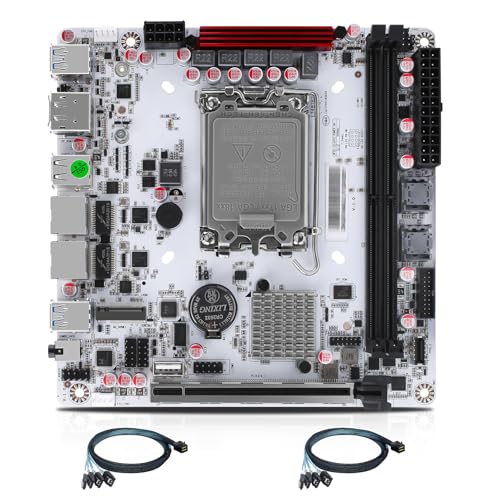
StoneStorm Q670 8-Bay Mini-ITX
Best for: Compact 8-bay NAS builds with dual 2.5GbE networking
- CPU Socket
- LGA1700
- Form Factor
- Mini ITX
- Memory Type
- DDR5
- PCIe Version
- PCIe 5.0
- M.2 Slots
- 3
- Ethernet Speed
- 2.5GbE
View on Amazon: StoneStorm Q670 8-Bay Mini-ITX Affiliate link
This Mini ITX motherboard targets home lab enthusiasts building compact storage servers. It supports 12th, 13th, and 14th Gen Intel LGA1700 processors and uses DDR5 memory. The board features three M.2 NVMe slots and expands to eight SATA drives via SFF-8643 cables. Dual 2.5GbE ports, including one with vPro support, provide flexible networking. It is designed for users who need high storage density in a small form factor.
Pros
- Expands to 8 SATA drives using included SFF-8643 cables
- Three M.2 NVMe slots for fast storage expansion
- Dual 2.5GbE ports with vPro support on the i226-LM
Cons
- Only two DDR5 DIMM slots limit maximum RAM to 64GB
- USB Type-C port supports data transfer only, not video output
- Requires both 24-pin and 8-pin power connections to boot
Good fit if
- You need a compact board that supports eight SATA drives
- You want dual 2.5GbE networking for your NAS setup
- You plan to use Intel vPro for remote system management
Skip if
- You require more than two memory slots for higher RAM capacity
- You need USB Type-C video output for display connectivity
- You prefer a standard single-power-connector motherboard design
Verdict: StoneStorm Q670 8-Bay Mini ITX NAS Motherboard fits users who prioritize storage capacity and networking flexibility in a small chassis. It is a solid choice for dedicated NAS builds but not for general-purpose gaming PCs.
Specifications side by side
| Spec | StoneStorm Q670 8-Bay Mini-ITX |
|---|---|
| CPU Socket | LGA1700 |
| Form Factor | Mini ITX |
| Memory Type | DDR5 |
| PCIe Version | PCIe 5.0 |
| M.2 Slots | 3 |
| Ethernet Speed | 2.5GbE |
| Dimensions | 6.7 × 6.7 × 1 inches |
| Weight | 1.32 pounds |
| Size | white Q670 with 2 SFF-8643 cable |
| Model | CW-L02-NMQ670PLUS |
Frequently asked questions
Is the StoneStorm Q670 suitable for a gaming PC?
No, this motherboard is not designed for gaming. It is a dedicated NAS board built for storage capacity and networking flexibility. The Mini-ITX form factor and LGA1700 socket prioritize data handling over graphical performance. You should skip this board if you plan to run high-end games or need extensive PCIe slots for graphics cards.
What kind of CPU does the StoneStorm Q670 support?
The board supports 12th, 13th, and 14th Gen Intel Core processors. It uses the LGA1700 socket, allowing you to install i3, i5, or i7 chips. The listing suggests using T-Series parts for better energy efficiency. This compatibility lets you choose from many modern CPUs to suit your storage needs.
How many hard drives can this motherboard handle?
The StoneStorm Q670 supports up to eight SATA drives. It achieves this capacity using two SFF-8643 cables. This setup is ideal for users who need high storage density in a small chassis. You can populate all eight bays to create a robust NAS system without requiring a larger motherboard.
What networking ports are included on this board?
This motherboard features dual 2.5GbE networking ports. These ports provide increased bandwidth for faster file transfers between devices on your network. The dual ports offer flexibility for link aggregation or separate network segmentation. This networking capability is a key feature for dedicated NAS builds that require high throughput.
Does the StoneStorm Q670 require specific power connections?
Yes, you must connect both the 24-pin and 8-pin power cables to start the system. The listing specifies that both connectors are necessary for stability. You should expect a slight delay on the first boot after installation. Ensuring both power sources are secure is critical for proper operation.
What is the physical size of the StoneStorm Q670?
The board measures 6.7 inches by 6.7 inches with a height of one inch. It weighs 1.32 pounds. This Mini-ITX footprint allows you to fit the board into tight cases. The compact size is designed for small form factor builds where space is limited but storage capacity is high.
Who is the ideal user for this motherboard?
This board fits users who prioritize storage capacity and networking flexibility in a small chassis. It is a solid choice for dedicated NAS builds. You should consider this if you need an 8-bay solution in a compact form. It is not suitable for general-purpose gaming PCs or users needing multiple expansion slots.