Ryzen 7 vs Ryzen Threadripper Processors in 2026: Key Differences
As an Amazon Associate we earn from qualifying purchases. Links on this page are affiliate links.
When you compare a Ryzen 7 vs ryzen threadripper processor, you are looking at two distinct tiers of AMD hardware. Both series offer unlocked multi-core performance for desktop computing. The main difference lies in their target audience and physical requirements. The Ryzen 7 5800X serves mainstream users with efficient core counts. The Ryzen Threadripper 1950X targets creators needing massive parallel processing power. You must choose based on your specific workload and motherboard compatibility needs.
Key differences
| Aspect | AMD Ryzen 7 5800X Desktop Processor | AMD Ryzen Threadripper 1950X 16-Core Processor |
|---|---|---|
| Core Count | 8 cores | 16 cores |
| Thread Count | 16 threads | 32 threads |
| CPU Socket | AM4 | not listed |
| Max Boost Clock | 4.7 GHz | 4.0 GHz |
| Cache Size | 36 MB | 40 MB |
| PCIe Lanes | PCIe 4.0 on X570/B550 | 64 PCIe Gen3 Lanes |
Which one should you choose?
Choose AMD Ryzen 7 5800X Desktop Processor if
- You want higher single-core boost speeds for gaming.
- You need a mainstream AM4 socket for easier upgrades.
- You prefer a smaller physical footprint for standard cases.
Choose AMD Ryzen Threadripper 1950X 16-Core Processor if
- You require 16 cores for heavy rendering or simulation.
- You need 64 PCIe lanes for multiple expansion cards.
- You prioritize maximum thread count over raw clock speed.
Verdict: The Ryzen 7 5800X is the better choice for gamers and general users who value higher clock speeds and mainstream compatibility. The Ryzen Threadripper 1950X suits professionals who need double the cores and extensive connectivity for workstation tasks.
Ryzen 7 vs Threadripper: Key Specs
Core and thread count
The AMD Ryzen 7 5800X offers eight cores and sixteen threads, designed for high-performance mainstream desktop tasks. In contrast, the AMD Ryzen Threadripper 1950X doubles that capability with sixteen cores and thirty-two threads. This significant increase in parallel processing power makes the Threadripper better suited for heavy workloads like 3D rendering, video editing, or running multiple virtual machines simultaneously. If your daily routine involves standard gaming or office applications, the Ryzen 7 provides ample power. However, for professional content creation where multi-threaded performance is critical, the Threadripper's additional cores provide a clear advantage in throughput and efficiency.
CPU socket compatibility
Motherboard compatibility is a major differentiator between these two processors. The Ryzen 7 5800X utilizes the AM4 socket, which is widely available across many budget and mid-range motherboards, including X570 and B550 chipsets. This makes building a system with the Ryzen 7 relatively straightforward and cost-effective. The Threadripper 1950X requires a specialized TR4 socket, which is found only on high-end workstation motherboards. These boards are significantly more expensive and often larger. For most users, the AM4 platform offers better accessibility and easier upgrades, while the Threadripper demands a specific, premium motherboard ecosystem.
PCIe lane availability
Expansion capabilities differ greatly due to the number of available PCIe lanes. The Ryzen 7 5800X supports PCIe 4.0, but only on compatible X570 and B550 motherboards, providing a limited number of high-speed lanes suitable for a single GPU and a few storage drives. The Threadripper 1950X provides sixty-four PCIe Gen3 lanes. This abundance allows you to install multiple high-speed NVMe SSDs, capture cards, or additional GPUs without bottlenecking. If you plan to build a system with extensive peripheral connectivity or multiple storage arrays, the Threadripper's extensive lane count is essential, whereas the Ryzen 7 is sufficient for typical single-GPU setups.
Memory channel support
Memory bandwidth and capacity are handled differently by each series. The Ryzen 7 5800X supports DDR4 memory at 3200 MHz, typically running in dual-channel mode on standard motherboards. This provides good performance for gaming and general productivity. The Threadripper 1950X features quad-channel DDR4 support. Quad-channel architecture significantly increases memory bandwidth, which is crucial for data-heavy applications like scientific computing or large dataset analysis. While the Ryzen 7 handles everyday memory tasks efficiently, the Threadripper's architecture ensures that data-intensive applications can process information faster by utilizing more memory channels simultaneously.
Cache and boost speeds
Single-core performance and cache size influence gaming and snappy application response. The Ryzen 7 5800X boasts 36 MB of cache and a max boost clock of 4.7 GHz, making it excellent for gaming and single-threaded tasks. The Threadripper 1950X has 40 MB of cache but a lower max boost of 4.0 GHz, or 4.2 GHz with XFR. While the Threadripper has slightly more cache, the Ryzen 7's higher boost clock often results in faster single-core performance. For gamers and users who prioritize quick application launches over multi-threaded workloads, the Ryzen 7's higher frequencies provide a noticeable advantage in responsiveness.
Which Ryzen Should You Choose
Mainstream gamers and general users
The Ryzen 7 5800X delivers elite performance for popular games with 100+ FPS potential. Its 8 cores and 16 threads handle daily tasks efficiently. You get a high 4.7 GHz max boost clock for snappy responsiveness. It fits standard AM4 motherboards, making it a practical choice for most desktop builds.
Content creators needing heavy multitasking
The Threadripper 1950X offers sixteen cores and thirty-two threads for demanding workloads. This doubled core count accelerates rendering and compilation tasks significantly. With 40MB of cache memory, it maintains speed under heavy loads. You get the processing power required for professional video editing and 3D modeling applications.
Users building expansion-heavy workstations
You need extensive connectivity for multiple drives and peripherals. The Threadripper 1950X provides 64 PCIe Gen3 lanes, far exceeding the Ryzen 7. This allows you to connect numerous high-speed devices without bottlenecking. It supports quad-channel DDR4 memory for higher bandwidth, ideal for data-intensive professional workflows.
Quick picks
| # | Product | Best for | Price |
|---|---|---|---|
| 1 | AMD Ryzen 7 5800X Desktop Processor | Mainstream gaming and general desktop use | Check price of AMD Ryzen 7 5800X Desktop Processor on Amazon |
| 2 | AMD Ryzen Threadripper 1950X 16-Core Processor | Professional workstations needing 16 cores | Check price of AMD Ryzen Threadripper 1950X 16-Core Processor on Amazon |
The products compared

AMD Ryzen 7 5800X Desktop Processor
Best for: Mainstream gaming and general desktop use
- Series
- Ryzen 7 (what this guide is about)
- Core Count
- 8 cores
- Thread Count
- 16 threads
- CPU Socket
- AM4
- Max Boost Clock
- 4.7 GHz
- Cache Size
- 36 MB
View on Amazon: AMD Ryzen 7 5800X Desktop Processor Affiliate link
The AMD Ryzen 7 5800X is an 8-core, 16-thread desktop processor built for the AM4 socket. It features a 4.7 GHz max boost clock and 36 MB of cache. This chip supports DDR-3200 memory and PCIe 4.0 on compatible X570 and B550 motherboards. It suits mainstream gamers and creators who need strong single-thread performance without the bulk of a Threadripper.
Pros
- 8 cores and 16 threads for multitasking
- 4.7 GHz max boost clock speed
- 36 MB of total cache memory
- Unlocked for overclocking potential
- Supports PCIe 4.0 on X570 and B550 boards
Cons
- Only 8 cores compared to 16 cores in the Threadripper 1950X
- Uses the mainstream AM4 socket instead of the HEDTR4 platform
- Does not include a stock cooler in the box
Good fit if
- You want high single-core performance for gaming
- You are building on a budget AM4 platform
- You need 8 cores for general productivity
Skip if
- You require more than 8 cores for heavy workloads
- You are building a high-end desktop workstation
- You need the PCIe lane count of a Threadripper
Verdict: The AMD Ryzen 7 5800X 8-Core Processor delivers strong mainstream performance with its 4.7 GHz boost and 8-core design. It is the right fit for gamers and enthusiasts who do not need the extreme core counts of a Threadripper.
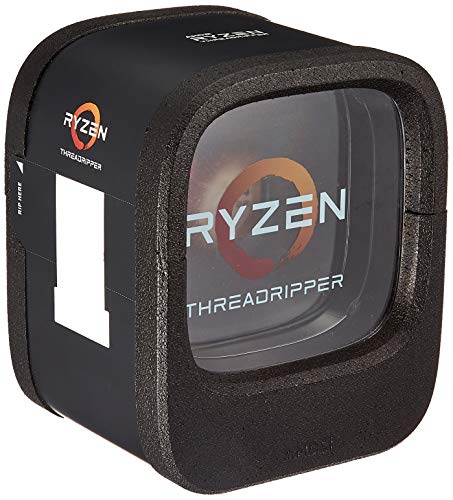
AMD Ryzen Threadripper 1950X 16-Core Processor
Best for: Professional workstations needing 16 cores
- Series
- Ryzen Threadripper (what this guide is about)
- Core Count
- 16 Cores
- Thread Count
- 32 Threads
- Max Boost Clock
- 4.0 GHz
- Cache Size
- 40MB
- Dimensions
- 3.1 × 2.2 × 0.3 inches
View on Amazon: AMD Ryzen Threadripper 1950X 16-Core Processor Affiliate link
The AMD Ryzen Threadripper 1950X delivers 16 cores and 32 threads for heavy workloads. It features a 4.0 GHz boost clock and 40 MB of cache. With 64 PCIe Gen3 lanes, it supports extensive expansion. This processor suits users who need maximum multi-threaded performance for professional tasks like 3D rendering or video editing. It is a high-end desktop solution designed for demanding applications.
Pros
- 16 cores and 32 threads for parallel processing
- 4.0 GHz Precision Boost clock speed
- 40 MB of cache memory
- 64 PCIe Gen3 lanes for expansion
Cons
- Only PCIe Gen3 support, not Gen4
- Quad-channel DDR4 memory bandwidth limit
- 68°C max temperature requires robust cooling
Good fit if
- You need 16 cores for heavy multi-threaded workloads
- You require 64 PCIe lanes for multiple GPUs
- You are building a high-end workstation
Skip if
- You only need 8 cores for gaming
- You want PCIe Gen4 connectivity
- You are on a tight budget
Verdict: AMD Ryzen Threadripper 1950X 16-Core is the right pick if you need 16 cores and 64 PCIe lanes for professional workstations. It fits users prioritizing raw multi-threaded power over single-core speed.
Specifications side by side
| Spec | AMD Ryzen 7 5800X Desktop Processor | AMD Ryzen Threadripper 1950X 16-Core Processor |
|---|---|---|
| Core Count | 8 cores | 16 Cores |
| Thread Count | 16 threads | 32 Threads |
| CPU Socket | AM4 | not stated |
| Max Boost Clock | 4.7 GHz | 4.0 GHz |
| Cache Size | 36 MB | 40MB |
| Series | Ryzen 7 | Ryzen Threadripper |
| Dimensions | 1.57 × 1.57 × 0.24 inches | 3.1 × 2.2 × 0.3 inches |
| Weight | 2.8 ounces | 3.2 ounces |
| Size | XX-Large | Processor |
| Color | Black | not stated |
| Model | AMD Ryzen 7 5800X | YD195XA8AEWOF |
Frequently asked questions
Can a Ryzen 7 5800X replace a Threadripper for video editing?
It depends on your project scale. The Ryzen 7 5800X has eight cores and sixteen threads, which is strong for mainstream tasks. However, the Threadripper 1950X offers sixteen cores and thirty-two threads. For heavy professional workloads, the extra cores in the Threadripper provide significantly more raw multi-threaded power than the Ryzen 7.
What is the main physical difference between these processors?
The Ryzen Threadripper 1950X is physically larger than the Ryzen 7 5800X. The Threadripper measures 3.1 inches in length and weighs 3.2 ounces. The Ryzen 7 5800X is smaller, measuring 1.57 inches in length and weighing 2.8 ounces. You must ensure your motherboard socket and case can accommodate the larger Threadripper form factor.
Which processor is better for pure gaming performance?
The Ryzen 7 5800X is the better choice for gaming. It features a 4.7 GHz boost clock, which helps with single-core speed. Gamers typically do not need the extreme core counts of a Threadripper. The Ryzen 7 5800X delivers strong mainstream performance that fits the needs of most desktop gamers efficiently.
How many PCIe lanes does each processor offer?
The AMD Ryzen Threadripper 1950X provides 64 PCIe lanes. This supports professional workstations with multiple high-speed devices. The data does not specify the exact lane count for the Ryzen 7 5800X, but it is designed for mainstream use rather than the extensive connectivity required by the Threadripper's 64 lanes.
Is the Ryzen Threadripper 1950X suitable for general desktop use?
It is overkill for general use. The Ryzen Threadripper 1950X is designed for professional workstations needing 16 cores. It prioritizes raw multi-threaded power over single-core speed. For general desktop tasks, the Ryzen 7 5800X with its eight cores is more appropriate and efficient for mainstream gaming and daily computing.
What is the thread count difference between the two?
The Ryzen Threadripper 1950X has thirty-two threads. The Ryzen 7 5800X has sixteen threads. This means the Threadripper can handle twice as many simultaneous processing tasks. This difference highlights the Threadripper's focus on heavy multi-threaded workloads compared to the Ryzen 7's balanced approach for mainstream applications.