What Is Ethernet Speed? A Guide for Motherboards Buyers (2026)
As an Amazon Associate we earn from qualifying purchases. Links on this page are affiliate links.
Ethernet Speed Explained For Buyers
Ethernet speed refers to the maximum data transfer rate of a wired network connection. For motherboard buyers, this specification determines how quickly your system can communicate with other devices on a local network or the internet. You will typically encounter three standard values in current listings: 1GbE, 2.5GbE, and 10GbE.
The 1GbE standard, or Gigabit Ethernet, has been the baseline for years. It offers a theoretical maximum throughput of 1,000 megabits per second. This speed is sufficient for most general home use, including streaming high-definition video and standard web browsing. If your internet plan caps at 100 or 200 Mbps, this port handles the load without issue.
The 2.5GbE option is becoming increasingly common on modern motherboards. It provides 2.5 times the bandwidth of the standard Gigabit port. This increase matters if you have a fast internet plan exceeding 1 Gbps or if you transfer large files between devices on a local network. It bridges the gap between basic connectivity and high-performance requirements.
The 10GbE specification delivers ten times the speed of the original Gigabit standard. This tier is reserved for professional workflows, such as video editing, large database management, or high-end home labs. You need compatible networking equipment, such as a 10GbE switch and appropriate cables, to realize these speeds. Most consumer routers do not support this rate.
When shopping, look for these labels in the specifications. The term "ethernet speed explained" helps you understand that higher numbers mean faster data movement. Choose 1GbE for budget builds. Select 2.5GbE for future-proofing in gaming or content creation setups. Opt for 10GbE only if your workflow demands extreme local transfer rates. Ensure your network infrastructure matches the port speed to avoid bottlenecks.
Understanding Ethernet Speed Options
2.5GbE
This speed offers 2.5 gigabits per second, bridging the gap between standard gigabit and 10-gigabit connections. It provides significantly higher bandwidth for large file transfers and local backups without requiring expensive 10GbE infrastructure. You benefit from faster LAN performance while keeping costs reasonable. The MSI PRO Z790-P WiFi is an example of a board featuring this spec, suitable for Intel 12th through 14th Gen builds. It delivers modern connectivity without the bulk of server-grade hardware. This option suits users who want more than standard gigabit but do not need enterprise-level speeds. It is a practical choice for high-performance desktops where wired stability matters.
1GbE
One gigabit per second is the long-standing standard for consumer networking. It supports typical internet speeds and basic local network tasks for most users. While adequate for streaming and web browsing, it may bottleneck large internal file transfers or high-speed local backups. The Biostar H310MHP Motherboard exemplifies this tier, targeting compact systems with older Intel processors. It fits users who prioritize form factor and basic connectivity over raw speed. If your internet plan is under 940 Mbps, this speed is often sufficient. However, gamers or creators moving large datasets might find it limiting. It remains the baseline for budget and mid-range builds.
10GbE
Ten gigabits per second provides ten times the bandwidth of standard gigabit connections. This speed is essential for dedicated servers, virtualization hosts, and users managing massive local data sets. It eliminates network congestion in high-demand environments. The Supermicro 16 Core Server Board showcases this capability, offering dense compute and networking power. It suits users who prioritize bandwidth and core count over desktop features. Similarly, the GIGABYTE X870E AORUS Xtreme targets enthusiasts needing ultra-fast wired networking alongside Wi-Fi 7. This option requires compatible switches and cables. It is not necessary for standard gaming or office use but critical for professional workstations and home labs.
Is 2.5GbE Worth the Upgrade?
Who needs it
You should prioritize motherboards with 2.5GbE if you frequently transfer large files between devices on your local network. This speed offers 2.5 gigabits per second, which is significantly faster than standard 1GbE. If you work with high-resolution video editing, large game libraries, or backup massive datasets, the extra bandwidth reduces wait times. It bridges the gap between basic gigabit and expensive 10GbE infrastructure. You benefit from faster LAN performance without the high cost of specialized cabling or switches. This spec is ideal for users who want noticeable improvements in daily data movement but do not need the extreme throughput of 10GbE. It ensures your network connection does not become a bottleneck for modern workloads.
Who can skip it
You can likely ignore 2.5GbE if your primary internet plan is below 1 gigabit per second. Most residential ISPs do not offer speeds that exceed the 1GbE limit. If you mainly browse the web, stream video, or use cloud services, standard gigabit is sufficient. The extra local network speed provides little benefit for these tasks. Instead, prioritize other specs like CPU cores, RAM capacity, or storage speed. These components have a more direct impact on overall system performance for general use. Upgrading to 2.5GbE is unnecessary if you do not have large files to move locally. Focus on getting a reliable connection that matches your internet provider's maximum speed. You will save money and avoid overpaying for features you will not use.
Ethernet Speed Glossary
Gigabit Ethernet
Standard 1 Gbps connection. Common in entry-level boards. Sufficient for most home internet plans and basic local transfers.
2.5GbE
Faster wired option. Offers 2.5 Gbps throughput. Ideal for local backups and large file moves without expensive 10GbE gear.
10GbE
High-speed wired standard. Provides 10 Gbps bandwidth. Used by professionals needing rapid data movement between servers or storage arrays.
Throughput
Actual data transfer rate. Measured in bits per second. Real-world speeds are often lower than the theoretical maximum spec.
Bandwidth
Maximum capacity of the connection. Determines how much data can flow simultaneously. Higher bandwidth supports more devices and larger files.
Local Area Network
LAN refers to your home or office network. Ethernet speed affects how fast devices communicate within this private network space.
LAN Port
Physical connector on the motherboard. Plugs into your router or switch. Determines the maximum wired speed your system can achieve.
Quick picks
| # | Product | Best for | Price |
|---|---|---|---|
| 1 | MSI PRO ATX DDR5 Motherboard | Intel 12th-14th Gen builds needing 2.5GbE LAN | Check price of MSI PRO ATX DDR5 Motherboard on Amazon |
| 2 | Biostar Intel H310 Micro-ATX Motherboard | Compact builds with older Intel CPUs | Check price of Biostar Intel H310 Micro-ATX Motherboard on Amazon |
| 3 | Supermicro 16-Core Dual 10GbE Motherboard | Dedicated servers and virtualization hosts | Check price of Supermicro 16-Core Dual 10GbE Motherboard on Amazon |
| 4 | MSI PRO DDR5 ATX Motherboard | 2.5GbE wired networking needs | Check price of MSI PRO DDR5 ATX Motherboard on Amazon |
| 5 | ASUS ROG Strix X570 ATX Motherboard | 2.5 Gbps gaming builds on AM4 | Check price of ASUS ROG Strix X570 ATX Motherboard on Amazon |
| 6 | GIGABYTE AORUS Xtreme AM5 E-ATX Motherboard | Users needing 10 GbE Ethernet and Wi-Fi 7 | Check price of GIGABYTE AORUS Xtreme AM5 E-ATX Motherboard on Amazon |
Our 6 picks

MSI PRO ATX DDR5 Motherboard
Best for: Intel 12th-14th Gen builds needing 2.5GbE LAN
- Ethernet Speed
- 2.5GbE (what this guide is about)
- CPU Socket
- LGA 1700
- Form Factor
- ATX
- Memory Type
- DDR5
- PCIe Version
- PCIe 5.0
- Wi-Fi Standard
- Wi-Fi 6E
View on Amazon: MSI PRO ATX DDR5 Motherboard Affiliate link
This MSI PRO Z790-P motherboard targets Intel 12th, 13th, and 14th Gen users seeking reliable connectivity. It features 2.5GbE LAN for faster wired transfers compared to standard Gigabit ports. You also get Wi-Fi 6E and Bluetooth 5.3 for wireless flexibility. The board supports DDR5 memory and PCIe 5.0, ensuring modern performance standards. It is an ATX form factor board suitable for standard desktop builds.
Pros
- 2.5GbE Ethernet speed for improved wired network throughput
- Wi-Fi 6E and Bluetooth 5.3 for modern wireless connectivity
- Supports 12th, 13th, and 14th Gen Intel processors
- PCIe 5.0 support for next-generation graphics cards and storage
Cons
- Ethernet speed is 2.5GbE, not the 10GbE found on some competitors
- ATX form factor requires a mid-tower or full-tower case
- No mention of built-in USB-C ports in the provided data
Good fit if
- You want faster than Gigabit wired speeds for local network transfers
- You are building with 12th, 13th, or 14th Gen Intel CPUs
- You need Wi-Fi 6E for high-bandwidth wireless connections
Skip if
- You require 10GbE networking for server-grade throughput
- You are using AMD Ryzen processors and need an AM5 socket
- You need a smaller ITX or micro-ATX board for compact builds
Verdict: MSI PRO Z790-P WiFi 2.5GbE ATX fits users who need 2.5GbE speeds and modern Intel support without the bulk of server boards.

Biostar Intel H310 Micro-ATX Motherboard
Best for: Compact builds with older Intel CPUs
- Ethernet Speed
- 1GbE (what this guide is about)
- Chipset
- Intel H310
- Form Factor
- MicroATX
- Dimensions
- 0.98 × 8.9 × 6.73 inches
- Weight
- 1.34 pounds
View on Amazon: Biostar Intel H310 Micro-ATX Motherboard Affiliate link
This Biostar motherboard uses the Intel H310 chipset and supports 8th and 9th generation Intel Core processors. It features a MicroATX form factor, measuring 8.9 by 6.73 inches. The board includes Gigabit LAN for standard wired connectivity. It weighs 1.34 pounds and offers HDMI and D-Sub outputs. This board suits users needing basic, compact builds with older Intel CPUs.
Pros
- Supports 8th and 9th Gen Intel Core processors
- Compact MicroATX form factor
- Includes Gigabit LAN connectivity
- Provides HDMI and D-Sub video outputs
Cons
- Limited to 1GbE Ethernet speed
- Supports only older 8th and 9th Gen CPUs
- MicroATX size limits expansion slots
Good fit if
- You need a compact build for older Intel hardware
- You require basic Gigabit Ethernet connectivity
- You want a simple motherboard with standard video outputs
Skip if
- You need 10GbE or 2.5GbE network speeds
- You are building with 12th, 13th, or 14th Gen Intel CPUs
- You require PCIe 4.0 or newer expansion capabilities
Verdict: Biostar H310MHP MicroATX Motherboard fits users building compact systems with 8th or 9th Gen Intel processors who only need standard Gigabit networking.

Supermicro 16-Core Dual 10GbE Motherboard
Best for: Dedicated servers and virtualization hosts
- Ethernet Speed
- 10GbE (what this guide is about)
- Core Count
- 16 Cores
View on Amazon: Supermicro 16-Core Dual 10GbE Motherboard Affiliate link
This Supermicro board targets high-density networking and compute tasks. It features 16 cores and 32 threads for robust processing power. The dual 10GbE ports provide significant bandwidth for data-intensive workflows. It suits users who need reliable, high-speed connectivity and multi-threaded performance in a compact server form factor.
Pros
- 16 cores and 32 threads for heavy multitasking
- Dual 10GbE ports for high-speed networking
- Compact server-grade design
Cons
- Limited to 16 cores compared to higher-end desktop options
- No consumer-grade audio or Wi-Fi connectivity
- Form factor may not fit standard desktop cases
Good fit if
- You need dual 10GbE networking for a home lab
- You require 16 cores for virtualization tasks
- You are building a compact server
Skip if
- You need standard desktop expansion slots
- You require built-in Wi-Fi
- You want a consumer gaming motherboard
Verdict: Supermicro 16 Core 10GbE Server Board delivers dense compute and networking power. It fits users building dedicated servers or virtualization hosts who prioritize bandwidth and core count over desktop features.

MSI PRO DDR5 ATX Motherboard
Best for: 2.5GbE wired networking needs
- Ethernet Speed
- 2.5GbE (what this guide is about)
- CPU Socket
- LGA 1700
- Chipset
- Intel B760
- Form Factor
- ATX
- Memory Type
- DDR5
- PCIe Version
- PCIe 4.0
View on Amazon: MSI PRO DDR5 ATX Motherboard Affiliate link
This ATX motherboard uses the Intel B760 chipset and LGA 1700 socket for 12th and 13th Gen Intel processors. It supports DDR5 memory and PCIe 4.0. The standout feature for your network is the 2.5 Gbps Ethernet port. You get Wi-Fi 5 for wireless connectivity. It fits standard ATX cases. This board suits users who want reliable wired speeds without needing the latest Wi-Fi standard.
Pros
- 2.5 Gbps Ethernet speed
- Supports DDR5 memory
- PCIe 4.0 connectivity
- Intel B760 chipset
Cons
- Wi-Fi 5 is older than Wi-Fi 6
- B760 chipset limits CPU overclocking
- No 10GbE support
Good fit if
- You want faster than 1 Gbps wired speeds
- You use 12th or 13th Gen Intel CPUs
- You prefer standard ATX form factor
Skip if
- You need 10 Gbps Ethernet
- You want the latest Wi-Fi standard
- You plan to overclock your CPU
Verdict: MSI PRO B760-VC WiFi ATX is a solid mid-range option for users who prioritize 2.5GbE wired speeds over cutting-edge wireless standards. It fits well in builds focused on stable performance with DDR5 and PCIe 4.0.
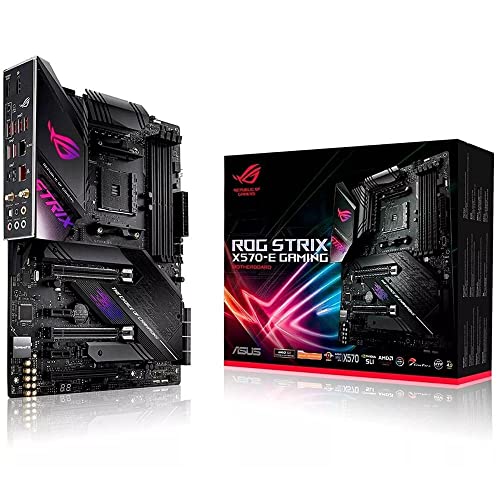
ASUS ROG Strix X570 ATX Motherboard
Best for: 2.5 Gbps gaming builds on AM4
- Ethernet Speed
- 1GbE (what this guide is about)
- CPU Socket
- AM4
- Chipset
- X570
- Form Factor
- ATX
- PCIe Version
- PCIe 4.0
- M.2 Slots
- 2
View on Amazon: ASUS ROG Strix X570 ATX Motherboard Affiliate link
This ATX motherboard pairs the AMD X570 chipset with an AM4 socket for Ryzen processors. It features dual Ethernet ports, including 2.5 Gbps LAN and Intel Gigabit Ethernet, alongside Wi-Fi 6. The board supports PCIe 4.0 and includes comprehensive cooling options. You will find it suitable for gaming builds that require faster wired networking speeds than standard gigabit connections.
Pros
- 2.5 Gbps Ethernet port for faster local network transfers
- Wi-Fi 6 (802.11ax) connectivity with MU-MIMO support
- PCIe 4.0 support for high-speed storage and graphics
- Dual M.2 slots with onboard heatsinks
Cons
- AM4 socket limits compatibility to older Ryzen CPUs
- ATX form factor requires a larger case
- No 10GbE option for extreme network throughput
Good fit if
- You need 2.5 Gbps wired speeds for gaming or streaming
- You are building with a Ryzen 3000 or 5000 series CPU
- You want Wi-Fi 6 without relying on a separate card
Skip if
- You require the latest AM5 socket for Ryzen 7000 or 9000 series
- You need 10GbE networking for professional data centers
- You are building a compact ITX or mATX system
Verdict: ASUS ROG Strix X570-E Gaming delivers 2.5 Gbps Ethernet and Wi-Fi 6 for gamers using Ryzen processors. It suits users who want faster LAN speeds than standard gigabit boards offer.

GIGABYTE AORUS Xtreme AM5 E-ATX Motherboard
Best for: Users needing 10 GbE Ethernet and Wi-Fi 7
- Ethernet Speed
- 10GbE (what this guide is about)
- CPU Socket
- AM5, LGA 1718
- Chipset
- X870E
- Form Factor
- E-ATX
- Memory Type
- DDR5
- PCIe Version
- PCIe 5.0
View on Amazon: GIGABYTE AORUS Xtreme AM5 E-ATX Motherboard Affiliate link
This E-ATX motherboard targets high-end AMD AM5 builds. It features a 10 GbE LAN port for fast wired networking and Wi-Fi 7 for wireless connections. You get four M.2 slots and PCIe 5.0 support for future storage and graphics cards. The 18+2+2 power phases handle demanding Ryzen processors. It is designed for users who need maximum bandwidth and expansion.
Pros
- 10 GbE Ethernet port for high-speed wired networking
- Wi-Fi 7 support for modern wireless connections
- Four M.2 slots for extensive storage expansion
- PCIe 5.0 support for next-gen components
- 18+2+2 power phase design for stable CPU power
Cons
- E-ATX form factor requires a large case
- Heavy build at 8.14 pounds
- 5GbE LAN port is less common than 2.5GbE
Good fit if
- You need 10 GbE Ethernet for fast file transfers
- You have a large case that fits E-ATX boards
- You want the latest Wi-Fi 7 connectivity
Skip if
- You are building in a standard ATX case
- You only need 1 GbE or 2.5 GbE networking
- You prefer a lighter and smaller motherboard
Verdict: GIGABYTE X870E AORUS Xtreme E-ATX fits enthusiasts who need 10 GbE Ethernet and Wi-Fi 7 in a large case. It is not suitable for standard ATX builds or users who do not need ultra-fast wired networking.
Specifications side by side
| Spec | MSI PRO ATX DDR5 Motherboard | Biostar Intel H310 Micro-ATX Motherboard | Supermicro 16-Core Dual 10GbE Motherboard | MSI PRO DDR5 ATX Motherboard | ASUS ROG Strix X570 ATX Motherboard | GIGABYTE AORUS Xtreme AM5 E-ATX Motherboard |
|---|---|---|---|---|---|---|
| CPU Socket | LGA 1700 | not stated | not stated | LGA 1700 | AM4 | AM5, LGA 1718 |
| Chipset | not stated | Intel H310 | not stated | Intel B760 | X570 | X870E |
| Form Factor | ATX | MicroATX | not stated | ATX | ATX | E-ATX |
| Memory Type | DDR5 | not stated | not stated | DDR5 | not stated | DDR5 |
| PCIe Version | PCIe 5.0 | not stated | not stated | PCIe 4.0 | PCIe 4.0 | PCIe 5.0 |
| M.2 Slots | not stated | not stated | not stated | 2 | 2 | 4 |
| Wi-Fi Standard | Wi-Fi 6E | not stated | not stated | Wi-Fi 5 | Wi-Fi 6 (802.11ax) | Wi-Fi 7 |
| Ethernet Speed | 2.5Gbps | Gigabit LAN | Dual 10Gbe | 2.5Gbps | 2.5 Gbps, Gigabit | 10 GbE, 5 GbE |
| Power Phases | not stated | not stated | not stated | not stated | not stated | 18+2+2 |
| Wi-Fi | Wi-Fi 6E | not stated | not stated | Wi-Fi 5 | Wi-Fi 6 | Wi-Fi 7 |
| Use Case | not stated | not stated | not stated | not stated | Gaming | not stated |
| Core Count | not stated | not stated | 16 Cores | not stated | not stated | not stated |
| Dimensions | 5.91 × 1.57 × 5.91 inches | 0.98 × 8.9 × 6.73 inches | not stated | 12 × 9.6 × 2.5 inches | 13.5 × 10.8 × 3.03 inches | 12.6 × 4.37 × 15.2 inches |
| Weight | 1.25 pounds | 1.34 pounds | not stated | not stated | 2.5 pounds | 8.14 pounds |
| Model | PRO Z790-P WiFi ProSeries | H310MHP 3.0 | X11SDV-16C+-TLN2F | MSI PRO B760-VC WiFi | ROG STRIX X570-E GAMING | X870E AORUS XTREME AI TOP |
| Size | not stated | not stated | not stated | ATX | 128 | EATX |
| Color | not stated | not stated | not stated | not stated | not stated | XTREME-AITOP |
Frequently asked questions
Can I use a 2.5GbE motherboard with a 1GbE router?
Yes, a 2.5GbE motherboard is backward compatible with standard 1GbE routers. The connection will automatically negotiate the highest common speed, which is 1GbE in this case. You get the flexibility to upgrade your network later without changing your hardware. This ensures you are not locked into a specific infrastructure level immediately.
What is the difference between 1GbE and 2.5GbE speeds?
1GbE provides one gigabit per second, while 2.5GbE offers 2.5 gigabits per second. This means 2.5GbE is 2.5 times faster than standard gigabit connections. For local file transfers, this difference is noticeable. You will see reduced wait times when moving large datasets between devices on your home network.
Do I need 10GbE for home gaming?
Most home gamers do not need 10GbE. Standard internet plans rarely exceed 1GbE, and online gaming relies more on latency than raw bandwidth. However, if you host a local server or transfer huge game libraries frequently, 10GbE helps. It provides maximum internal network throughput for demanding tasks.
Does Ethernet speed affect internet performance?
Ethernet speed sets the maximum local transfer rate, but your internet service provider limits your external speed. If you have a 500Mbps plan, a 1GbE board is sufficient. A 2.5GbE board allows you to utilize faster plans if you upgrade later. It also speeds up local file sharing.
What motherboard form factors support 2.5GbE?
2.5GbE is available on various form factors, including ATX and Micro-ATX. For example, the MSI PRO Z790-P WiFi is an ATX board with this feature. The Biostar H310MHP is a Micro-ATX option, though it offers 1GbE. You can find 2.5GbE in both compact and full-sized boards depending on your build needs.
Is 10GbE only for servers?
While 10GbE is common in servers, enthusiast boards also include it. The GIGABYTE X870E AORUS Xtreme offers 10GbE for desktop users needing high bandwidth. It is suitable for virtualization hosts or users managing large media libraries. You do not need a dedicated server to benefit from these speeds in a home lab.
How do I check my motherboard Ethernet speed?
Check the product specifications for the Ethernet Speed attribute. It will list values like 1GbE, 2.5GbE, or 10GbE. You can also look at the physical port if it is labeled. Online product pages usually highlight this spec. Ensure your network switch or router supports the same speed for full benefits.