ASUS TUF Gaming AM5 ATX Motherboard or ASUS TUF Gaming PCIe 5.0 ATX Motherboard? Which ASUS Model to Buy
As an Amazon Associate we earn from qualifying purchases. Links on this page are affiliate links.
You are deciding between the asus tuf gaming z790 plus wifi vs tuf gaming b650 plus wifi. Both boards support DDR5 memory, Wi-Fi 6, and 2.5GbE Ethernet for gaming. They share the ATX form factor and PCIe 5.0 support. The main difference is the platform. One uses Intel LGA 1700 with a Z790 chipset. The other uses AMD Socket AM5 with a B650 chipset. Your choice depends on which CPU family you prefer.
Key differences
| Aspect | ASUS TUF Gaming PCIe 5.0 ATX Motherboard | ASUS TUF Gaming AM5 ATX Motherboard |
|---|---|---|
| CPU Socket | LGA 1700 | Socket AM5 (LGA 1718) |
| Chipset | Z790 | B650 |
| Power Phases | 16+1 | 14 |
| M.2 Slots | 4 | not listed |
| Weight | 2.91 pounds | 1 pounds |
Which one should you choose?
Choose ASUS TUF Gaming PCIe 5.0 ATX Motherboard if
- You want to build with Intel 12th, 13th, or 14th Gen processors.
- You need four M.2 slots for storage expansion.
- You prefer a motherboard with a 16+1 phase power design.
Choose ASUS TUF Gaming AM5 ATX Motherboard if
- You want to build with AMD Ryzen 7000 series processors.
- You prefer a lighter motherboard at one pound.
- You are building an AMD AM5 platform.
Verdict: Choose the Z790 model if you are building an Intel PC and need more M.2 slots and power phases. Choose the B650 model if you are building an AMD PC and prefer a lighter board. Both offer solid connectivity for gaming.
Platform and Power Comparison
cpu socket
The ASUS TUF Gaming PCIe 5.0 ATX Motherboard uses the LGA 1700 socket, supporting Intel 14th, 12th, and 13th Gen processors. This limits you to Intel CPUs. The ASUS TUF Gaming AM5 ATX Motherboard features the Socket AM5 (LGA 1718), designed for AMD Ryzen 7000 series. AM5 offers a longer upgrade path for AMD users. If you prefer Intel, the Z790 board is your only choice. If you want AMD, the B650 board is the correct platform. This is a fundamental platform decision that dictates your entire system build.
power phases
Power delivery is critical for stable performance under load. The ASUS TUF Gaming PCIe 5.0 ATX Motherboard specifies 16+1 power phases. This configuration suggests robust power handling for high-end Intel chips. The ASUS TUF Gaming AM5 ATX Motherboard lists 14 power stages. While still strong, it has fewer total phases than the Intel counterpart. For users pushing high-core-count CPUs, the extra phases on the Z790 model may provide better thermal headroom and stability during heavy multitasking or rendering tasks.
m.2 slots
Storage expansion capabilities differ between the two boards. The ASUS TUF Gaming PCIe 5.0 ATX Motherboard includes four M.2 slots. This allows for extensive storage configurations, such as multiple NVMe drives for gaming libraries and work files. The data for the ASUS TUF Gaming AM5 ATX Motherboard does not specify the number of M.2 slots. You must check the full specification sheet for this model to know its storage capacity. If you need maximum drive bays, the Z790 board offers a clear advantage with its four slots.
weight
Physical weight can matter for case compatibility and shipping. The ASUS TUF Gaming PCIe 5.0 ATX Motherboard weighs 2.91 pounds. The ASUS TUF Gaming AM5 ATX Motherboard weighs 1 pound. The significant weight difference suggests the AM5 board may use lighter materials or have a simpler VRM heatsink design. Heavier boards often feel more premium and may dissipate heat better, but the lighter AM5 board is easier to handle during installation. This is a minor practical difference for most builders.
dimensions
Both motherboards share the standard ATX form factor, fitting most mid-tower and full-tower cases. However, their exact dimensions vary slightly. The Z790 board measures 10.7 inches in length and 14 inches in height. The B650 board is slightly longer at 10.8 inches and shorter at 13.3 inches. These differences are negligible for standard case compatibility. Both will fit in typical gaming cases without issue. The form factor is identical, so space constraints in your chassis will not be a deciding factor between these two specific models.
Which motherboard fits your build
Intel 14th gen user
You need the LGA 1700 socket for Intel 12th, 13th, or 14th Gen CPUs. This board offers 16+1 power phases for stable performance. It includes four M.2 slots for storage expansion. The Z790 chipset provides robust features for high-end gaming rigs.
Ryzen 7000 builder
You require the AM5 socket to use Ryzen 7000 series processors. This board features 14 power stages and supports DDR5 memory. It includes Wi-Fi 6 and 2.5GbE Ethernet. The B650 chipset ensures compatibility with the latest AMD platforms for gaming.
Max storage capacity user
You prioritize drive options over CPU brand. This motherboard provides four M.2 slots, offering more expansion than the AM5 alternative. It supports PCIe 5.0 for fast data transfer. The LGA 1700 socket pairs with Intel processors for a complete system.
The products compared
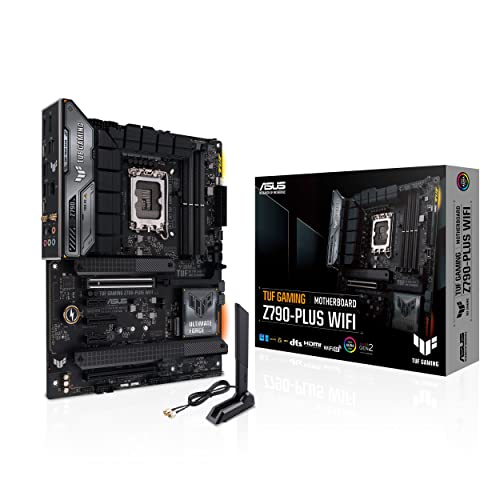
ASUS TUF Gaming PCIe 5.0 ATX Motherboard
Best for: Intel 12th to 14th Gen gaming builds
- CPU Socket
- LGA 1700
- Chipset
- Z790
- Form Factor
- ATX
- Memory Type
- DDR5
- PCIe Version
- PCIe 5.0
- M.2 Slots
- 4
View on Amazon: ASUS TUF Gaming PCIe 5.0 ATX Motherboard Affiliate link
This is an ASUS TUF Gaming Z790 ATX motherboard for Intel 14th, 12th, and 13th Gen CPUs. It uses the LGA 1700 socket and supports DDR5 memory. You get PCIe 5.0 lanes and four M.2 slots for fast storage. It includes Wi-Fi 6 and 2.5GbE networking. This board suits gamers who want a robust platform for Intel processors with modern connectivity options.
Pros
- Supports Intel 14th, 12th, and 13th Gen processors via LGA 1700 socket
- Features PCIe 5.0 for next-generation graphics cards and storage
- Includes four M.2 slots for ample NVMe SSD expansion
- Equipped with Wi-Fi 6 and 2.5GbE Ethernet for reliable networking
Cons
- Uses the older LGA 1700 socket instead of the newer AM5 platform
- Limited to DDR5 memory only, excluding older DDR4 options
- Weighs 2.91 pounds, which is heavier than some compact alternatives
Good fit if
- You are building a PC with an Intel 12th, 13th, or 14th Gen CPU
- You need multiple M.2 drives for your storage setup
- You want built-in Wi-Fi 6 and high-speed Ethernet
Skip if
- You are using AMD Ryzen processors and need the AM5 socket
- You prefer DDR4 memory to save on RAM costs
- You are building a small form factor PC that cannot fit an ATX board
Verdict: ASUS TUF Gaming Z790-Plus WiFi is a solid choice for Intel-based gaming rigs. It delivers strong connectivity and storage options for users upgrading from previous Intel generations.

ASUS TUF Gaming AM5 ATX Motherboard
Best for: AMD Ryzen 7000 gaming builds
- CPU Socket
- Socket AM5 (LGA 1718)
- Form Factor
- ATX
- Memory Type
- DDR5
- PCIe Version
- PCIe 5.0
- Wi-Fi Standard
- WiFi 6
- Ethernet Speed
- 2.5 Gb
View on Amazon: ASUS TUF Gaming AM5 ATX Motherboard Affiliate link
This is an ATX motherboard for AMD Ryzen 7000 series processors. It uses the AM5 socket and supports DDR5 memory. The board features 14 power stages and includes Wi-Fi 6 along with 2.5 Gb Ethernet. It is designed for gaming builds that need reliable connectivity and stable power delivery for modern CPUs.
Pros
- Supports Ryzen 7000 series via AM5 socket
- Includes Wi-Fi 6 for wireless networking
- Features 14 power stages for stable performance
- Has 2.5 Gb Ethernet for fast wired connections
Cons
- Only supports Wi-Fi 6, not the newer Wi-Fi 6E or 7
- Uses DDR5 memory which may be more expensive than DDR4 options
- Weighs 1 pound, adding slight weight to the build
Good fit if
- You are building a PC with an AMD Ryzen 7000 processor
- You need built-in Wi-Fi 6 for your network setup
- You prefer an ATX form factor for your case
Skip if
- You are using an Intel processor
- You require DDR4 memory support
- You need Wi-Fi 7 connectivity
Verdict: ASUS TUF Gaming B650-Plus WiFi AM5 is a solid choice for gamers using AMD Ryzen 7000 CPUs who want reliable Wi-Fi 6 and 2.5 Gb Ethernet.
Specifications side by side
| Spec | ASUS TUF Gaming PCIe 5.0 ATX Motherboard | ASUS TUF Gaming AM5 ATX Motherboard |
|---|---|---|
| CPU Socket | LGA 1700 | Socket AM5 (LGA 1718) |
| Chipset | Z790 | not stated |
| Form Factor | ATX | ATX |
| Memory Type | DDR5 | DDR5 |
| PCIe Version | PCIe 5.0 | PCIe 5.0 |
| M.2 Slots | 4 | not stated |
| Wi-Fi Standard | not stated | WiFi 6 |
| Ethernet Speed | not stated | 2.5 Gb |
| Power Phases | 16+1 | 14 |
| Wi-Fi | Wi-Fi 6 | Wi-Fi 6 |
| Use Case | Gaming | Gaming |
| Dimensions | 10.7 × 2.75 × 14 inches | 10.8 × 2.9 × 13.3 inches |
| Weight | 2.91 pounds | 1 pounds |
| Color | BLACK | not stated |
| Model | TUF GAMING Z790-PLUS WIFI | B650-PLUS |
Frequently asked questions
Does the ASUS TUF Gaming PCIe 5.0 ATX Motherboard support DDR5 memory?
Yes, this model supports DDR5 memory. It uses the LGA 1700 socket for Intel 12th through 14th Gen processors. You get PCIe 5.0 lanes for future-proofing. The board also includes Wi-Fi 6 and 2.5GbE Ethernet for fast connectivity. It is designed specifically for gaming builds.
Can I use AMD Ryzen 7000 CPUs with the ASUS TUF Gaming AM5 ATX Motherboard?
Yes, it is built for AMD Ryzen 7000 gaming builds. The board features the Socket AM5, which is required for these processors. It supports DDR5 memory and Wi-Fi 6. The 2.5 Gb Ethernet port ensures stable wired connections. It is a solid choice for AMD-based gaming rigs.
Which board offers faster Wi-Fi connectivity?
Both boards offer identical Wi-Fi 6 capabilities. Neither model lists Wi-Fi 6E or Wi-Fi 7 support in the data. You will get the same wireless speeds on either platform. Both also include 2.5GbE Ethernet for wired connections. The choice depends on your CPU preference, not wireless performance.
Is the ASUS TUF Gaming PCIe 5.0 ATX Motherboard compatible with PCIe 5.0 devices?
Yes, it explicitly supports PCIe 5.0. This allows for faster data transfer rates with compatible graphics cards and storage drives. The LGA 1700 socket supports Intel 12th, 13th, and 14th Gen CPUs. It is designed for users who want the latest interface standards for their gaming setup.
What is the difference in weight between the two motherboards?
The ASUS TUF Gaming PCIe 5.0 ATX Motherboard weighs 2.91 pounds. The ASUS TUF Gaming AM5 ATX Motherboard weighs 1 pound. The Intel board is significantly heavier, likely due to its VRM heatsinks and chassis. Both share the ATX form factor for standard case compatibility.
Do both motherboards have Ethernet ports?
Yes, both models include 2.5GbE Ethernet ports. This provides faster wired network speeds compared to standard 1GbE connections. The Intel board lists this in its attributes. The AMD board also specifies 2.5 Gb Ethernet in its verdict. You get reliable wired connectivity on either platform.
Which motherboard is better for upgrading from an older Intel system?
The ASUS TUF Gaming PCIe 5.0 ATX Motherboard is the better choice. It uses the LGA 1700 socket, supporting Intel 12th, 13th, and 14th Gen processors. This allows you to reuse compatible CPUs if you are staying within the Intel ecosystem. It offers strong connectivity for existing Intel users.
Does the ASUS TUF Gaming AM5 ATX Motherboard support DDR5 RAM?
Yes, it supports DDR5 memory. The AM5 platform requires DDR5 modules for operation. This ensures high bandwidth for gaming and productivity tasks. The board is optimized for AMD Ryzen 7000 CPUs. You will need DDR5 sticks to install this motherboard.