ASUS TUF Gaming PCIe 5.0 ATX Motherboard vs ASUS Prime Micro ATX AM4 Motherboard (2026): Key Differences
As an Amazon Associate we earn from qualifying purchases. Links on this page are affiliate links.
When comparing asus tuf gaming z790 plus wifi vs prime b550m a AC amd, you are looking at two distinct ASUS platforms. Both boards offer wireless connectivity and robust build quality from the manufacturer. The primary difference lies in their generation and form factor. The TUF model supports newer Intel processors with DDR5 memory in a standard ATX size. The Prime board targets AMD Ryzen CPUs with DDR4 support in a compact Micro ATX layout. Your choice depends on your CPU platform preference and case size.
Key differences
| Aspect | ASUS TUF Gaming PCIe 5.0 ATX Motherboard | ASUS Prime Micro ATX AM4 Motherboard |
|---|---|---|
| CPU Socket | LGA 1700 | AM4 |
| Form Factor | ATX | Micro ATX |
| Memory Type | DDR5 | DDR4 |
| PCIe Version | PCIe 5.0 | PCIe 4.0 |
| Wi-Fi | Wi-Fi 6 | Wi-Fi 5 |
| Ethernet Speed | 2.5GbE | 1GbE |
Which one should you choose?
Choose ASUS TUF Gaming PCIe 5.0 ATX Motherboard if
- You want to build with 12th, 13th, or 14th Gen Intel processors.
- You need the latest PCIe 5.0 bandwidth for future graphics cards.
- You prefer faster DDR5 memory and 2.5GbE wired networking.
Choose ASUS Prime Micro ATX AM4 Motherboard if
- You are building a compact PC with a Micro ATX case.
- You want to use existing DDR4 memory and AM4 CPUs.
- You need a smaller footprint without sacrificing core connectivity.
Verdict: The TUF Gaming Z790-Plus WiFi is the better choice for new builds using Intel processors and modern components. The Prime B550M-A AC is ideal for budget-conscious users or those with existing AMD AM4 parts and smaller cases. Select the board that matches your processor socket and memory type first.
TUF Gaming Z790 vs Prime B550M Comparison
CPU socket generation
Product A uses the LGA 1700 socket, supporting Intel 12th, 13th, and 14th Gen processors. This allows you to use the latest high-performance Intel chips. Product B relies on the AM4 socket, designed for AMD 3rd Gen Ryzen CPUs. AM4 is an older platform that has reached the end of its lifecycle for new CPU releases. If you want to build a system with current-generation Intel hardware, Product A is the only choice. Product B is limited to older AMD processors that are no longer being updated with new models.
form factor size
Product A is an ATX motherboard, measuring 10.7 inches by 14 inches. This standard size fits in most mid-tower and full-tower cases, offering ample space for multiple expansion cards and components. Product B is a Micro ATX board, measuring 10 inches by 10 inches. Its smaller footprint makes it ideal for compact builds or smaller cases where space is limited. While Product A offers more physical room for expansion, Product B is better suited for users who prioritize a smaller chassis and need to save desk space.
memory type support
Product A supports DDR5 memory, which is the latest standard for high-speed data transfer and bandwidth. DDR5 allows for significantly faster speeds compared to previous generations, benefiting gaming and heavy multitasking. Product B uses DDR4 memory, which is a mature and widely available standard. While DDR4 is slower than DDR5, it is often more affordable and sufficient for many users. You must choose the memory type that matches your motherboard, as DDR4 and DDR5 are not compatible with each other. Product A offers a clear performance advantage here.
pcie version bandwidth
Product A features PCIe 5.0, providing double the bandwidth of PCIe 4.0. This future-proofs your system for next-generation graphics cards and storage devices that will utilize the increased throughput. Product B offers PCIe 4.0, which is currently sufficient for most high-end GPUs and NVMe SSDs. While PCIe 5.0 is not yet fully utilized by consumer hardware, Product A ensures you are ready for upcoming technologies. For immediate needs, both are capable, but Product A has the technical edge for future upgrades.
network connectivity speed
Product A includes 2.5GbE Ethernet, offering higher wired network speeds than standard Gigabit connections. This is beneficial for large file transfers, local network backups, and high-bandwidth streaming. Product B provides 1Gb LAN, which is the standard for most home networks and sufficient for gaming and web browsing. Additionally, Product A supports Wi-Fi 6, while Product B supports Wi-Fi 5. Wi-Fi 6 offers better performance in congested wireless environments. Product A provides superior wired and wireless networking capabilities.
Which motherboard fits your build needs
You need high-end gaming with latest Intel
Choose this board if you want the latest Intel 14th Gen processors. It uses the LGA 1700 socket and supports fast DDR5 memory. The Z790 chipset and PCIe 5.0 support ensure future-proof performance for gaming. You also get four M.2 slots for ample storage expansion.
You prefer compact size and AMD Ryzen
This Micro ATX board fits smaller cases while supporting 3rd Gen AMD Ryzen CPUs via the AM4 socket. It uses DDR4 memory and PCIe 4.0 for solid performance. The smaller footprint saves space, and it includes Wi-Fi and 1Gb LAN for reliable connectivity in tighter builds.
You want maximum storage and connectivity options
This model offers four M.2 slots compared to just two on the other board. It features faster 2.5GbE Ethernet and Wi-Fi 6 for quicker network speeds. The 16+1 power phases provide stable power delivery for high-end Intel processors. You get more expansion options for multiple drives.
You are building a budget-friendly small PC
This Micro ATX board is lighter and smaller, making it ideal for compact builds. It supports DDR4 memory, which is often more affordable than DDR5. The AM4 platform with 3rd Gen Ryzen offers good value. You get essential features like Wi-Fi 5 and dual M.2 slots without extra cost.
The products compared
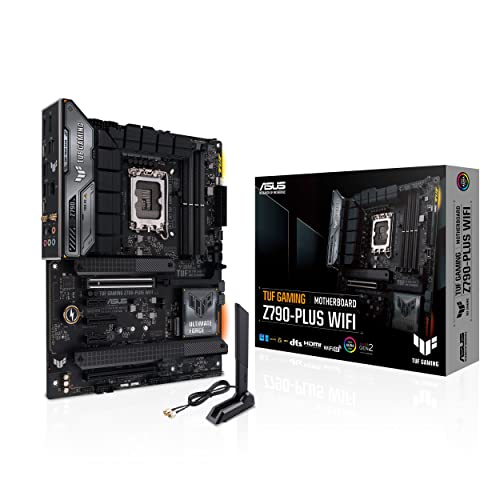
ASUS TUF Gaming PCIe 5.0 ATX Motherboard
Best for: Intel gaming builds needing PCIe 5.0 and DDR5
- CPU Socket
- LGA 1700
- Chipset
- Z790
- Form Factor
- ATX
- Memory Type
- DDR5
- PCIe Version
- PCIe 5.0
- M.2 Slots
- 4
View on Amazon: ASUS TUF Gaming PCIe 5.0 ATX Motherboard Affiliate link
This ASUS TUF Gaming Z790 motherboard supports Intel 14th, 12th, and 13th Gen processors via the LGA 1700 socket. It uses DDR5 memory and features PCIe 5.0 support for future-proofing. The ATX form factor provides four M.2 slots for storage expansion. You will get Wi-Fi 6 and 2.5GbE connectivity. This board is designed for gaming builds that need robust power delivery and modern expansion options.
Pros
- PCIe 5.0 support for next-gen GPUs and storage
- 16+1 power phases for stable CPU performance
- Four M.2 slots for ample storage expansion
- Integrated Wi-Fi 6 and 2.5GbE Ethernet
Cons
- Requires DDR5 memory, which is more expensive than DDR4
- ATX form factor is larger than Micro ATX options
- Limited to Intel 12th through 14th Gen CPUs
Good fit if
- You are building a high-end Intel gaming PC
- You need multiple M.2 drives for large libraries
- You want PCIe 5.0 readiness for future upgrades
Skip if
- You are using an AMD Ryzen processor
- You prefer DDR4 memory for budget reasons
- You need a compact Micro ATX case fit
Verdict: ASUS TUF Gaming Z790 ATX Motherboard fits Intel gamers who want PCIe 5.0 and DDR5 speeds. It suits builders prioritizing storage capacity and modern connectivity over compact size.

ASUS Prime Micro ATX AM4 Motherboard
Best for: Compact AMD AM4 builds with dual M.2 storage needs
- CPU Socket
- AM4
- Form Factor
- Micro ATX
- Memory Type
- DDR4
- PCIe Version
- PCIe 4.0
- M.2 Slots
- 2
- Ethernet Speed
- 1Gb LAN
View on Amazon: ASUS Prime Micro ATX AM4 Motherboard Affiliate link
This Micro ATX motherboard pairs AMD AM4 sockets with PCIe 4.0 support for 3rd Gen Ryzen CPUs. It includes dual M.2 slots, one running at PCIe 4.0 x4 speeds, plus built-in Wi-Fi 5 and 1Gb LAN. The board features DDR4 memory support with ASUS OptiMem technology for stable high-frequency operation. It is designed for compact builds that need reliable connectivity and modern storage speeds without requiring a full-size ATX chassis.
Pros
- Supports PCIe 4.0 for faster storage and GPU bandwidth
- Includes dual M.2 slots with one PCIe 4.0 x4 connection
- Built-in Wi-Fi 5 and 1Gb Ethernet for network connectivity
- ASUS OptiMem trace layout optimizes DDR4 memory performance
- Comprehensive cooling via VRM and PCH heatsinks with Fan Xpert 2
Cons
- Micro ATX form factor limits expansion slot availability
- Supports only DDR4 memory, not newer DDR5 standards
- Wi-Fi 5 offers lower maximum speeds than Wi-Fi 6
Good fit if
- You are building a compact PC using an AMD AM4 processor
- You need dual M.2 NVMe SSD slots for storage expansion
- You want built-in wireless networking in a smaller chassis
Skip if
- You require PCIe 5.0 support for next-generation GPUs or drives
- You plan to use DDR5 memory for maximum future-proofing
- You need a full-size ATX board for extensive expansion cards
Verdict: ASUS Prime B550M-A AC Micro ATX is a solid choice for users building compact systems with 3rd Gen Ryzen CPUs who value dual M.2 storage and reliable Wi-Fi 5 connectivity.
Specifications side by side
| Spec | ASUS TUF Gaming PCIe 5.0 ATX Motherboard | ASUS Prime Micro ATX AM4 Motherboard |
|---|---|---|
| CPU Socket | LGA 1700 | AM4 |
| Chipset | Z790 | not stated |
| Form Factor | ATX | Micro ATX |
| Memory Type | DDR5 | DDR4 |
| PCIe Version | PCIe 5.0 | PCIe 4.0 |
| M.2 Slots | 4 | 2 |
| Ethernet Speed | not stated | 1Gb LAN |
| Power Phases | 16+1 | not stated |
| Wi-Fi | Wi-Fi 6 | Wi-Fi 5 |
| Use Case | Gaming | not stated |
| Dimensions | 10.7 × 2.75 × 14 inches | 10 × 2.6 × 10 inches |
| Weight | 2.91 pounds | 1.27 pounds |
| Color | BLACK | not stated |
| Model | TUF GAMING Z790-PLUS WIFI | B550M-A AC |
| Size | not stated | Micro ATX |
Frequently asked questions
Does the ASUS TUF Gaming Z790 support DDR5 memory?
Yes, this motherboard uses DDR5 memory. This allows for higher bandwidth and faster data transfer speeds compared to older standards. You benefit from improved performance in gaming and heavy multitasking. The Prime B550M-A AC, by contrast, relies on DDR4 technology.
What is the main difference between ATX and Micro ATX form factors?
ATX boards are larger, typically measuring 12 by 9.6 inches, while Micro ATX boards are smaller, around 9.6 by 9.6 inches. The TUF Gaming Z790 uses the larger ATX standard, offering more expansion slots. The Prime B550M-A AC uses the compact Micro ATX size, saving space in smaller cases.
Can I use PCIe 5.0 devices with the ASUS Prime B550M-A AC?
No, the ASUS Prime B550M-A AC supports PCIe 4.0. It does not provide PCIe 5.0 lanes for your graphics card or storage drives. If you need the latest PCIe 5.0 standard for future-proofing, you must choose the TUF Gaming Z790 motherboard instead.
Which motherboard has faster Wi-Fi connectivity?
The ASUS TUF Gaming Z790 features Wi-Fi 6 for faster wireless speeds and better performance in congested networks. The ASUS Prime B550M-A AC is equipped with Wi-Fi 5, which is older technology. You will notice a difference in throughput and latency between the two standards.
Does the TUF Gaming Z790 include an Ethernet port?
Yes, it includes a 2.5GbE Ethernet port. This provides faster wired internet speeds compared to standard 1GbE ports. The ASUS Prime B550M-A AC only offers 1GbE connectivity. You get a significant boost in local network transfer rates with the TUF Gaming board.
Is the ASUS Prime B550M-A AC compatible with Intel CPUs?
No, it uses the AM4 socket, which is designed exclusively for AMD processors. You cannot install Intel chips on this board. The ASUS TUF Gaming Z790 uses the LGA 1700 socket, which is built specifically for Intel 12th, 13th, and 14th Gen processors.