ASUS TUF Gaming PCIe 5.0 ATX Motherboard vs ASUS Prime Micro-ATX Commercial Motherboard: Spec Comparison
As an Amazon Associate we earn from qualifying purchases. Links on this page are affiliate links.
When you compare the asus tuf gaming pcie 5 0 atx motherboard vs prime micro atx commercial, you see two distinct ASUS designs. Both boards support modern connectivity standards and include robust protection features for your components. The primary difference lies in their target audience and physical size. One is built for high-performance gaming with a larger form factor, while the other is designed for commercial environments with a smaller footprint.
Key differences
| Aspect | ASUS TUF Gaming PCIe 5.0 ATX Motherboard | ASUS Prime Micro-ATX Commercial Motherboard |
|---|---|---|
| CPU Socket | LGA 1700 | AM4 |
| Form Factor | ATX | Micro ATX |
| Chipset | Z790 | B550 |
| Memory Type | DDR5 | not listed |
| PCIe Version | PCIe 5.0 | PCIe 4.0 |
| Ethernet Speed | 2.5GbE | 1GbE |
Which one should you choose?
Choose ASUS TUF Gaming PCIe 5.0 ATX Motherboard if
- You need support for the latest Intel 14th, 12th, and 13th Gen processors.
- You require DDR5 memory for higher bandwidth and future-proofing.
- You want faster 2.5GbE networking and PCIe 5.0 expansion slots.
Choose ASUS Prime Micro-ATX Commercial Motherboard if
- You are building a compact system using AMD Ryzen 3rd Gen CPUs.
- You need ECC memory support for commercial data integrity.
- You prefer a smaller Micro ATX board for space-constrained commercial setups.
Verdict: Choose the TUF Gaming board if you are building a high-end gaming PC with the latest Intel hardware and need maximum expansion options. Select the Prime Commercial board for small-form-factor business deployments that rely on AMD Ryzen processors and require ECC memory stability.
Specs: Socket, Size, and Speed
cpu socket
The ASUS TUF Gaming motherboard uses the LGA 1700 socket. This supports Intel 14th, 12th, and 13th Gen processors. The ASUS Prime Micro-ATX board uses the AM4 socket. This is designed for 3rd Gen AMD Ryzen CPUs. These sockets are not compatible with each other. You must choose a CPU based on the socket type. The TUF board targets Intel users, while the Prime board targets AMD users. This is a fundamental hardware difference that dictates your entire platform choice.
form factor
The TUF Gaming board is an ATX form factor. It measures 10.7 inches by 14 inches. The Prime board is Micro-ATX. It measures 10.4 inches by 10.6 inches. ATX boards are larger and fit in standard mid-tower and full-tower cases. Micro-ATX boards are smaller and fit in compact cases. The TUF board weighs 2.91 pounds. The Prime board weighs 1.31 pounds. Your case size determines which board you can physically install. Larger cases offer more expansion slots for the TUF board.
pcie version
The TUF Gaming motherboard supports PCIe 5.0. This is the latest standard for high-speed data transfer. It allows for faster connections with future graphics cards and storage devices. The Prime motherboard supports PCIe 4.0. This is a previous generation standard. It is still very fast for current hardware. PCIe 5.0 offers double the bandwidth of PCIe 4.0. If you plan to use the newest high-end components, the TUF board has a clear advantage in raw throughput potential.
ethernet speed
The TUF Gaming motherboard features 2.5GbE Ethernet. This allows for network speeds up to 2.5 gigabits per second. The Prime motherboard features 1Gb LAN. This allows for network speeds up to 1 gigabit per second. The TUF board is faster for local file transfers and large downloads. You need a router that supports 2.5GbE to see the benefit. The Prime board is sufficient for standard home internet connections. The TUF board is better for high-bandwidth local networks.
memory type
The TUF Gaming motherboard uses DDR5 memory. This is the latest standard for RAM. It offers higher speeds and better efficiency than previous generations. The Prime motherboard supports DDR4 memory. This is the older standard. DDR5 is faster but often more expensive. DDR4 is more affordable and widely available. The TUF board is designed for modern performance needs. The Prime board is designed for cost-effective stability. You must buy the correct RAM type for each board.
Choose the right board for your needs
Intel gamers needing top speed
You need the latest Intel processors and maximum bandwidth. This board features the LGA 1700 socket for 14th, 12th, and 13th Gen CPUs. It supports PCIe 5.0 and DDR5 memory for future-proofing. The 16+1 power phases handle high-end chips well. You also get Wi-Fi 6 and 2.5GbE Ethernet for fast networking.
Business users managing fleets
Your priority is stability and easy management. This commercial board includes ASUS Control Center Express for simpler IT endpoint management. It offers ECC memory support for data integrity. The design fits smaller Micro-ATX cases. You get reliable 1Gb LAN connectivity and robust protection features like LANGuard and SafeSlot Core for long-term use.
Budget builders with AMD parts
You are building a compact system with existing AMD hardware. This board uses the AM4 socket, compatible with 3rd Gen Ryzen CPUs. It is smaller and lighter than the ATX option, saving space. You still get PCIe 4.0 speeds and USB 3.2 Gen 2 ports. It is a practical choice for standard office or home setups.
The products compared
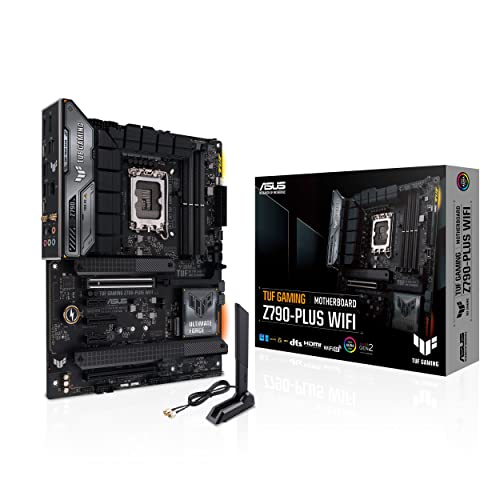
ASUS TUF Gaming PCIe 5.0 ATX Motherboard
Best for: Intel gaming builds with multiple NVMe drives
- CPU Socket
- LGA 1700
- Chipset
- Z790
- Form Factor
- ATX
- Memory Type
- DDR5
- PCIe Version
- PCIe 5.0
- M.2 Slots
- 4
View on Amazon: ASUS TUF Gaming PCIe 5.0 ATX Motherboard Affiliate link
This is an ATX motherboard built for Intel 14th, 12th, and 13th Gen processors via the LGA 1700 socket. It features the Z790 chipset and supports DDR5 memory. The board includes PCIe 5.0 lanes for future-proofing graphics and storage. You get four M.2 slots for fast drives, plus Wi-Fi 6 and 2.5GbE networking. It suits gamers who need a standard-sized board with robust power delivery.
Pros
- Supports Intel 14th, 12th, and 13th Gen CPUs
- Includes PCIe 5.0 for next-gen components
- Features four M.2 slots for storage
- Powered by a 16+1 phase VRM design
- Built-in Wi-Fi 6 and 2.5GbE Ethernet
Cons
- ATX form factor requires a mid-tower or full-tower case
- Uses DDR5 memory which is more expensive than DDR4
- Heavier at 2.91 pounds compared to smaller boards
Good fit if
- You are building a desktop with an Intel 13th or 14th Gen processor
- You need multiple NVMe drives for your system
- You prefer a standard ATX case size
Skip if
- You are using an AMD processor
- You require a compact microATX or mini-ITX layout
- You are on a tight budget for DDR4 components
Verdict: ASUS TUF Gaming Z790 ATX is a solid choice for Intel-based gaming rigs that need high-speed storage and modern connectivity. It fits users who prioritize PCIe 5.0 support and ample M.2 slots in a standard ATX form factor.

ASUS Prime Micro-ATX Commercial Motherboard
Best for: compact commercial AMD builds
- CPU Socket
- AM4
- Form Factor
- Micro ATX
- PCIe Version
- PCIe 4.0
- Ethernet Speed
- 1Gb LAN
- Use Case
- Commercial
- Dimensions
- 10.4 × 2.03 × 10.6 inches
View on Amazon: ASUS Prime Micro-ATX Commercial Motherboard Affiliate link
This ASUS Prime B550M-A/CSM is a micro-ATX commercial motherboard built for AMD AM4 processors. It supports PCIe 4.0 and includes 1Gb LAN connectivity. The board features ECC memory support and ASUS Control Center Express for easier IT management. It offers five layers of protection for system stability. This model suits businesses needing reliable, manageable hardware for small form factor builds.
Pros
- Supports 3rd Gen AMD Ryzen CPUs via AM4 socket
- Includes PCIe 4.0 for faster data transfer speeds
- Features ECC memory support for improved data integrity
- Provides 1Gb LAN and USB 3.2 Gen 2 ports
- Includes ASUS Control Center Express for endpoint management
Cons
- Micro-ATX form factor limits expansion slots
- Only includes 1Gb Ethernet, lacking faster networking options
- Does not mention built-in Wi-Fi or Bluetooth connectivity
Good fit if
- You need a compact board for commercial deployments
- You require ECC memory support for stability
- You want centralized IT management via ACCE
Skip if
- You need high-speed 2.5Gb or 10Gb networking
- You require built-in wireless connectivity options
- You are building a large ATX gaming PC
Verdict: The ASUS Prime B550M-A/CSM Micro-ATX is a practical choice for businesses needing compact, manageable AMD systems with ECC support.
Specifications side by side
| Spec | ASUS TUF Gaming PCIe 5.0 ATX Motherboard | ASUS Prime Micro-ATX Commercial Motherboard |
|---|---|---|
| CPU Socket | LGA 1700 | AM4 |
| Chipset | Z790 | not stated |
| Form Factor | ATX | Micro ATX |
| Memory Type | DDR5 | not stated |
| PCIe Version | PCIe 5.0 | PCIe 4.0 |
| M.2 Slots | 4 | not stated |
| Ethernet Speed | not stated | 1Gb LAN |
| Power Phases | 16+1 | not stated |
| Wi-Fi | Wi-Fi 6 | not stated |
| Use Case | Gaming | Commercial |
| Dimensions | 10.7 × 2.75 × 14 inches | 10.4 × 2.03 × 10.6 inches |
| Weight | 2.91 pounds | 1.31 pounds |
| Color | BLACK | not stated |
| Model | TUF GAMING Z790-PLUS WIFI | PRIME B550M-A/CSM |
| Size | not stated | Micro ATX |
Frequently asked questions
Which motherboard is better for gaming?
The ASUS TUF Gaming PCIe 5.0 ATX Motherboard is the better choice for gaming. It features an LGA 1700 socket for Intel processors and supports PCIe 5.0. This board also includes Wi-Fi 6 and 2.5GbE Ethernet for high-speed connectivity. The ASUS Prime Micro-ATX board is designed for commercial use with an AM4 socket.
Does the TUF board support DDR5?
Yes, the ASUS TUF Gaming PCIe 5.0 ATX Motherboard supports DDR5 memory. This allows for faster data transfer rates compared to older standards. The ASUS Prime Micro-ATX Commercial Motherboard does not list DDR5 support, as it uses the older AM4 socket architecture. DDR5 is ideal for modern Intel gaming builds requiring high bandwidth.
What is the difference in form factor?
The ASUS TUF Gaming board uses the standard ATX form factor, measuring 10.7 inches in length. The ASUS Prime Micro-ATX board is smaller, measuring 10.4 inches in length. The ATX size provides more expansion slots and space for larger components. The Micro-ATX size is better for compact cases and smaller commercial setups.
Which board has faster Ethernet?
The ASUS TUF Gaming PCIe 5.0 ATX Motherboard has faster Ethernet with 2.5GbE support. The ASUS Prime Micro-ATX Commercial Motherboard offers standard 1GbE Ethernet. If you need higher network throughput for gaming or large file transfers, the TUF board provides the speed advantage. The Prime board is sufficient for general office connectivity.
Can I use AMD processors on the TUF board?
No, you cannot use AMD processors on the ASUS TUF Gaming PCIe 5.0 ATX Motherboard. It uses the LGA 1700 socket, which is exclusive to Intel processors. The ASUS Prime Micro-ATX Commercial Motherboard uses the AM4 socket, which supports 3rd Gen AMD Ryzen CPUs. You must match the socket type to your CPU brand.
Does the Prime board support ECC memory?
The ASUS Prime Micro-ATX Commercial Motherboard is described as supporting ECC memory in its verdict. This feature is useful for commercial environments where data integrity is critical. The ASUS TUF Gaming board is geared toward gaming and does not highlight ECC support. If you need error-correcting code memory, the Prime board is the appropriate choice.
Which board is lighter?
The ASUS Prime Micro-ATX Commercial Motherboard is lighter, weighing 1.31 pounds. The ASUS TUF Gaming PCIe 5.0 ATX Motherboard weighs 2.91 pounds. The difference in weight correlates with their sizes and component density. The smaller Micro-ATX form factor naturally requires less material and fewer expansion slots than the full ATX board.
What Wi-Fi standard does the TUF board use?
The ASUS TUF Gaming PCIe 5.0 ATX Motherboard uses Wi-Fi 6. This provides improved speed and efficiency over older wireless standards. The ASUS Prime Micro-ATX Commercial Motherboard does not list Wi-Fi specifications in its attributes. If wireless connectivity is a priority, the TUF board offers modern Wi-Fi 6 support for reliable connections.