ASUS ROG Strix Z690-F ATX Motherboard Review (2026): A Spec-Based Look
As an Amazon Associate we earn from qualifying purchases. Links on this page are affiliate links.
This asus rog strix z690 f gaming review focuses on the ASUS ROG Strix Z690-F ATX Motherboard, a platform built for Intel’s 12th Gen Core processors. It features an LGA 1700 socket and supports DDR5 memory. The board also offers PCIe 5.0 connectivity for future-proofed storage and graphics. With a robust 16+1 power stage design, it aims to handle demanding workloads. The listing highlights integrated WiFi 6E and 2.5Gb Ethernet for reliable networking. You get four M.2 slots for ample expansion. This guide breaks down these specifications to help you decide if this motherboard fits your build needs.
What stands out
- 16+1 power stages with ProCool II connectors for stable CPU power delivery
- LGA 1700 socket supporting 12th Gen Intel Core processors
- Integrated WiFi 6E and Intel 2.5 Gb Ethernet for high-speed networking
- Four M.2 slots with double-sided heatsinks for optimized thermal management
Who it fits
Good fit for
This motherboard suits gamers and creators using Intel 12th Gen CPUs who need strong power delivery. The 16+1 power stages and VRM heatsink support multi-core processors under load. If you want fast networking without extra cards, the WiFi 6E and 2.5Gb Ethernet are practical. The four M.2 slots with heatsinks help you manage drive temperatures. It is a solid choice for ATX builds that prioritize connectivity and thermal efficiency for sustained performance.
Who should skip it
Users with older Intel processors should look elsewhere, as this board only supports the LGA 1700 socket for 12th Gen CPUs. If you prefer DDR4 memory, this platform is not suitable since it requires DDR5. Builders with small form factor cases will find the ATX size too large, as the board measures 12 by 9.6 inches. Those needing more than four M.2 slots or higher bandwidth networking options may want to consider different models.
Verdict: The ASUS ROG Strix Z690-F offers a spec-heavy package for Intel 12th Gen builders, emphasizing power, connectivity, and storage flexibility. It is a practical choice for ATX systems that do not need niche features.
Key specs explained
CPU Socket: LGA 1700
This socket physically holds Intel 12th Gen Core processors. It defines the compatibility of your build, meaning you must choose a compatible CPU from that specific generation. If you plan to upgrade later, check if newer chips fit this same socket. It is the central connection point for all processor functions.
Memory Type: DDR5
This indicates the board uses the latest DDR5 RAM standard. DDR5 offers higher bandwidth and efficiency compared to older DDR4 modules. You need to purchase DDR5 sticks specifically, as they are not compatible with previous generations. This choice impacts overall system speed and data transfer rates for modern tasks.
PCIe Version: PCIe 5.0
This version supports faster data transfer rates for connected devices like graphics cards and storage drives. It provides double the bandwidth of PCIe 4.0. This future-proofs your system for next-generation hardware that utilizes these increased speeds. You benefit from reduced latency and quicker asset loading in high-performance scenarios.
Power Phases: 16+1
This count refers to the voltage regulator modules that deliver stable power to the CPU. More phases generally mean better power delivery and cooler operation under heavy loads. This setup supports multi-core processors efficiently. It ensures consistent performance during intensive gaming or rendering tasks without thermal throttling or instability.
Wi-Fi Standard: Wi-Fi 6E
This standard adds a 6 GHz band to existing Wi-Fi frequencies. It reduces congestion and interference from other devices. You experience lower latency and faster wireless speeds, which is ideal for gaming and streaming. It works with compatible routers and provides a more reliable connection than older Wi-Fi 6 or Wi-Fi 5 standards.
Design and build quality
The ASUS ROG Strix Z690-F uses an ATX form factor. According to the listing, the board measures 13.3 inches in length and 10.7 inches in width. It weighs 2.99 pounds. This standard size fits most mid-tower and full-tower cases. You can expect it to align with standard mounting holes in your chassis. The weight suggests a substantial metal backplate and heatsinks, which help with stability and heat dissipation.
Thermal management is a key part of this design. The listing notes a robust VRM heatsink and a fanless PCH heatsink. These components cover the power delivery and chipset areas. You get double-sided M.2 heatsinks for your storage drives. This layout helps keep NVMe SSDs cool under load. Hybrid fan headers and Fan Xpert 4 utility let you control case airflow. You can adjust speeds based on your system’s temperature needs.
Power delivery features 16+1 power stages. The listing highlights ProCool II power connectors, alloy chokes, and durable capacitors. These parts support multi-core processors by providing stable voltage. The board also includes onboard WiFi 6E and Intel 2.5 Gb Ethernet. ASUS LANGuard protects the network port. This combination of cooling and power components suggests a design focused on sustained performance during gaming or heavy workloads.
Setup and everyday use
You install this motherboard by fitting an Intel 12th Gen Core processor into the LGA 1700 socket. The board is ready for Windows 11 out of the box, which simplifies initial configuration. You must use DDR5 memory modules, as the platform does not support older DDR4 types. This choice affects your memory bandwidth and power efficiency. The robust power solution includes 16+1 power stages. These components deliver stable current to multi-core processors during heavy workloads. You benefit from reliable performance when running demanding applications or games. The board includes four M.2 slots. This allows you to install multiple high-speed NVMe SSDs for storage. The optimized thermal design helps manage heat. VRM heatsinks and a fanless PCH heatsink keep critical components cool without adding noise. You can use the Fan Xpert 4 utility to adjust fan speeds based on system temperatures. Networking is handled by onboard Wi-Fi 6E and a 2.5 Gb Ethernet port. This provides faster local network transfers compared to standard Gigabit connections. The AI features automate certain tasks. AI Overclocking adjusts processor settings for performance. AI Cooling manages fan curves automatically. AI Networking prioritizes game traffic through GameFirst VI. AI Noise cancellation filters background sounds from your microphone. These tools reduce manual tweaking, letting you focus on usage rather than configuration. The setup process is straightforward if you follow the manual. Everyday use involves stable connectivity and responsive performance for gaming and content creation.
Before you buy this motherboard
You should verify that your case supports the ATX form factor before purchasing. This board requires DDR5 memory, so you must buy compatible RAM sticks. Ensure your power supply has the correct connectors for the ProCool II power connector. The Z690 chipset works with Intel 12th Gen Core processors, so confirm your CPU choice matches the LGA 1700 socket. You may need additional cooling for the VRM and M.2 slots, especially if you plan to run high-end processors. The onboard WiFi 6E and 2.5Gb Ethernet reduce the need for separate network cards. Keep the BIOS updated to maintain compatibility with newer software and hardware. This motherboard sits alongside other Z690 options, offering robust power delivery and thermal design. It suits builders who prioritize connectivity and stability for gaming. Check your existing components for compatibility to avoid installation issues.
Check before you buy
- Confirm your case fits the ATX form factor.
- Purchase DDR5 memory modules for the platform.
- Verify your CPU fits the LGA 1700 socket.
- Ensure your power supply supports the power connector.
The product at a glance
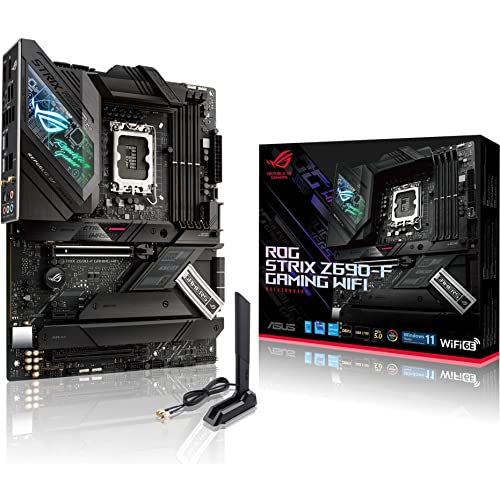
ASUS ROG Strix Z690-F ATX Motherboard
Best for: 12th Gen Intel gaming builds with ATX cases
- CPU Socket
- LGA 1700
- Chipset
- Z690
- Form Factor
- ATX
- Memory Type
- DDR5
- PCIe Version
- PCIe 5.0
- M.2 Slots
- 4
View on Amazon: ASUS ROG Strix Z690-F ATX Motherboard Affiliate link
This ASUS ROG Strix Z690-F ATX motherboard supports 12th Gen Intel Core processors via the LGA 1700 socket. It features PCIe 5.0 and DDR5 memory for high-speed data transfer. The board includes 16+1 power stages to handle multi-core loads. You get onboard Wi-Fi 6E and 2.5 Gb Ethernet for reliable networking. It is designed for gaming builds that need robust thermal management and modern connectivity options.
Pros
- LGA 1700 socket for 12th Gen Intel processors
- PCIe 5.0 and DDR5 support
- 16+1 power stages with ProCool II connector
- On-board Wi-Fi 6E and 2.5 Gb Ethernet
- Four M.2 slots with double-sided heatsinks
Cons
- ATX form factor requires a mid-tower or full-tower case
- Heavier build at 2.99 pounds
- No mention of USB-C front-panel header support
Good fit if
- You are building a desktop with 12th Gen Intel CPUs
- You need PCIe 5.0 and DDR5 for future-proofing
- You want integrated Wi-Fi 6E and 2.5 Gb Ethernet
Skip if
- You require a micro-ATX or ITX board for a small case
- You are using older DDR4 memory
- You need PCIe 4.0 only and want a lower cost option
Verdict: ASUS ROG Strix Z690-F ATX provides a solid foundation for 12th Gen Intel gaming PCs with its 16+1 power stages and PCIe 5.0 support. It suits users who prioritize modern connectivity and robust power delivery for multi-core processors.
Specifications side by side
| Spec | ASUS ROG Strix Z690-F ATX Motherboard |
|---|---|
| CPU Socket | LGA 1700 |
| Chipset | Z690 |
| Form Factor | ATX |
| Memory Type | DDR5 |
| PCIe Version | PCIe 5.0 |
| M.2 Slots | 4 |
| Wi-Fi Standard | WiFi 6E |
| Ethernet Speed | 2.5Gb |
| Power Phases | 16+1 |
| Wi-Fi | Wi-Fi 6E |
| Use Case | Gaming |
| Dimensions | 13.3 × 10.7 × 2.7 inches |
| Weight | 2.99 pounds |
| Size | 12"x9.6" |
| Model | ROG STRIX Z690-F GAMING WIFI |
Frequently asked questions
Is the ASUS ROG Strix Z690-F good for gaming?
Yes, this motherboard is designed specifically for gaming builds. It features the Intel Z690 chipset and supports 12th Gen Intel processors. The board includes 16+1 power stages to handle multi-core CPUs. It also offers Wi-Fi 6E and 2.5GbE Ethernet for stable online play.
What type of memory does this motherboard support?
The ASUS ROG Strix Z690-F supports DDR5 memory only. It does not work with older DDR4 modules. You must purchase DDR5 RAM sticks to use this platform. This ensures higher bandwidth and better performance for modern gaming applications and heavy multitasking.
Does this board have built-in Wi-Fi?
Yes, it includes integrated Wi-Fi 6E support. This allows for faster wireless connections and lower latency compared to previous standards. You also get 2.5GbE Ethernet for wired connections. Both options provide robust connectivity for gaming and streaming without needing external adapters.
Will this motherboard fit in a standard case?
Yes, it uses the standard ATX form factor. The board measures 13.3 inches in length and 10.7 inches in width. This size fits most mid-tower and full-tower computer cases. You can verify your case compatibility by checking its supported form factors before installation.
Is PCIe 5.0 supported on this motherboard?
Yes, the ASUS ROG Strix Z690-F supports PCIe 5.0. This allows for faster data transfer speeds with compatible graphics cards and storage devices. It provides future-proofing for next-generation hardware. You can take advantage of this bandwidth for high-performance gaming and content creation tasks.
What CPU socket does this motherboard use?
This motherboard uses the LGA 1700 socket. It is compatible with Intel 12th Gen Core processors. You must select a CPU that fits this specific socket type. The board is optimized for these chips to ensure stable operation and full feature access.
Can I use this motherboard for Windows 11?
Yes, the board is ready for Windows 11. The Z690 chipset and LGA 1700 socket meet the platform requirements. You can install the operating system directly after hardware setup. This simplifies the initial configuration process for new gaming PCs or system upgrades.