AMD B550 vs Intel Z690 Motherboards: Which Should You Buy?
As an Amazon Associate we earn from qualifying purchases. Links on this page are affiliate links.
Choosing between an AMD B550 vs Intel Z690 motherboard depends on your platform needs. Both boards target gaming and support PCIe 4.0 speeds for fast storage. They also feature 2.5 Gb Ethernet for wired networking. The main difference lies in the CPU socket and memory type. One uses the AM4 socket with DDR4 RAM, while the other uses LGA 1700 with DDR5. This choice defines your upgrade path and performance ceiling.
Key differences
| Aspect | ASUS TUF Gaming B550M-PLUS Micro-ATX | MSI Z690 Force WiFi ATX Motherboard |
|---|---|---|
| CPU Socket | AM4 | LGA 1700 |
| Form Factor | Micro ATX | ATX |
| Memory Type | DDR4 | DDR5 |
| Wi-Fi | not listed | Wi-Fi 6E |
| Chipset | AMD B550 | Intel Z690 |
Which one should you choose?
Choose ASUS TUF Gaming B550M-PLUS Micro-ATX if
- You want a compact Micro ATX build with DDR4 memory.
- You are using an AMD Ryzen processor on the AM4 socket.
- You need a board with a dedicated audio codec and 2.5 Gb Ethernet.
Choose MSI Z690 Force WiFi ATX Motherboard if
- You are building with a 12th Gen Intel Core processor.
- You want the latest DDR5 memory for higher bandwidth.
- You need built-in Wi-Fi 6E for wireless connectivity.
Verdict: Choose the ASUS TUF Gaming B550M-PLUS if you are sticking with AMD Ryzen and DDR4 memory in a smaller case. Pick the MSI Z690 Force if you need the latest Intel platform and DDR5 speeds with integrated Wi-Fi 6E.
B550 and Z690 Specs Compared
cpu socket compatibility
The ASUS TUF Gaming B550M-PLUS uses the AM4 socket, which supports AMD Ryzen processors. This platform has been around for several generations, offering a wide range of compatible CPUs. In contrast, the MSI Z690 Force WiFi utilizes the LGA 1700 socket designed for 12th Gen Intel Core processors. This newer socket supports Intel's latest architecture. Your choice here depends entirely on whether you prefer the AMD ecosystem or the Intel lineup. You cannot mix CPUs between these two sockets. This decision locks you into one manufacturer's platform for the life of the motherboard.
memory type support
Memory technology differs significantly between these two boards. The ASUS B550M-PLUS supports DDR4 memory. DDR4 is a mature standard with affordable and widely available modules. The MSI Z690 Force WiFi supports DDR5 memory, which offers higher speeds, up to 5600 MHz when overclocked. DDR5 provides greater bandwidth for demanding tasks and modern gaming. However, DDR5 modules are generally more expensive than DDR4. If you already own DDR4 RAM, the B550 board is the practical choice. If you want the latest performance standards, the Z690 board requires new DDR5 kits.
form factor size
Physical dimensions affect case compatibility and build space. The ASUS TUF Gaming B550M-PLUS is a Micro ATX board. It measures 9.61 inches by 9.61 inches, making it smaller than standard ATX boards. This size is ideal for compact cases or builders who do not need extensive expansion slots. The MSI Z690 Force WiFi is a full ATX board, measuring 12 inches by 9.6 inches. It requires a larger case with more mounting points. The larger size allows for more PCIe slots and better airflow for components. Choose Micro ATX for space efficiency, or ATX for maximum expansion.
wireless connectivity
Built-in wireless capabilities vary between these models. The MSI Z690 Force WiFi includes Intel Wi-Fi 6E support. This standard offers faster speeds, lower latency, and less congestion compared to older Wi-Fi versions. It utilizes the 6 GHz band for improved performance in crowded areas. The ASUS TUF Gaming B550M-PLUS does not list Wi-Fi support in its key specifications or features. You would need to purchase a separate Wi-Fi card or USB adapter for wireless connectivity. If you rely on wireless connections for streaming or gaming, the MSI board provides a more integrated solution.
power delivery phases
Power delivery affects system stability and CPU performance under load. The ASUS TUF Gaming B550M-PLUS features an 8+2 DrMOS power stage configuration. This setup uses military-grade TUF components for durability and efficient power transfer to the CPU. The MSI Z690 Force WiFi does not list specific phase counts in the provided data. It does mention a premium thermal solution with extended heatsinks to manage power delivery temperatures. Without explicit phase numbers for the MSI board, we compare based on available data. The ASUS board offers transparent power specs for enthusiasts who monitor VRM efficiency closely.
Which B550 or Z690 board fits you
Budget builders using existing AM4 CPUs
You already own an AMD Ryzen processor with the AM4 socket. This board supports those chips directly. It uses DDR4 memory, which is often cheaper and more available than DDR5. The micro-ATX size fits smaller cases. You get PCIe 4.0 speeds for storage without the cost of a new platform.
Users wanting future-proof DDR5 and Wi-Fi
You want the latest Intel 12th Gen processors with the LGA 1700 socket. This board supports fast DDR5 memory up to 5600 MHz. It includes built-in Wi-Fi 6E for wireless connectivity. The ATX form factor offers more expansion slots. You get robust cooling for sustained high performance.
Gamers prioritizing wired network stability
You prefer a wired connection for low-latency gaming. This board features 2.5 Gb Ethernet with TUF LANGuard technology. It also includes a Realtek S1200A audio codec for clear sound. The 8+2 DrMOS power stages ensure stable voltage for your CPU. It is a solid choice for dedicated gaming setups.
Creators needing high-speed wireless and storage
You need fast data transfer and reliable wireless connections. This board offers Intel Wi-Fi 6E for secure and stable networking. The Lightning M.2 slot runs at PCIe Gen4 x4 for maximum NVMe SSD performance. The extended heatsink design helps manage heat during long rendering tasks. It supports high-speed DDR5 memory for multitasking.
Quick picks
| # | Product | Best for | Price |
|---|---|---|---|
| 1 | ASUS TUF Gaming B550M-PLUS Micro-ATX | compact AM4 gaming builds | Check price of ASUS TUF Gaming B550M-PLUS Micro-ATX on Amazon |
| 2 | MSI Z690 Force WiFi ATX Motherboard | Intel 12th Gen gaming builds with fast networking | Check price of MSI Z690 Force WiFi ATX Motherboard on Amazon |
The products compared
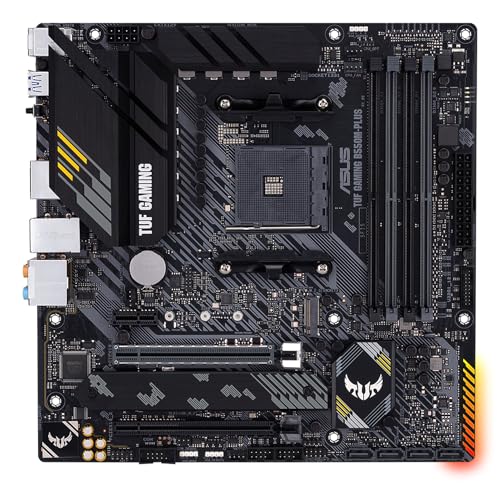
ASUS TUF Gaming B550M-PLUS Micro-ATX
Best for: compact AM4 gaming builds
- Chipset
- AMD B550 (what this guide is about)
- CPU Socket
- AM4
- Form Factor
- Micro-ATX
- Memory Type
- DDR4
- PCIe Version
- PCIe 4.0
- M.2 Slots
- Dual M.2
View on Amazon: ASUS TUF Gaming B550M-PLUS Micro-ATX Affiliate link
This is an AMD B550 Micro ATX motherboard for Ryzen AM4 processors. It supports PCIe 4.0 and DDR4 memory up to 4400 MHz. The board includes two M.2 slots and 2.5 Gb Ethernet. Its 8+2 DrMOS power stages provide stable energy for your CPU. It suits gamers who want reliable performance in a compact build.
Pros
- 8+2 DrMOS power stages for durable voltage regulation
- Supports PCIe 4.0 for faster data transfer
- Dual M.2 slots for multiple storage drives
- 2.5 Gb Ethernet for high-speed networking
- Realtek S1200A audio codec with 108 dB SNR
Cons
- Micro ATX form factor limits expansion slots
- AM4 socket does not support newer Ryzen 7000 series
- No built-in Wi-Fi connectivity
Good fit if
- You are building a compact gaming PC
- You use an AM4 Ryzen processor
- You need reliable wired networking
Skip if
- You require ATX expansion room
- You plan to use DDR5 memory
- You need built-in wireless networking
Verdict: The ASUS TUF Gaming B550M-PLUS Micro ATX delivers solid B550 performance for AM4 builds. It fits users who prioritize wired speed and compact size over modern socket support.

MSI Z690 Force WiFi ATX Motherboard
Best for: Intel 12th Gen gaming builds with fast networking
- Chipset
- Intel Z690 (what this guide is about)
- CPU Socket
- LGA 1700
- Form Factor
- ATX
- Memory Type
- DDR5
- PCIe Version
- PCIe 4
- Wi-Fi Standard
- Wi-Fi 6E
View on Amazon: MSI Z690 Force WiFi ATX Motherboard Affiliate link
The MSI Z690 Force WiFi is an ATX motherboard built for 12th Gen Intel Core processors on the LGA 1700 socket. It supports DDR5 memory up to 5600 MHz and includes Wi-Fi 6E and 2.5G LAN for fast connectivity. The board features PCIe 4.0 support and robust thermal solutions. This setup suits gamers who want high-speed networking and modern memory standards for their desktop.
Pros
- Supports 12th Gen Intel Core processors on LGA 1700 socket
- DDR5 memory support up to 5600 MHz
- Integrated Wi-Fi 6E and 2.5G LAN
- PCIe 4.0 Lightning M.2 slots for fast NVMe SSDs
Cons
- ATX form factor requires a larger case
- Wi-Fi 6E requires compatible router for full speed
- No mention of USB-C front panel headers in data
Good fit if
- You are building a desktop with 12th Gen Intel CPUs
- You need high-speed Wi-Fi 6E connectivity
- You have a mid-tower or full-tower case for ATX boards
Skip if
- You are using AMD Ryzen processors
- You prefer DDR4 memory for budget reasons
- You need a compact Micro ATX or Mini ITX form factor
Verdict: MSI Z690 Force WiFi ATX delivers modern connectivity and DDR5 support for Intel 12th Gen builds. It fits users who prioritize fast networking and high-speed storage in a standard ATX chassis.
Specifications side by side
| Spec | ASUS TUF Gaming B550M-PLUS Micro-ATX | MSI Z690 Force WiFi ATX Motherboard |
|---|---|---|
| CPU Socket | AM4 | LGA 1700 |
| Chipset | AMD B550 | Z690 |
| Form Factor | Micro-ATX | ATX |
| Memory Type | DDR4 | DDR5 |
| PCIe Version | PCIe 4.0 | PCIe 4 |
| M.2 Slots | Dual M.2 | not stated |
| Wi-Fi Standard | not stated | Wi-Fi 6E |
| Ethernet Speed | 2.5 Gb | 2.5G |
| Power Phases | 8+2 | not stated |
| Wi-Fi | not stated | Wi-Fi 6E |
| Use Case | Gaming | Gaming |
| Dimensions | 9.61 × 1.57 × 9.61 inches | 12 × 9.6 × 2.5 inches |
| Weight | 1.76 pounds | not stated |
| Size | Micro-ATX | not stated |
| Color | Black | not stated |
| Model | 90MB14A0-M0EAY0 | Z690FORCEWIFI |
Frequently asked questions
Does the B550 chipset support PCIe 4.0?
Yes. The ASUS TUF Gaming B550M-PLUS supports PCIe 4.0. This allows for faster data transfer rates with compatible NVMe SSDs and graphics cards. You get modern storage speeds without needing the latest AMD platform. It is a practical choice for gamers who want speed.
Can I use DDR5 memory with an AMD B550 board?
No. The ASUS TUF Gaming B550M-PLUS uses DDR4 memory. It does not support DDR5 modules. You must buy DDR4 RAM for this board. If you want DDR5, you need to look at Intel Z690 motherboards instead. This limits your memory upgrade path on this specific board.
What size is the MSI Z690 Force WiFi?
It is an ATX motherboard. The dimensions are 12 inches in length and 9.6 inches in width. This standard size fits most mid-tower and full-tower computer cases. It provides ample space for multiple expansion slots and cooling solutions compared to smaller form factors.
Does the Z690 board have built-in wireless?
Yes. The MSI Z690 Force WiFi includes Wi-Fi 6E. You can connect to your network without using an Ethernet cable. It also features 2.5 Gb Ethernet for wired connections. This gives you flexible networking options for gaming and streaming in your home setup.
Which socket does the AMD B550 motherboard use?
It uses the AM4 socket. This socket is compatible with various AMD Ryzen processors. You can install a wide range of AMD CPUs on this board. It is a mature platform with many compatible options available for different performance levels and budgets.
Is the MSI Z690 good for Intel 12th Gen?
Yes. The MSI Z690 Force WiFi is designed for Intel 12th Gen processors. It uses the LGA 1700 socket for these chips. The board supports DDR5 memory and PCIe 4.0. It offers modern features for users building a new high-performance Intel gaming system.
What is the weight of the ASUS TUF B550M-PLUS?
The board weighs 1.76 pounds. It is a Micro-ATX form factor, making it lighter and smaller than standard ATX boards. This compact size is ideal for smaller cases. You get solid connectivity in a package that takes up less space inside your computer chassis.