Best Micro-Atx Motherboards in 2026: 15 Picks Ranked by Specs
As an Amazon Associate we earn from qualifying purchases. Links on this page are affiliate links.
A compact desktop build begins with choosing the right Micro-ATX motherboard for your processor and hardware requirements. We evaluated 15 different models based strictly on the specifications published on their product listings.
The ASUS Prime Micro-ATX DDR5 Motherboard earns the top ranking because it provides an LGA 1700 socket, DDR5 memory support, Wi-Fi 6, and fast 2.5GbE networking. This buying guide helps you decide which socket architecture, memory standard, and internal connectivity options best match your system needs.
Quick picks
The best fit for you
- You need modern Intel support with fast networking ASUS Prime Micro-ATX DDR5 Motherboard It features an LGA 1700 socket, DDR5 memory compatibility, Wi-Fi 6, and 2.5GbE Ethernet.
- You want a compact build for server hardware ASRock Rack AMD EPYC Micro-ATX Server Motherboard It is built for server use cases and supports AMD EPYC 9004 series processors.
- You want a compact DDR5 gaming setup Gigabyte Micro-ATX DDR5 Gaming Motherboard This board provides DDR5 memory compatibility, PCIe 4.0 support, and USB Type-C connectivity.
- You are building with legacy Intel hardware Biostar Intel H310 Micro-ATX Motherboard It supports 8th and 9th Gen Intel Core processors alongside 1GbE networking and D-Sub output.
Our 15 picks

ASUS Prime Micro-ATX DDR5 Motherboard
Best for: modern Intel builds needing fast networking
- Form Factor
- Micro-ATX
- CPU Socket
- LGA 1700
- Memory Type
- DDR5
- PCIe Version
- PCIe 4.0
- M.2 Slots
- 2
- Wi-Fi Standard
- Wi-Fi 6
View on Amazon: ASUS Prime Micro-ATX DDR5 Motherboard (paid link)
The ASUS Prime Intel DDR5 Micro-ATX Motherboard is a compact board built for 12th and 13th Gen Intel LGA 1700 processors. It provides modern high-speed connections, including DDR5 memory support, two PCIe 4.0 M.2 slots, Wi-Fi 6, and 2.5 GbE networking. This layout suits you if you want an updated Intel setup in a smaller chassis without giving up fast wireless data transfer or current USB Type-C connectivity.
Pros
- Supports 12th and 13th Gen Intel Core CPUs on the LGA 1700 socket
- Dual networking with integrated Wi-Fi 6 and 2.5 GbE LAN
- Two PCIe 4.0 M.2 slots for high-speed NVMe storage
- Rear USB 3.2 Gen 2 and front USB 3.2 Gen 1 Type-C ports
Cons
- Maximum memory capacity is limited to 64GB of DDR5
- Only includes two M.2 storage slots
Good fit if
- You plan to use a 12th or 13th Gen Intel processor with DDR5 memory.
- You need both Wi-Fi 6 and 2.5 GbE wired network options.
- You want front-panel USB Type-C support in a Micro-ATX build.
Skip if
- You need more than 64GB of system memory.
- You are using an AMD processor.
Verdict: ASUS Prime Intel DDR5 Micro-ATX Motherboard delivers current-generation platform features, including PCIe 4.0 and Wi-Fi 6, inside a compact footprint. It provides a reliable, spec-rich base for everyday 12th and 13th Gen Intel desktop setups.

Biostar Intel H310 Micro-ATX Motherboard
Best for: 8th and 9th Gen Intel Core builds
- Form Factor
- Micro-ATX
- Chipset
- Intel H310
- Ethernet Speed
- Gigabit LAN
- Dimensions
- 0.98 × 8.9 × 6.73 inches
- Weight
- 1.34 pounds
View on Amazon: Biostar Intel H310 Micro-ATX Motherboard (paid link)
The Biostar Micro-ATX Intel H310 Motherboard gives you a compact platform built around the Intel H310 chipset. You get direct hardware support for 8th and 9th Generation Intel Core processors. For connectivity and monitor setups, the board provides dedicated HDMI and D-Sub video ports along with 1GbE wired networking. This makes it a straightforward option if you build or maintain an everyday system using compatible hardware.
Pros
- Intel H310 chipset supports 8th and 9th Gen Intel Core CPUs
- Equipped with both HDMI and D-Sub video outputs
- Integrated 1GbE wired network connectivity
- Compact Micro-ATX form factor fits smaller chassis
Cons
- Supports only 8th and 9th Generation Intel Core processors
- No integrated Wi-Fi connectivity listed
Good fit if
- You need a Micro-ATX board for an 8th or 9th Gen Intel CPU.
- You use displays requiring HDMI or D-Sub connections.
- You rely on a standard 1GbE wired network connection.
Skip if
- You plan to install a 10th Generation or newer processor.
- You require onboard Wi-Fi without adding expansion cards.
Verdict: Biostar Micro-ATX Intel H310 Motherboard provides essential 1GbE networking and legacy Intel Core CPU support for compact builds. It suits standard desktop configurations needing HDMI and D-Sub outputs.

ASRock Rack AMD EPYC Micro-ATX Server Motherboard
Best for: compact AMD EPYC enterprise server builds
- Form Factor
- Micro-ATX
- CPU Socket
- Single Socket SP5 (LGA 6096)
- Ethernet Speed
- Dual 10G
- Use Case
- Server
View on Amazon: ASRock Rack AMD EPYC Micro-ATX Server Motherboard (paid link)
The ASRock Rack AMD EPYC Micro-ATX Server Motherboard is a compact board designed specifically for enterprise server environments. It features a single Socket SP5 (LGA 6096) that supports AMD EPYC 9004 series processors in a Micro-ATX footprint. This board suits you if you need enterprise processing power for a dedicated server build while fitting inside a smaller Micro-ATX chassis.
Pros
- Features Socket SP5 (LGA 6096) for AMD EPYC 9004 series CPUs
- Designed specifically for enterprise server environments
- Compact Micro-ATX form factor for smaller chassis
Cons
- Restricted to enterprise AMD EPYC 9004 processors
- Deep Micro-ATX profile may restrict fit in standard cases
- Not designed for mainstream consumer desktop use
Good fit if
- You need an enterprise server board built around Socket SP5.
- You plan to run an AMD EPYC 9004 series processor.
- You want server-grade hardware in a compact Micro-ATX chassis.
Skip if
- You are building a standard consumer desktop or gaming PC.
- You use consumer AMD AM4 or AM5 processors.
Verdict: ASRock Rack AMD EPYC Micro-ATX Server Motherboard delivers specialized enterprise processing support for AMD EPYC 9004 series CPUs in a compact form factor. It provides a dedicated server foundation where chassis space is limited.

Gigabyte Micro-ATX DDR5 Gaming Motherboard
Best for: compact DDR5 gaming builds
- Form Factor
- Micro-ATX
- Chipset
- AMD A620
- Memory Type
- DDR5
- PCIe Version
- PCIe 4.0
- Use Case
- Gaming
- Dimensions
- 9.61 × 9.61 × 1.38 inches
View on Amazon: Gigabyte Micro-ATX DDR5 Gaming Motherboard (paid link)
This GIGABYTE board is a Micro-ATX motherboard designed for gaming setups. It provides DDR5 memory compatibility and a PCIe 4.0 expansion slot for your graphics card or add-in components. For external connectivity, it includes USB 3.2 Gen1x2 Type-C support, backed by a 5-year warranty. You will find this board fits well if you are assembling a compact gaming system that uses modern DDR5 RAM without needing extra full-sized expansion space.
Pros
- DDR5 memory support
- PCIe 4.0 expansion standard
- USB 3.2 Gen1x2 Type-C connectivity
- 5-year warranty included
Cons
- PCIe 4.0 rather than PCIe 5.0
- No integrated Wi-Fi listed in specifications
Good fit if
- You want a compact Micro-ATX motherboard with DDR5 memory support.
- You need USB 3.2 Gen1x2 Type-C connectivity for external hardware.
Skip if
- You require PCIe 5.0 bandwidth for your expansion cards.
- You need integrated Wi-Fi hardware listed directly on the board.
Verdict: GIGABYTE Gaming DDR5 Micro-ATX Motherboard delivers core gaming essentials with DDR5 memory, PCIe 4.0, and USB Type-C support. It is a solid foundation for compact builds that prioritize updated memory architecture.

Biostar Micro-ATX AM2+ Motherboard
Best for: legacy AMD AM2 and AM2+ system builds
- Form Factor
- Micro-ATX
- CPU Socket
- Socket AM2+/AM2
- Chipset
- NVIDIA GeForce 6150 / nforce430a
- Memory Type
- DDR2
- Dimensions
- 3 × 10 × 13 inches
- Weight
- 1 pounds
View on Amazon: Biostar Micro-ATX AM2+ Motherboard (paid link)
This Biostar Micro-ATX motherboard runs on Socket AM2+ and AM2 architecture with DDR2 memory support. It features NVIDIA GeForce 6150 graphics and nForce 430a chipsets alongside HyperTransport technology up to 2G. If you need a board for legacy AMD Phenom II, Phenom, Athlon 64, or Sempron builds with CPUs up to 95W, this board provides the necessary hardware interfaces to maintain or rebuild your older system.
Pros
- Supports AMD Socket AM2+ and AM2 processors
- Compatible with Phenom II, Athlon, and Sempron CPUs
- HyperTransport technology rated up to 2G
- Features NVIDIA GeForce 6150 and nForce 430a chipset
Cons
- Recommended CPU limit capped at 95W
- Uses older DDR2 memory architecture
- Limited to legacy AMD AM2 and AM2+ sockets
Good fit if
- You need a Micro-ATX motherboard for AMD AM2+ or AM2 processors.
- You run DDR2 memory modules in your setup.
- You use compatible AMD CPUs that draw 95W or less.
Skip if
- You plan to build with modern DDR4 or DDR5 RAM.
- You run AMD AM4 or AM5 generation processors.
- You use high-draw processors exceeding 95W.
Verdict: Biostar Micro-ATX AM2+ Motherboard serves legacy AMD PC builds that require Socket AM2 or AM2+ CPU compatibility and DDR2 memory. Its architecture supports select Phenom, Athlon, and Sempron processors up to 95W.

Biostar Micro-ATX AM3 Motherboard
Best for: legacy Socket AM3 desktop configurations
- Form Factor
- Micro-ATX
- CPU Socket
- Socket AM3
- Chipset
- nVidia MCP68S
- Memory Type
- DDR3
- Dimensions
- 9.6 × 7.5 × 2 inches
View on Amazon: Biostar Micro-ATX AM3 Motherboard (paid link)
This Biostar board delivers a micro-ATX platform built on the nVidia MCP68S chipset and Socket AM3 architecture. You get support for AMD Phenom II and Athlon II processors up to 95W. The layout provides two DDR3 slots handling up to 8GB of system memory, alongside four SATA2 connectors with RAID capability and dual legacy PCI slots. It fits builds requiring older AMD hardware and dedicated serial connections.
Pros
- Includes two legacy PCI slots alongside one PCIe x16 slot
- Four SATA2 ports supporting RAID 0, 1, 5, and 10
- Dedicated serial port and dual PS/2 connections
Cons
- Maximum memory capacity is limited to 8GB DDR3
- Video output is restricted to a single VGA port
Good fit if
- You need a Micro-ATX board for an AM3 processor up to 95W.
- You run expansion cards that require traditional PCI slots.
Skip if
- You need more than 8GB of system memory.
- You require digital display connections or modern USB speeds.
Verdict: Biostar Micro-ATX AM3 DDR3 Motherboard provides essential connectivity for Socket AM3 processors, legacy PCI expansion, and dual-channel DDR3 memory. It is a focused solution for maintaining compatible AMD systems without modern interfaces.

ASUS Prime Micro ATX AM4 Motherboard
Best for: AM4 builds needing built-in Wi-Fi 5
- Form Factor
- Micro-ATX
- CPU Socket
- AM4
- Chipset
- B550
- Memory Type
- DDR4
- PCIe Version
- PCIe 4.0
- M.2 Slots
- 2
View on Amazon: ASUS Prime Micro ATX AM4 Motherboard (paid link)
This ASUS Prime micro-ATX board runs on the AMD AM4 platform with DDR4 memory support. You get PCIe 4.0 capability, dual M.2 storage slots, and built-in Wi-Fi 5 for wireless networks. It also features 1Gb Ethernet, HDMI 2.1, DVI, and D-Sub video outputs alongside USB 3.2 Gen 2 Type-A ports. It suits you if you want a compact build with legacy display outputs and integrated wireless connectivity.
Pros
- Dual M.2 slots with PCIe 4.0 x4 support on the primary slot
- Built-in Wi-Fi 5 and 1Gb Ethernet connectivity
- Multiple video ports including HDMI 2.1, D-Sub, and DVI
- Integrated VRM and PCH heatsinks
Cons
- Uses Wi-Fi 5 rather than newer wireless standards
- Ethernet capped at 1GbE speed
- DDR4 memory architecture instead of newer DDR5
Good fit if
- You need an AM4 socket micro-ATX board with built-in Wi-Fi 5.
- You require legacy video outputs like D-Sub or DVI alongside HDMI 2.1.
- You plan to install dual M.2 NVMe solid-state drives.
Skip if
- You want Wi-Fi 6 or 2.5GbE wired network support.
- You are building a newer system on the AM5 platform.
Verdict: ASUS Prime Micro-ATX Wi-Fi 5 Motherboard delivers PCIe 4.0 speed, built-in wireless networking, and flexible display outputs for AM4 systems.

MSI MPG Micro-ATX Wi-Fi Motherboard
Best for: compact 10th Gen Intel gaming builds
- Form Factor
- Micro-ATX
- CPU Socket
- LGA 1200
- Chipset
- Z490
- Memory Type
- DDR4
- Wi-Fi Standard
- Wi-Fi 6
- Ethernet Speed
- Gigabit, 2.5G
View on Amazon: MSI MPG Micro-ATX Wi-Fi Motherboard (paid link)
This micro-ATX board from MSI fits LGA 1200 socket processors, specifically 10th Generation Intel Core, Pentium Gold, and Celeron chips. It pairs with dual-channel DDR4 memory and includes built-in Wi-Fi 6 capable of speeds up to 2400 Mbps. With a 9.6 by 9.6-inch footprint, an aluminum IO cover, and M.2 support, it suits you if you are assembling a compact Intel gaming desktop that relies on wireless connectivity.
Pros
- LGA 1200 socket for 10th Gen Intel Core processors
- Wi-Fi 6 connectivity supporting up to 2400 Mbps
- Dual-channel DDR4 memory support
- Aluminum IO cover for heat dissipation
Cons
- Limited to DDR4 rather than DDR5 memory
- Restricted to 10th Generation Intel LGA 1200 processors
Good fit if
- You want an LGA 1200 board for a 10th Gen Intel Core build.
- You require integrated Wi-Fi 6 wireless networking.
- You are building inside a standard micro-ATX chassis.
Skip if
- You plan to use newer DDR5 memory modules.
- You need a motherboard for AMD or LGA 1700 processors.
Verdict: MSI Micro-ATX LGA 1200 Motherboard delivers Wi-Fi 6 connectivity, DDR4 memory compatibility, and an aluminum IO cover in a compact form factor. It gives you a dedicated micro-ATX foundation for 10th Gen Intel desktop setups.

ASUS Prime Micro-ATX Commercial Motherboard
Best for: commercial enterprise deployments on AM4
- Form Factor
- Micro-ATX
- CPU Socket
- AM4
- PCIe Version
- PCIe 4.0
- Ethernet Speed
- 1Gb LAN
- Use Case
- Commercial
- Dimensions
- 10.4 × 2.03 × 10.6 inches
View on Amazon: ASUS Prime Micro-ATX Commercial Motherboard (paid link)
This ASUS Micro-ATX board targets enterprise deployments using the AMD AM4 socket. You get PCIe 4.0 support for compatible 3rd Gen AMD Ryzen processors, paired with Corporate Stable Model lifecycle management and ASUS Control Center Express. For everyday office workloads, it provides triple video outputs through HDMI 2.1, DVI, and D-Sub, alongside 1Gb Ethernet and USB 3.2 Gen 2 connectivity. It suits business builds needing managed stability.
Pros
- Corporate Stable Model program with ASUS Control Center Express support
- PCIe 4.0 ready for 3rd Gen AMD Ryzen AM4 processors
- Triple display outputs via HDMI 2.1, D-Sub, and DVI
- Includes USB 3.2 Gen 2 Type-A and Type-C ports
Cons
- Networking caps out at 1Gb Ethernet without integrated Wi-Fi
- Limited to AM4 socket processors and Windows 10 64-bit support
Good fit if
- You need enterprise IT management software and long-term lifecycle support.
- You run monitors requiring HDMI, DVI, or legacy D-Sub connections.
- You plan to build a commercial workstation using a 3rd Gen Ryzen CPU.
Skip if
- You need built-in Wi-Fi connectivity or networking speeds above 1GbE.
- You are planning a build around newer CPU sockets beyond AM4.
Verdict: ASUS Prime Micro-ATX Commercial Motherboard delivers solid corporate lifecycle stability and versatile display outputs for AM4-based office systems. Its enterprise management tools make it an efficient foundation for business deployments.

MSI ProSeries Micro-ATX AM4 Motherboard
Best for: AM4 builds needing PCIe 4.0 and Wi-Fi
- Form Factor
- Micro-ATX
- CPU Socket
- AM4
- Memory Type
- DDR4
- PCIe Version
- PCIe 4.0
- Dimensions
- 9.6 × 9.6 × 1.5 inches
- Weight
- 2.43 pounds
View on Amazon: MSI ProSeries Micro-ATX AM4 Motherboard (paid link)
This MSI ProSeries Micro-ATX motherboard uses the AMD AM4 socket for third-generation and compatible Ryzen desktop processors. You get dual-channel DDR4 memory support up to 128 GB at speeds reaching 4400 MHz. It provides high-speed storage via a PCIe 4.0 M.2 slot protected by a dedicated heatsink, plus integrated Wi-Fi connectivity. This board suits you if you need a compact foundation for an AM4 build.
Pros
- PCIe 4.0 and Lightning Gen 4 M.2 slot with M.2 Shield Frozr
- Dual-channel DDR4 support up to 128 GB and 4400 MHz
- Flash BIOS Button allows updates without a CPU or memory installed
- Integrated Wi-Fi connectivity on a 9.6 by 9.6 inch footprint
Cons
- Limited to DDR4 memory rather than DDR5
- Uses Realtek ALC892 or ALC897 audio codec
- Confined to AM4 socket processors instead of AM5
Good fit if
- You build a system using an AMD AM4 Ryzen processor.
- You need PCIe 4.0 storage speeds paired with integrated Wi-Fi.
- You plan to install up to 128 GB of DDR4 system RAM.
Skip if
- You want an AMD AM5 or Intel platform with DDR5 memory.
- You require a higher-end onboard audio codec.
Verdict: MSI ProSeries Wi-Fi Micro-ATX Motherboard balances fast PCIe 4.0 storage support, dual-channel DDR4 capability up to 128 GB, and integrated wireless connectivity in a compact form factor. It gives AM4 system builders reliable modern connectivity and convenient CPU-free BIOS flashing.
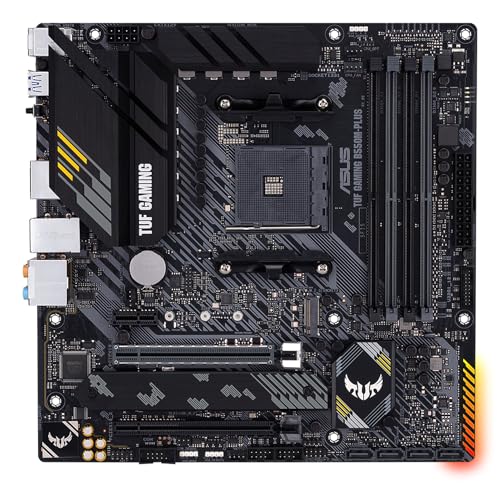
ASUS TUF Gaming B550M-PLUS Micro-ATX
Best for: wired AMD AM4 Micro-ATX gaming setups
- Form Factor
- Micro-ATX
- CPU Socket
- AM4
- Chipset
- AMD B550
- Memory Type
- DDR4
- PCIe Version
- PCIe 4.0
- M.2 Slots
- 2
View on Amazon: ASUS TUF Gaming B550M-PLUS Micro-ATX (paid link)
The ASUS TUF Gaming B550M-PLUS is a Micro-ATX board built around the AMD B550 chipset and AM4 socket. You get PCIe 4.0 support, dual M.2 storage slots, and an 8+2 DrMOS power stage design paired with dedicated VRM and M.2 heatsinks. For networking, it includes 2.5 Gb Ethernet. This board fits your build if you run an AM4 processor with DDR4 memory and prefer wired connectivity.
Pros
- 2.5 Gb Ethernet port
- 8+2 DrMOS power stages
- PCIe 4.0 support
- Dual M.2 storage slots with heatsink
- Realtek S1200A audio codec
Cons
- No integrated Wi-Fi
- Uses DDR4 memory instead of DDR5
Good fit if
- You need 2.5 Gb wired networking on a Micro-ATX AM4 setup.
- You plan to use an AMD AM4 processor with DDR4 memory.
- You want dual M.2 drive slots with PCIe 4.0 compatibility.
Skip if
- You require built-in Wi-Fi connectivity.
- You want an AM5 platform with DDR5 memory support.
Verdict: ASUS TUF Gaming B550M-PLUS Micro-ATX Motherboard delivers PCIe 4.0, 2.5 Gb Ethernet, and robust power delivery for AM4 builds. It is a solid B550 Micro-ATX option when you rely on wired LAN and DDR4 RAM.

ASRock Micro-ATX AM4 Motherboard
Best for: AM4 desktop builds needing legacy video outputs
- Form Factor
- Micro-ATX
- CPU Socket
- AM4
- Memory Type
- DDR4
- PCIe Version
- PCIe 4.0
- M.2 Slots
- 1
- Ethernet Speed
- Gigabit LAN
View on Amazon: ASRock Micro-ATX AM4 Motherboard (paid link)
This Micro-ATX board features an AMD AM4 socket compatible with Ryzen 3000, 4000, and 5000 series processors. You get a PCIe 4.0 x16 slot for your graphics card, a single Hyper M.2 slot for storage, and four SATA3 ports. With HDMI, DVI-D, and VGA outputs, it suits you if you need flexible display options for an everyday desktop build or an office workstation.
Pros
- PCIe 4.0 x16 slot for modern expansion cards
- Three display outputs: HDMI, DVI-D, and D-Sub (VGA)
- One Hyper M.2 slot supporting PCIe Gen4x4 and SATA3
- Supports DDR4 memory speeds up to 4733+ (OC)
Cons
- Only two DDR4 memory slots
- Only one M.2 storage slot
- No integrated Wi-Fi support
Good fit if
- You need legacy video ports like VGA or DVI-D alongside HDMI.
- You run an AMD AM4 Ryzen processor with up to two DDR4 memory sticks.
- You only plan to install a single M.2 NVMe or SATA solid-state drive.
Skip if
- You need four DIMM slots for high-capacity memory configurations.
- You require multiple M.2 slots for high-speed storage expansion.
- You need integrated Wi-Fi connectivity out of the box.
Verdict: ASRock AM4 Micro-ATX Motherboard provides essential AM4 connectivity with PCIe 4.0 support and triple video outputs. It offers a practical foundation for standard desktop systems using Ryzen processors.

ASUS Prime A520M-K Micro-ATX Motherboard
Best for: basic AMD AM4 DDR4 micro-ATX builds
- Form Factor
- Micro-ATX
- CPU Socket
- AM4
- Memory Type
- DDR4
- Chipset
- AMD A520
- Dimensions
- 8.9 × 8.7 × 0.79 inches
- Weight
- 1.19 pounds
View on Amazon: ASUS Prime A520M-K Micro-ATX Motherboard (paid link)
This ASUS Prime micro-ATX motherboard runs on the AMD A520 chipset and houses an AM4 socket for your processor. You get two DDR4 DIMM slots that support up to 64GB of system memory. For display output, the board provides both HDMI and D-Sub ports alongside a PCIe slot for expansion. It suits you if you need a compact, straightforward AM4 platform for everyday desktop tasks.
Pros
- Supports up to 64GB DDR4 memory across two DIMM slots
- Includes both HDMI and D-Sub video outputs
- Compact Micro-ATX form factor measuring under 9 by 9 inches
- AMD AM4 socket compatible with AMD A520 chipset
Cons
- Limited to two memory slots
- Restricted to DDR4 memory rather than newer standards
Good fit if
- You need an AMD AM4 socket motherboard with DDR4 support.
- You require legacy D-Sub or standard HDMI display connections.
- You want a compact Micro-ATX build with up to 64GB RAM.
Skip if
- You need more than two DIMM slots for memory expansion.
- You plan to use a processor that requires a non-AM4 socket.
Verdict: ASUS Prime A520 Micro-ATX Motherboard delivers essential AM4 functionality with 64GB DDR4 memory support, HDMI, and D-Sub connectivity. It provides a simple foundation for basic micro-ATX builds that do not require extensive memory slot expansion.

Gigabyte AM4 Micro-ATX Motherboard
Best for: AM4 builds using PCIe 3.0 components
- Form Factor
- Micro-ATX
- CPU Socket
- AM4
- Memory Type
- DDR4
- PCIe Version
- PCIe 3.0
- M.2 Slots
- 1
- Ethernet Speed
- 1GbE
View on Amazon: Gigabyte AM4 Micro-ATX Motherboard (paid link)
This Gigabyte board is a Micro-ATX platform built for AMD AM4 socket systems. It supports 3rd Gen AMD Ryzen processors and features dual-channel DDR4 memory across two slots. For expansion, you get one PCIe 3.0 x16 slot and one NVMe PCIe 3.0 x4 M.2 connector for storage. Wired networking runs at 1GbE speeds alongside an ALC887 audio codec. It suits AM4 desktop setups needing essential PCIe 3.0 connectivity.
Pros
- PCIe 3.0 x16 slot for dedicated graphics cards
- NVMe PCIe 3.0 x4 M.2 slot for solid-state storage
- Gigabit Ethernet port delivering 1GbE wired networking
- 4+3 phases digital PWM power design
Cons
- Limited to two DDR4 memory slots
- Provides only one M.2 storage slot
- Restricted to PCIe 3.0 transfer bandwidth
Good fit if
- You use a 3rd Gen AMD Ryzen AM4 processor.
- You need one PCIe 3.0 x4 NVMe M.2 drive for system storage.
- You plan to run two DDR4 memory sticks in dual-channel mode.
Skip if
- You require four DDR4 memory slots for expansion.
- You need PCIe 4.0 or faster expansion interfaces.
- You plan to install multiple M.2 storage drives.
Verdict: Gigabyte AM4 Micro-ATX Motherboard provides core AM4 processor support with a PCIe 3.0 x16 slot and a single NVMe M.2 connector. It delivers straightforward functionality for compact systems requiring 1GbE LAN and two DDR4 memory slots.

ASRock Pro4 Micro-ATX AM4 Motherboard
Best for: AM4 desktop builds needing multi-display outputs
- Form Factor
- Micro-ATX
- CPU Socket
- AM4
- Chipset
- A520
- Memory Type
- DDR4
- PCIe Version
- PCIe 3.0
- Power Phases
- 8
View on Amazon: ASRock Pro4 Micro-ATX AM4 Motherboard (paid link)
This micro-ATX board features the AMD A520 chipset and an AM4 socket, designed for AMD Ryzen 3000, 4000 G-Series, and 5000 series processors. You get an 8-phase power design, DDR4 memory overclocking support up to 4733 MHz, and two PCIe 3.0 x16 expansion slots. With DisplayPort, HDMI, and D-Sub outputs, this board suits you if you need flexible display connections in a standard micro-ATX desktop build.
Pros
- 8 power phase Digi Power design
- Three display outputs: HDMI, DisplayPort, and D-Sub
- Dedicated M.2 Key E slot for Wi-Fi
- Supports DDR4 memory overclocking up to 4733+
Cons
- PCIe slots limited to version 3.0
- No integrated Wi-Fi module included
Good fit if
- You use an AMD Ryzen 3000, 4000 G-Series, or 5000 series processor.
- You need multiple display options including HDMI, DisplayPort, and D-Sub.
Skip if
- You require PCIe 4.0 expansion support.
- You need built-in Wi-Fi hardware included.
Verdict: ASRock AM4 Micro-ATX Motherboard provides essential AM4 connectivity with an 8-phase power design and triple monitor outputs. It serves systems requiring flexible display ports and memory speeds up to DDR4 4733+.
Specifications side by side
| Spec | ASUS Prime Micro-ATX DDR5 Motherboard | Biostar Intel H310 Micro-ATX Motherboard | ASRock Rack AMD EPYC Micro-ATX Server Motherboard | Gigabyte Micro-ATX DDR5 Gaming Motherboard | Biostar Micro-ATX AM2+ Motherboard | Biostar Micro-ATX AM3 Motherboard | ASUS Prime Micro ATX AM4 Motherboard | MSI MPG Micro-ATX Wi-Fi Motherboard | ASUS Prime Micro-ATX Commercial Motherboard | MSI ProSeries Micro-ATX AM4 Motherboard | ASUS TUF Gaming B550M-PLUS Micro-ATX | ASRock Micro-ATX AM4 Motherboard | ASUS Prime A520M-K Micro-ATX Motherboard | Gigabyte AM4 Micro-ATX Motherboard | ASRock Pro4 Micro-ATX AM4 Motherboard |
|---|---|---|---|---|---|---|---|---|---|---|---|---|---|---|---|
| CPU Socket | LGA 1700 | not specified | Single Socket SP5 (LGA 6096) | not specified | Socket AM2+/AM2 | Socket AM3 | AM4 | LGA 1200 | AM4 | AM4 | AM4 | AM4 | AM4 | AM4 | AM4 |
| Chipset | not specified | Intel H310 | not specified | AMD A620 | NVIDIA GeForce 6150 / nforce430a | nVidia MCP68S | B550 | Z490 | not specified | not specified | AMD B550 | not specified | not specified | not specified | A520 |
| Form Factor | microATX | MicroATX | Deep Micro-ATX | Micro ATX | MATX | Micro ATX | Micro ATX | Micro-ATX | Micro ATX | Micro-ATX | Micro ATX | Micro-ATX | MATX | MicroATX | Micro ATX |
| Memory Type | DDR5 | not specified | not specified | DDR5 | DDR2 | DDR3 | DDR4 | DDR4 | not specified | DDR4 | DDR4 | DDR4 | DDR4 | DDR4 | DDR4 |
| PCIe Version | PCIe 4.0 | not specified | not specified | PCIe 4.0 | not specified | not specified | PCIe 4.0 | not specified | PCIe 4.0 | PCIe 4.0 | PCIe 4.0 | PCIe 4.0 | not specified | PCIe 3.0 | PCIe 3.0 |
| M.2 Slots | 2 | not specified | not specified | not specified | not specified | not specified | 2 | not specified | not specified | not specified | 2 | 1 | not specified | 1 | not specified |
| Wi-Fi Standard | Wi-Fi 6 | not specified | not specified | not specified | not specified | not specified | not specified | Wi-Fi 6 | not specified | not specified | not specified | not specified | not specified | not specified | not specified |
| Ethernet Speed | 2.5 Gb | Gigabit LAN | Dual 10G | not specified | not specified | not specified | 1Gb LAN | Gigabit, 2.5G | 1Gb LAN | not specified | 2.5 Gb Ethernet | Gigabit LAN | not specified | 1GbE | not specified |
| Power Phases | not specified | not specified | not specified | not specified | not specified | not specified | not specified | not specified | not specified | not specified | 8+2 | 6 | not specified | 4+3 | 8 |
| Wi-Fi | Wi-Fi 6 | not specified | not specified | not specified | not specified | not specified | Wi-Fi 5 | Wi-Fi 6 | not specified | not specified | not specified | not specified | not specified | not specified | not specified |
| Use Case | not specified | not specified | Server | Gaming | not specified | not specified | not specified | Gaming | Commercial | not specified | Gaming | not specified | not specified | Gaming | not specified |
| Dimensions | 10.8 × 10.4 × 2.58 inches | 0.98 × 8.9 × 6.73 inches | not specified | 9.61 × 9.61 × 1.38 inches | 3 × 10 × 13 inches | 9.6 × 7.5 × 2 inches | 10 × 2.6 × 10 inches | 9.6 × 9.6 × 2 inches | 10.4 × 2.03 × 10.6 inches | 9.6 × 9.6 × 1.5 inches | 9.61 × 1.57 × 9.61 inches | 11 × 9.5 × 2.5 inches | 8.9 × 8.7 × 0.79 inches | 10.4 × 9.25 × 2.04 inches | 9.45 × 9.45 × 1.18 inches |
| Weight | 3.11 pounds | 1.34 pounds | not specified | 1.96 pounds | 1 pounds | not specified | 1.27 pounds | 4.41 pounds | 1.31 pounds | 2.43 pounds | 1.76 pounds | 1.54 pounds | 1.19 pounds | 15.5 ounces | 2.2 pounds |
| Size | PRIME B760M-A AX | not specified | not specified | not specified | not specified | not specified | Micro ATX | mATX | Micro ATX | (Pack of 1) | B550 | not specified | Prime | Pack of 1 | not specified |
| Color | BLACK | not specified | not specified | not specified | not specified | not specified | not specified | not specified | not specified | not specified | Black | not specified | Black | Multicolor | not specified |
| Model | PRIME B760M-A AX | H310MHP 3.0 | not specified | A620M GAMING X | MCP6PB M2+ | N68S3+ | B550M-A AC | MPG Z490M GAMING EDGE WIFI | PRIME B550M-A/CSM | B550M PRO-VDH WIFI | 90MB14A0-M0EAY0 | B550M-HDV | 90MB1500-M0EAY0 | A520M S2H | A520M PRO4 |
Is a Micro-ATX motherboard worth it?
A Micro-ATX motherboard delivers core desktop or enterprise server capabilities within a compact footprint, with board dimensions typically around 9.6 by 9.6 inches. Choosing this form factor allows you to build inside smaller computer cases where chassis space is limited. You keep essential connections, including a PCIe 4.0 or PCIe 3.0 x16 slot, NVMe M.2 storage, and dual-channel memory support up to 128 GB. In daily operation, this form factor provides standard video outputs, up to 2.5GbE wired networking, and Wi-Fi 6 options without taking up excessive physical space.
Worth it if
- You want a compact desktop or server build that fits inside a case where chassis space is limited.
- You need core connectivity like PCIe 4.0, NVMe M.2 storage, and Wi-Fi 6 in a smaller footprint.
Skip it if
- You require extensive memory expansion beyond the two slots provided on basic models.
- You need multiple full-length PCIe slots beyond a single PCIe x16 slot configuration.
To house these components, you can choose a Micro-ATX PC case with the clearance specifications your cooler and graphics card require.
How We Picked Micro-ATX Motherboards
You find motherboards in this guide by their Micro-ATX form factor, stated in listing titles or feature specifications. Only one model variant per product family is included. Selection focuses on published technical specs, covering CPU sockets, memory types, and expansion capabilities. Products are not physically handled. Every detail comes strictly from manufacturer specifications published on Amazon listings.
The 15 picks are ordered with products in stock first, then by Amazon sales rank (better-selling products first). Availability updates live on the page at least daily. This spec-based comparison lets you evaluate socket options from AMD AM4 to Intel LGA 1700, DDR4 or DDR5 support, and PCIe generation for your compact build.
How To Choose A Micro-ATX Motherboard
-
Compare PCIe Version Support
Check the PCIe revision of the primary expansion slots and M.2 storage paths. PCIe 4.0 doubles the bandwidth over PCIe 3.0, allowing faster communication with supported graphics cards and NVMe solid-state drives. If you install older components or standard office drives, a PCIe 3.0 interface such as the one on the Gigabyte AM4 Micro-ATX Motherboard provides sufficient throughput. For higher data transfer rates with modern hardware, prioritize boards featuring PCIe 4.0 lanes.
-
Check Wired Ethernet Speed
Review the published local area network specifications before you connect your board to high-speed home networks. Basic desktop setups and standard internet packages function well with a 1GbE controller. If you move large files across local network storage or maintain a high-bandwidth wired infrastructure, select a board with 2.5GbE connectivity. The ASUS TUF Gaming B550M-PLUS Micro-ATX includes a 2.5GbE port, which delivers faster wired data transfers than boards restricted to standard gigabit networking speeds.
-
Evaluate Integrated Wi-Fi Standards
Examine wireless networking standards if you plan to operate without a direct Ethernet cable. Boards on this list offer different wireless protocols, ranging from Wi-Fi 5 to Wi-Fi 6, while other models omit wireless hardware entirely. The MSI MPG Micro-ATX Wi-Fi Motherboard includes integrated Wi-Fi 6, which offers improved wireless efficiency and higher throughput compared to older Wi-Fi 5 standards. Verify whether the board incorporates wireless antennas out of the box so you avoid purchasing separate add-in networking adapters.
-
Choose The Right Chipset
Check the motherboard chipset tier to align with your platform requirements. Budget chipsets like the AMD A520, found on the ASUS Prime A520M-K Micro-ATX Motherboard, provide baseline connectivity for general desktop tasks with DDR4 support. Midrange chipsets such as the AMD B550 add support for PCIe 4.0 lanes for faster graphics and storage communication. Identifying the specific chipset ensures you do not buy a platform that restricts lane speeds or limits future component additions for your planned build.
-
Identify Intended Use Case
Confirm the motherboard matches your specific operational environment. General gaming boards prioritize performance features such as DDR5 memory or gaming audio designs. In contrast, specialized hardware serves distinct needs outside standard gaming rigs. The ASUS Prime Micro-ATX Commercial Motherboard targets enterprise office deployments with corporate lifecycle stability and management tools. Server boards cater strictly to multi-core enterprise CPUs. Matching the published use case prevents deploying standard desktop motherboards in specialized enterprise or server rack applications.
-
Verify Legacy Hardware Needs
Determine whether you are maintaining older hardware or building a modern machine. Replacing a failed component in an existing older setup requires exact legacy architecture support rather than current interfaces. The Biostar Micro-ATX AM3 Motherboard features Socket AM3 processor support, DDR3 memory slots, and legacy PCI expansion. These legacy boards lack modern PCIe 4.0 storage and current RAM standards, so check your existing CPU and memory inventory carefully before selecting older socket designs.
Frequently asked questions
What size case do you need for a Micro-ATX motherboard?
You need a computer case that explicitly supports the Micro-ATX or standard ATX form factor. Micro-ATX motherboards typically measure up to 9.6 by 9.6 inches, though some models like the Biostar H310MHP 3.0 measure roughly 8.9 by 6.7 inches. While these boards fit easily inside mid-tower and full-tower ATX cases, you can also mount them inside dedicated compact Micro-ATX chassis to save desk space without sacrificing multi-slot expansion capabilities.
Can you use DDR4 RAM on a DDR5 Micro-ATX motherboard?
No, you cannot install DDR4 memory modules into a DDR5 Micro-ATX motherboard. DDR4 and DDR5 memory use completely different pin configurations and keying notches, making them physically incompatible. For instance, the ASUS Prime B760M-A AX and Gigabyte A620M GAMING X require DDR5 modules, whereas boards such as the ASUS TUF Gaming B550M-PLUS and MSI MPG Z490M require DDR4. Always match your memory kit to the exact generation supported by your board.
Do Micro-ATX motherboards come with integrated Wi-Fi?
Some Micro-ATX motherboards include built-in Wi-Fi, while others rely entirely on wired Ethernet connections. The ASUS Prime B760M-A AX and MSI MPG Z490M offer integrated Wi-Fi 6, and the ASUS Prime B550M-A AC includes Wi-Fi 5. Conversely, models such as the Biostar H310MHP 3.0 and ASUS TUF Gaming B550M-PLUS omit built-in wireless networking and instead supply 1GbE or 2.5GbE LAN ports for dedicated wired setups.
What is the difference between 1GbE and 2.5GbE Ethernet on these boards?
A 2.5GbE Ethernet port provides two and a half times the maximum theoretical bandwidth of a standard 1GbE port. This allows faster local network file transfers, backups, and network-attached storage operations if your router and switches support multigigabit speeds. Boards like the ASUS Prime B760M-A AX and ASUS TUF Gaming B550M-PLUS provide 2.5GbE, while models like the ASRock B550M-HDV and Gigabyte A520M S2H feature standard 1GbE connections.
Can a Micro-ATX motherboard be used for server hardware?
Yes, specific Micro-ATX boards are engineered specifically for enterprise server processors. The ASRock Rack AMD EPYC Micro-ATX Server Motherboard supports enterprise-grade AMD EPYC 9004 series processors inside compact chassis. These server-oriented boards provide platform stability and hardware management features for data center or commercial deployments where physical rack or enclosure space is restricted.
How does PCIe 4.0 differ from PCIe 3.0 on a Micro-ATX board?
PCIe 4.0 offers double the data throughput per lane compared to PCIe 3.0. This added speed benefits high-speed solid-state drives and modern graphics cards capable of higher transfer rates. Models like the ASUS TUF Gaming B550M-PLUS, Gigabyte A620M GAMING X, and MSI B550M PRO-VDH WIFI feature PCIe 4.0 lanes, while entry options like the Gigabyte A520M S2H use PCIe 3.0 for primary expansion and storage.
Can you run older AMD processors on modern Micro-ATX motherboards?
No, CPU socket types are not backward compatible across differing socket designs. Older chips such as Socket AM2, AM2+, or AM3 processors require dedicated legacy boards like the Biostar MCP6PB M2+ or Biostar N68S3+. Modern AMD Ryzen desktop processors utilize Socket AM4, as found on the ASUS Prime B550M-A/CSM, and will not fit or operate inside legacy motherboard sockets.